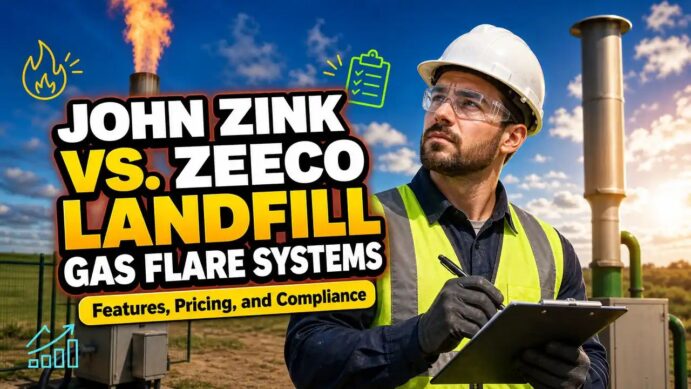
Zeeco Inc. and John Zink Hamworthy Combustion are two of the world’s leading companies in landfill gas flare systems, providing high-efficiency enclosed and elevated flares for biogas and landfill gas (LFG) compliance.
Key Points: John Zink vs. Zeeco Landfill Gas Flares
- Landfill gas flare systems are a regulatory requirement for most municipal solid waste landfills — but choosing between John Zink and Zeeco comes down to specific performance needs, emissions targets, and site conditions.
- John Zink’s ZTOF® Enclosed Flare and ZULE® Ultra-Low Emissions Flare are engineered for facilities facing the strictest NOx and VOC compliance thresholds, while the ZEF™ Elevated Flare offers a leaner, cost-effective alternative.
- Zeeco’s enclosed and open biogas flare systems are purpose-built to handle high CO2 concentrations in landfill gas — a combustion challenge that standard flares often fail to address reliably.
- EPA NSPS Subpart XXX sets the compliance baseline for municipal solid waste landfills, and both manufacturers have engineered their systems to meet — and in some cases exceed — these destruction efficiency requirements.
- The right system for your facility depends on more than price — keep reading to see how each product stacks up on destruction efficiency, gas composition flexibility, and long-term operational costs.
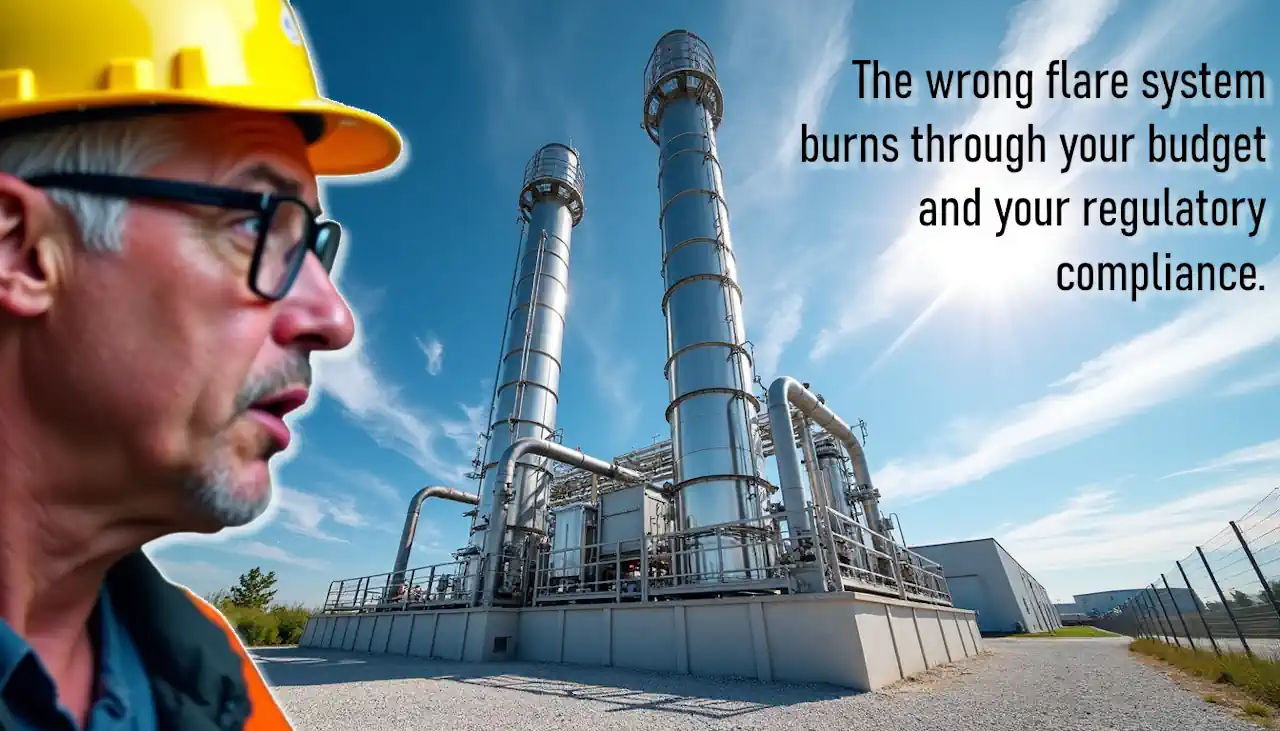
Picking the wrong landfill gas flare system doesn’t just cost money — it can put your facility out of compliance and keep it there.
Landfill gas (LFG) is a byproduct of decomposing organic waste, primarily composed of roughly 50% methane and 50% carbon dioxide, along with trace amounts of non-methane organic compounds (NMOCs). Methane is a potent greenhouse gas — approximately 28 to 36 times more powerful than CO2 over a 100-year period, according to the EPA. Flare systems are the front-line solution for destroying this gas before it reaches the atmosphere. For facilities evaluating combustion-based emissions control, Zeeco provides a comprehensive range of biogas and landfill flare systems designed for demanding real-world conditions.
Two manufacturers consistently rise to the top of the specification list: John Zink Hamworthy Combustion and Zeeco. Both have decades of field experience, global installation bases, and product lines that span enclosed flares, open elevated flares, and hybrid thermal oxidizers. But their engineering philosophies, product strengths, and ideal use cases differ in ways that matter enormously when you’re designing a landfill gas control system.
Two Industry Giants, One Critical Decision
John Zink has been active in landfill and biogas combustion since the 1970s, making them one of the longest-standing players in this space. Zeeco, while newer in relative terms, has built a strong reputation specifically around biogas enclosed flare technology and handling the unique combustion challenges that high-CO2 landfill gas presents. Both companies serve anaerobic digesters, municipal solid waste landfills, and renewable natural gas (RNG) purification facilities — but they approach the engineering differently.
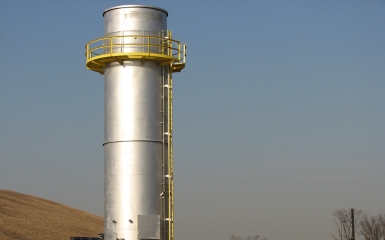
“Landfill & Biogas | John Zink” from www.johnzink.com and used with no modifications.
John Zink Landfill Gas Flare Systems
John Zink’s landfill and biogas product line covers the full spectrum of combustion requirements, from simple open flares for smaller operations to advanced hybrid thermal oxidizers for RNG plants with complex emission profiles. Their systems are designed around unmatched reliability and seamless integration — a claim backed by installations across some of the most demanding LFG environments in North America and internationally.
What separates John Zink from generic flare suppliers is their combustion engineering depth. Each system in their biogas lineup is optimized for a specific operational scenario, which matters when landfill gas composition and flow rates fluctuate — as they almost always do.
ZTOF® Enclosed Flare: Field-Proven for Landfill and RNG Operations
The ZTOF® Enclosed Flare is John Zink’s flagship landfill and RNG flare system. It is engineered to deliver superior performance across a wide range of flow rates while maintaining consistent methane destruction removal efficiency (DRE). The enclosed design conceals the flame within a refractory-lined combustion chamber, which eliminates visible flame, reduces noise, and allows for better temperature control — all critical factors in urban-adjacent landfill sites.
- Handles wide flow rate variability common in active landfill gas collection systems
- Designed for seamless integration with LFG collection and control systems
- Refractory-lined combustion chamber supports consistent thermal performance
- Suitable for landfill gas, biogas, and RNG purification facility applications
- Built to meet stringent environmental regulations in both U.S. and international markets
The ZTOF® is particularly well-suited for facilities that need to demonstrate continuous compliance with destruction efficiency standards. Its enclosed configuration supports temperature monitoring across the combustion zone, which is a key data requirement under EPA NSPS Subpart XXX for landfill gas control devices.
For RNG operations specifically, where inlet gas composition can shift as purification processes fluctuate, the ZTOF® provides the combustion stability needed to prevent flameouts or incomplete combustion events — both of which carry serious compliance and operational consequences.
ZULE® Ultra-Low Emissions Flare: Built for Strict NOx Compliance
The ZULE® (Zink Ultra-Low Emissions) Biogas Flare takes John Zink’s combustion technology a step further by specifically targeting NOx reduction. Using advanced combustion engineering, the ZULE® achieves ultra-low NOx emissions while maintaining the high methane DRE required for landfill gas compliance. This system is designed for facilities operating in air quality management districts with stringent NOx thresholds — particularly relevant in California and other states with aggressive emissions standards.
ZEF™ Elevated Flare: Cost-Effective Open Flare Option
The ZEF™ Elevated Flare offers a straightforward, cost-effective solution for biogas destruction where an enclosed flare isn’t required by permit. Open elevated flares like the ZEF™ are simpler in design, easier to maintain, and carry lower upfront capital costs. They are best suited for facilities with more predictable gas flow and composition, or for operations in earlier stages of LFG collection where gas volumes don’t yet justify a full enclosed system.
ZBRID Hybrid Thermal Oxidizer: Reducing Fuel Costs in RNG Plants
The ZBRID Hybrid Thermal Oxidizer bridges the gap between a traditional flare and a full thermal oxidizer system. It is specifically designed for RNG purification facilities where off-spec or reject gas needs to be destroyed reliably without consuming excessive auxiliary fuel. The hybrid design allows the system to recover and recirculate heat, significantly reducing fuel consumption compared to conventional thermal oxidizers.
For RNG plant operators, this translates directly into lower operating costs — especially during commissioning phases or periods of process upset when reject gas volumes spike unpredictably.
The ZBRID is engineered to handle the variable gas streams typical of RNG operations, including gases with fluctuating methane content that can challenge standard flare systems. Its design prioritizes both thermal efficiency and emissions compliance, making it a strong candidate for facilities pursuing both cost control and environmental performance goals.
- Heat recovery design reduces auxiliary fuel demand in RNG reject gas applications
- Handles variable methane content and fluctuating gas streams
- Positioned between a traditional enclosed flare and a full thermal oxidizer in terms of cost and complexity
- Suited for commissioning phases and process upset scenarios in RNG purification facilities
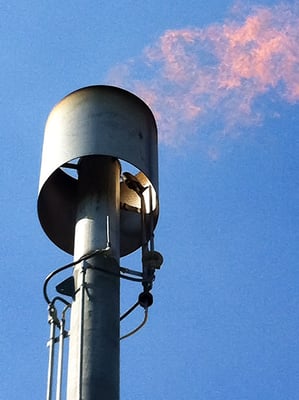
“Biogas and RNG Solutions” from www.zeeco.com and used with no modifications.
Zeeco Landfill Gas Flare Systems
Zeeco approaches biogas and landfill flare design with a specific engineering focus: solving the combustion challenges created by high CO2 concentrations in landfill gas. Standard flares are designed around relatively consistent, combustible gas streams. Landfill gas — with CO2 content often ranging from 40% to 60% — dilutes the combustible fraction enough to destabilize flames, reduce DRE, and create compliance headaches. Zeeco’s biogas flare lineup is built explicitly to overcome this challenge.
Their product range covers both open utility flares and enclosed ground flares, with systems designed to handle wide variations in both flow rate and gas composition. Zeeco serves anaerobic digesters, municipal landfills, and RNG facilities, and their enclosed biogas flare systems incorporate the latest features and options to ensure optimal performance across that full operational range.
Open Biogas Flares: Handling High CO2 Concentrations and Flow Variability
Zeeco’s open biogas flare systems are engineered to maintain stable combustion even when CO2 levels are high and methane content is relatively low — conditions that cause conventional flares to struggle with flame stability. Their utility flare designs dispose of methane and other decomposition byproducts efficiently and effectively, with long-lasting reliability built into the core mechanical design.
For facilities with variable gas flow — a reality at virtually every active landfill — Zeeco’s open flare systems are configured to accommodate these swings without sacrificing combustion performance or triggering emission exceedances.
Enclosed Ground Flares: VOC and Methane Destruction for Anaerobic Digesters
Zeeco’s enclosed biogas flare system is their primary solution for facilities that require both high methane DRE and VOC control. The system is purpose-built for anaerobic digesters, landfills, and RNG operations facing increasing regulatory pressure. The enclosed configuration hides the combustion flame, controls thermal output, and enables temperature-based performance monitoring — all of which support continuous compliance documentation under federal and state air quality regulations.
Head-to-Head Feature Comparison
With both manufacturers offering enclosed flares, open flares, and advanced thermal oxidation options, the differences come down to specific engineering approaches, emissions performance targets, and the operational scenarios each system handles best. For more information on how these systems are utilized and comply with regulations, check out our article on gas flaring systems vs. gas-to-energy systems.
Destruction Efficiency: How Each System Performs
Destruction removal efficiency is the single most important performance metric for any landfill gas flare system. It measures the percentage of methane and NMOCs that are actually combusted versus what passes through unburned. The EPA’s baseline requirement for landfill gas control devices is a minimum 98% DRE for NMOCs — or a reduction to less than 20 parts per million by volume (ppmv) — and both John Zink and Zeeco engineer their enclosed flare systems to meet this threshold. For more insights, you can explore the environmental impact of landfill gas.
Where the two manufacturers begin to diverge is in how they achieve and sustain that efficiency under real-world operating conditions. Landfill gas flow rates and methane concentrations are rarely stable — they shift with seasonal temperature changes, landfill age, precipitation, and extraction system pressure variations. A flare that performs at 98% DRE under ideal test conditions may underperform during low-flow periods or when CO2 concentrations spike.
- John Zink ZTOF® Enclosed Flare: Engineered for consistent DRE across a wide range of flow rates, with refractory-lined combustion chambers that maintain thermal stability during flow fluctuations
- John Zink ZULE® Biogas Flare: Targets high DRE while simultaneously achieving ultra-low NOx — a dual performance goal that most standard enclosed flares don’t attempt
- John Zink ZEF™ Elevated Flare: Cost-effective open flare option with reliable destruction efficiency for facilities where enclosed flare permits aren’t required
- Zeeco Enclosed Biogas Flare: Specifically designed to maintain high methane DRE even when CO2 concentrations are elevated, addressing one of the most common combustion stability failures in landfill gas applications
- Zeeco Open Biogas Flare: Handles variable flow rates and high-CO2 gas compositions with stable combustion performance built into the burner design
The combustion chamber temperature is the operating variable that most directly determines DRE in enclosed flare systems. Both John Zink and Zeeco design their enclosed flares to maintain the minimum temperature residence time combinations required by regulation — typically 1,400°F (760°C) for at least 0.3 seconds — but their specific burner configurations and refractory designs reflect different engineering priorities.
For more details on engineering considerations, you can explore landfill gas extraction well design.
Gas Composition Flexibility: CO2, NMOCs, and Variable Flow Handling
This is where Zeeco has built a particularly strong engineering reputation. Landfill gas with CO2 content in the 40% to 60% range presents a genuine combustion challenge — the diluent effect of CO2 lowers flame temperature, narrows the flammability range of the gas mixture, and increases the risk of flame instability or extinction.
Zeeco’s biogas flare systems are explicitly engineered to overcome this, with burner designs that stabilise combustion even when the gas stream is heavily diluted. John Zink’s ZTOF® and ZBRID systems address gas composition variability through design features that accommodate wide flow rate ranges and fluctuating methane content — particularly relevant for RNG reject gas applications where inlet composition can shift rapidly during process upsets.
Emissions Control Technology: NOx, VOC, and Methane Reduction
Beyond DRE, facilities in states like California, Texas, and states in the Northeast face layered emissions requirements that go well beyond methane destruction. NOx emissions from combustion devices are regulated under state implementation plans and local air quality management district rules, and this is where John Zink’s ZULE® Ultra-Low Emissions Flare stands out as a purpose-built solution.
Zeeco’s enclosed flare systems control VOC and methane emissions through complete combustion engineering, while John Zink’s ZULE® adds a specific low-NOx combustion technology layer on top of standard destruction efficiency — giving facilities in the most regulated air basins a compliant pathway without requiring a full selective catalytic reduction (SCR) system downstream.
Compliance and Regulatory Standards
- EPA NSPS Subpart WWW — Original performance standards for municipal solid waste landfills, requiring gas collection and control systems above specific emission thresholds
- EPA NSPS Subpart XXX — Updated 2016 standards for new, modified, or reconstructed MSW landfills with stricter NMOC emission thresholds and enhanced monitoring requirements
- EPA Emission Guidelines Subpart Cf — Applies to existing landfills, requiring states to adopt regulations consistent with the updated federal guidelines
- 40 CFR Part 60, Appendix A — Test methods for measuring NMOC emission rates and demonstrating compliance with DRE requirements
- State and local air quality permits — Add NOx, CO, and VOC limits on top of federal requirements, often more stringent in California (CARB/SCAQMD) and northeastern states
Federal landfill gas regulations create a compliance floor — but for most operating facilities, state and local air quality permits are actually the binding constraint. A facility in the South Coast Air Quality Management District in California faces NOx limits and operational monitoring requirements that go far beyond what EPA NSPS Subpart XXX mandates on its own.
This regulatory layering is exactly why selecting the right flare system from the start matters so much — retrofitting a standard enclosed flare with additional emissions control equipment after permitting is expensive and operationally disruptive. For more insights on landfill gas systems, explore gas flaring systems vs. gas-to-energy systems.
Both John Zink and Zeeco design their systems to support compliance documentation requirements, including continuous temperature monitoring, automated ignition systems, and operational parameter recordkeeping. These are not optional engineering features — they are required elements under NSPS Subpart XXX for enclosed combustion devices used as landfill gas control systems.
Facilities transitioning from older systems permitted under Subpart WWW to the newer Subpart XXX requirements face a specific compliance challenge: demonstrating that their updated control device meets the enhanced monitoring and performance standards without triggering a full permit re-evaluation. Both manufacturers have experience supporting facilities through these transitions, though the specific compliance pathway depends heavily on the state agency and the facility’s existing permit conditions.
EPA NSPS Subpart XXX Requirements for Municipal Solid Waste Landfills
NSPS Subpart XXX, finalised in 2016, lowered the NMOC emission threshold that triggers the requirement for a gas collection and control system from 50 megagrams per year to 34 megagrams per year. For enclosed flare systems used as control devices, the rule requires continuous monitoring of combustion chamber temperature, an operational parameter that serves as a proxy for DRE performance.
The temperature must be recorded every 15 minutes, and operational deviations must be documented and reported. This monitoring requirement directly influences flare system design — both John Zink and Zeeco integrate temperature monitoring capabilities into their enclosed flare systems to support Subpart XXX compliance documentation.
How John Zink Addresses Regulatory Compliance
John Zink’s enclosed flare systems — particularly the ZTOF® — are designed with the operational monitoring requirements of NSPS Subpart XXX built into the system architecture. Temperature monitoring ports, automated ignition and re-ignition systems, and control panel integration for data logging are standard design elements rather than add-on options. This design approach simplifies the compliance documentation burden for facility operators and reduces the risk of monitoring gaps that could trigger compliance notices of violation. For more insights on landfill gas solutions, visit landfills and methane gas solutions.
For facilities in states with NOx limits that go beyond federal requirements, the ZULE® Ultra-Low Emissions Flare provides a direct compliance solution without requiring downstream SCR or other secondary treatment. This is particularly valuable in California, where air district permit conditions for combustion devices at landfills can include NOx limits as low as 30 to 50 ppmv — thresholds that standard enclosed flares cannot reliably achieve.
How Zeeco Addresses Regulatory Compliance
Zeeco’s enclosed biogas flare systems are engineered to meet the continuous monitoring and performance documentation requirements of NSPS Subpart XXX while specifically addressing the combustion stability challenges that can undermine compliance in high-CO2 landfill gas applications. Their focus on stable combustion under variable gas composition conditions directly supports consistent temperature maintenance in the combustion chamber — which is the operational parameter on which regulatory compliance is evaluated. For anaerobic digester and RNG facilities facing both federal and state emissions requirements, Zeeco’s enclosed flares provide a reliable compliance foundation built on proven combustion engineering.
Pricing Factors for Landfill Gas Flare Systems
Landfill gas flare system pricing varies enormously based on system type, capacity, site conditions, and regulatory requirements. A basic open elevated flare for a smaller landfill operation can cost significantly less than a full enclosed flare system with continuous monitoring, automated controls, and refractory lining engineered for a large MSW facility. Understanding the cost drivers helps operators make procurement decisions that reflect total cost of ownership rather than just capital expenditure.
What Drives the Cost of an Enclosed vs. Open Flare
The fundamental cost difference between an enclosed and open flare system comes down to combustion chamber complexity, refractory materials, and control system integration. Open flares like John Zink’s ZEF™ Elevated Flare are mechanically simpler — the burner tip, ignition system, and structural support are the primary components, and there is no combustion chamber to engineer, line, or maintain.
Enclosed flares add a refractory-lined combustion chamber, temperature monitoring instrumentation, combustion air management systems, and more sophisticated control panels — all of which add to the capital cost but are required for NSPS Subpart XXX compliance and urban-adjacent site permitting.
For larger landfill operations or facilities with complex gas streams, the ZBRID Hybrid Thermal Oxidizer represents a higher capital investment than a standard enclosed flare — but its heat recovery design offsets operating costs over time. Facilities evaluating the ZBRID should model the total cost of ownership over a 10 to 15-year operating horizon, factoring in auxiliary fuel savings against the higher upfront system cost.
Long-Term Operational Costs: Maintenance, Fuel, and Monitoring
Refractory maintenance is the most significant recurring cost for enclosed flare systems. The refractory lining inside the combustion chamber degrades over time due to thermal cycling — particularly in landfill gas applications where flow rates and temperatures fluctuate frequently.
Both John Zink and Zeeco design their enclosed flares with refractory systems engineered for longevity, but inspection and eventual refractory replacement should be factored into the operational budget from day one. Typical refractory service intervals vary based on operating hours, temperature cycles, and gas composition, but major refractory work is generally expected within 5 to 10 years of continuous operation.
Auxiliary fuel consumption is the other major operational cost variable. Enclosed flares require a pilot flame and often an auxiliary burner to maintain combustion stability when gas flow is low or when methane content drops. The ZBRID’s heat recovery design directly addresses this cost driver for RNG applications. For standard enclosed flares, operators should evaluate gas flow projections carefully — a system operating frequently at minimum turndown will consume considerably more auxiliary fuel than one running at or near design capacity.
Aftermarket Support and Service Infrastructure
John Zink maintains a dedicated parts and services infrastructure for their landfill and biogas product line, including a specific Landfill & Biogas Parts category within their replacement parts catalog. Zeeco similarly provides aftermarket support for their biogas flare systems, with service capabilities backed by their global engineering organization.
For U.S.-based landfill operators, proximity of service resources and parts availability are practical considerations that can determine how quickly a system returns to operation after an unplanned maintenance event — and both manufacturers have established support networks that reduce exposure to extended downtime.
Which System Is Right for Your Facility
Facility Type Recommended System Primary Reason Large MSW Landfill John Zink ZTOF® Enclosed Flare Wide flow range handling, continuous compliance monitoring, proven reliability Urban-Adjacent Landfill (NOx-regulated) John Zink ZULE® Ultra-Low Emissions Flare Ultra-low NOx without SCR, meets strict air district permit conditions Anaerobic Digester Zeeco Enclosed Biogas Flare High CO2 combustion stability, VOC and methane DRE compliance RNG Purification Facility John Zink ZBRID Hybrid Thermal Oxidizer Heat recovery reduces auxiliary fuel cost for reject gas destruction Smaller or Early-Stage Landfill John Zink ZEF™ Elevated Flare or Zeeco Open Biogas Flare Lower capital cost, simpler maintenance, suitable where enclosed flare not required
No single flare system wins across every application — and that’s actually the most important insight you can take from this comparison. Both John Zink and Zeeco manufacture genuinely capable systems, but their engineering strengths align with different operational scenarios, regulatory environments, and facility types. Choosing based on brand alone, or on capital cost alone, consistently leads to either over-engineered systems burning budget unnecessarily or under-engineered systems creating compliance exposure down the road.
The decision framework that works best is to start with your permit requirements and gas characterization data — not with a product catalog. What does your air quality permit require in terms of DRE, NOx, and operational monitoring? What is your gas collection system’s projected flow range and expected methane concentration over the life of the system? Those two data sets will narrow your options faster than any feature comparison table.
Once you have the regulatory and operational parameters defined, match them against the specific engineering strengths each system brings. The table above provides a starting framework, but the sections below break down the three primary facility scenarios in more practical terms.
Best Fit for Large-Scale Landfill Operations
Large municipal solid waste landfills — those collecting gas from active and closed cells simultaneously — face the most complex operating conditions in the landfill gas control world. Gas flow rates vary across a wide range depending on collection header pressure, extraction well field performance, and seasonal temperature effects on waste decomposition. The control system has to handle these variations without flame instability, DRE exceedances, or operational shutdowns that trigger compliance reporting obligations.
John Zink’s ZTOF® Enclosed Flare is the strongest fit for this scenario. Its engineering specifically addresses wide flow rate variability, and the refractory-lined combustion chamber maintains thermal stability even when inlet gas conditions shift. For large facilities in states with NOx requirements layered on top of federal NSPS Subpart XXX obligations — California being the clearest example — the ZULE® Ultra-Low Emissions Flare provides a direct compliance pathway without requiring secondary treatment equipment downstream.
Zeeco’s enclosed biogas flare is also a viable option for large landfill operations, particularly where the landfill gas has consistently high CO2 content that creates combustion stability concerns. The selection between John Zink and Zeeco at this scale often comes down to the specific permit conditions, the site’s gas composition profile, and the engineering preferences of the project team — both manufacturers have the track record to support large-scale MSW landfill applications.
Key Consideration for Large Landfills: Request guaranteed DRE performance data at minimum, mid-range, and maximum design flow rates from both manufacturers — not just at design point. Real-world compliance depends on consistent performance across the full operating range, not just at optimal conditions.
Best Fit for Anaerobic Digesters and RNG Plants
Anaerobic digesters and RNG purification facilities present a different set of challenges than traditional MSW landfills. The gas streams are often more consistent in flow rate but can carry higher concentrations of CO2 and trace contaminants depending on the feedstock and digestion process. For anaerobic digester applications where high CO2 content is a design-day reality, Zeeco’s enclosed biogas flare systems have a specific engineering advantage — their combustion design is purpose-built to maintain flame stability and high DRE under these exact conditions.
For RNG facilities, John Zink’s ZBRID Hybrid Thermal Oxidizer stands out as the most operationally intelligent choice. RNG purification processes generate reject gas streams that can vary dramatically in methane content and volume — particularly during startup, shutdown, and process upset events. The ZBRID’s heat recovery design handles these variable streams while reducing the auxiliary fuel cost that makes conventional thermal oxidizers expensive to operate in intermittent-duty applications.
Best Fit for Budget-Constrained or Smaller Projects
Not every landfill gas project requires an enclosed flare system. Smaller landfills that fall below the NSPS Subpart XXX NMOC threshold triggering mandatory gas collection, or facilities in earlier stages of LFG collection where gas volumes are modest and permit conditions allow an open flare, can achieve compliance with a significantly lower capital investment. John Zink’s ZEF™ Elevated
Flare and Zeeco’s open biogas utility flare both provide reliable methane destruction for these scenarios without the capital and maintenance overhead of an enclosed system. For more information on landfill gas production rates, visit landfill-gas.com.
The critical caveat for budget-driven decisions is to evaluate the full project lifecycle, not just the purchase price. A smaller facility that selects an open flare today but anticipates significant gas volume growth over the next five years may face a costly retrofit when permit conditions require an upgrade to an enclosed system. Building a phased compliance pathway into the initial project design — with equipment sizing that accommodates future enclosed flare addition — is a more cost-effective long-term strategy than optimizing only for today’s capital budget.
Frequently Asked Questions:
: John Zink vs. Zeeco Landfill Gas Flares
The questions below address the most common decision points that landfill operators, project engineers, and environmental compliance managers encounter when evaluating John Zink and Zeeco flare systems.
What destruction efficiency can I expect from John Zink and Zeeco landfill gas flare systems?
Both John Zink and Zeeco design their enclosed landfill gas flare systems to achieve a minimum 98% NMOC destruction removal efficiency — the baseline required under EPA NSPS Subpart XXX for enclosed combustion devices. In practice, well-maintained enclosed flares from both manufacturers operating within their design parameters routinely achieve DRE performance at or above this threshold during EPA performance testing.
The more relevant question is not peak DRE, but consistent DRE across the facility’s actual operating flow range. Both manufacturers should be asked to provide guaranteed performance data at minimum turndown conditions, not just at design flow — because regulatory compliance is evaluated continuously, not only during scheduled performance tests. John Zink’s ZTOF® and Zeeco’s enclosed biogas flare are both engineered with flow variability in mind, but the specific DRE guarantees will vary based on the project-specific design parameters.
Are John Zink and Zeeco flare systems compliant with EPA NSPS Subpart XXX?
Yes — both manufacturers engineer their enclosed landfill gas flare systems to meet the operational monitoring, performance, and recordkeeping requirements of EPA NSPS Subpart XXX. This includes continuous temperature monitoring of the combustion chamber, automated ignition and re-ignition systems, and operational parameter documentation capabilities.
However, compliance is ultimately the facility operator’s responsibility, and the specific permit conditions, monitoring plan, and operational protocols must be developed in coordination with the applicable state environmental agency. State and local air quality permits may impose additional NOx, CO, or VOC requirements beyond the federal NSPS baseline. For more information on gas flaring systems, you can explore the differences between gas flaring systems and gas-to-energy systems for LFG utilization and compliance.
What is the typical price range for a landfill gas enclosed flare system?
Landfill gas enclosed flare system pricing is highly project-specific, and neither John Zink nor Zeeco publishes standard list pricing for these systems. Capital costs are influenced by design flow rate, combustion chamber sizing, refractory specification, control system complexity, site integration requirements, and applicable regulatory standards. For more insights, you might want to explore the comparison of gas flaring systems and gas-to-energy systems for landfill gas utilization and compliance.
As a general market reference, smaller enclosed flare systems for landfills or digesters with lower gas flow rates can range from several hundred thousand dollars into the low seven figures when fully installed. Larger systems for major MSW landfills, or advanced systems like the ZBRID Hybrid Thermal Oxidizer with heat recovery, represent higher capital investments that are typically evaluated on a total cost of ownership basis rather than purchase price alone. For more insights on landfill gas systems, you can explore UK landfill gas energy insights.
The most accurate pricing approach is to develop a project-specific specification package — including gas flow range, composition data, regulatory requirements, and site conditions — and submit it to both manufacturers for competitive budgetary proposals. This also provides a basis for evaluating differences in scope, performance guarantees, and warranty terms that affect the true cost comparison, especially when considering gas flaring systems vs. gas-to-energy systems.
- System type: Open elevated flares carry lower capital cost than enclosed flares; hybrid thermal oxidizers are typically the highest capital option
- Design flow rate: Larger combustion chambers for higher flow rates increase material and fabrication costs significantly
- Refractory specification: Higher-performance refractory materials for demanding gas compositions or elevated temperature requirements add cost
- Control system complexity: SCADA integration, continuous emissions monitoring system (CEMS) interfaces, and remote monitoring capabilities all add to the control panel cost
- Installation and site work: Foundation requirements, utility connections, gas header integration, and fencing for enclosed flare installations add to the total installed cost beyond the equipment purchase price
Can these flare systems handle gases with high CO2 concentrations?
Yes, but with an important distinction in engineering approach. Zeeco’s biogas flare systems are explicitly engineered to address the combustion stability challenges created by high CO2 concentrations — this is a specific design focus that runs through their entire biogas flare product line.
John Zink’s enclosed flare systems, including the ZTOF®, are designed to handle wide variations in gas composition and flow rate, including the dilution effects of elevated CO2 content. For facilities where CO2 concentrations are consistently at the high end of the landfill gas range — above 50% — Zeeco’s specific focus on this combustion challenge gives their systems a meaningful engineering advantage worth evaluating carefully in the system selection process.
How do John Zink and Zeeco compare on lead times and aftermarket service?
Both John Zink and Zeeco are established manufacturers with global engineering and service organizations, which means both are capable of supporting U.S. landfill and biogas projects from initial specification through long-term operation. Lead times for custom-engineered flare systems from either manufacturer are typically project-specific and depend on current manufacturing capacity, scope complexity, and whether the project requires custom engineering versus a closer-to-standard configuration.
John Zink maintains a dedicated Landfill & Biogas Parts category within their replacement parts catalog, providing documented aftermarket support infrastructure for their biogas and landfill flare product line. This structured parts availability is a practical operational advantage — particularly for facilities in locations where expedited parts sourcing is critical to minimizing downtime after an unplanned maintenance event. Zeeco similarly provides aftermarket support backed by their global service network. For more information on landfill gas management, you can explore landfill gas extraction well design.