
Gas flaring is a necessary safety and waste-disposal mechanism that burns off excess or unwanted gas from sanitary landfills. In contrast, gas-to-energy systems capture this byproduct gas to generate electricity, create heat, or produce liquid fuels. While flaring destroys harmful methane, gas-to-energy converts a waste product into a valuable resource.
Key Points We Make Here:
- Gas flaring destroys landfill methane to meet EPA Clean Air Act requirements, but it converts a valuable resource into compliance cost with zero financial return.
- LFG energy recovery systems — including electricity generation, RNG pipeline injection, and direct heat use — can turn regulatory compliance into a revenue-generating community asset.
- The EPA’s Landfill Methane Outreach Program (LMOP) provides tools like the LFG Energy Benefits Calculator to help landfill operators quantify the financial and environmental upside of switching from flaring to energy recovery.
- Proper methane mass flow monitoring and documentation are required under both flaring and gas-to-energy systems — but only energy recovery systems allow operators to also generate carbon credits.
- Keep reading to find out exactly which system wins on compliance performance, economic returns, and long-term environmental outcomes — and what factors should drive your decision.
Choosing the wrong LFG management system doesn’t just cost money — it locks landfill operators into years of missed revenue and avoidable emissions.
Landfill gas is more than just an annoying byproduct. It’s a powerful greenhouse gas stream that larger landfills are required by the EPA to actively collect and burn. This requirement creates a decision point: install a flaring system to destroy the gas and meet the requirement, or build a system to recover energy that turns the same gas into electricity, renewable natural gas, or heat.
This decision has financial, environmental, and community impacts that can be felt for decades into the future. Professionals in the renewable energy field and landfill operators who are seeking clarity on this decision can find a full comparison here. Organisations like those who are working to raise awareness of LFG energy have long stressed that understanding both systems is the first step toward making the right decision.
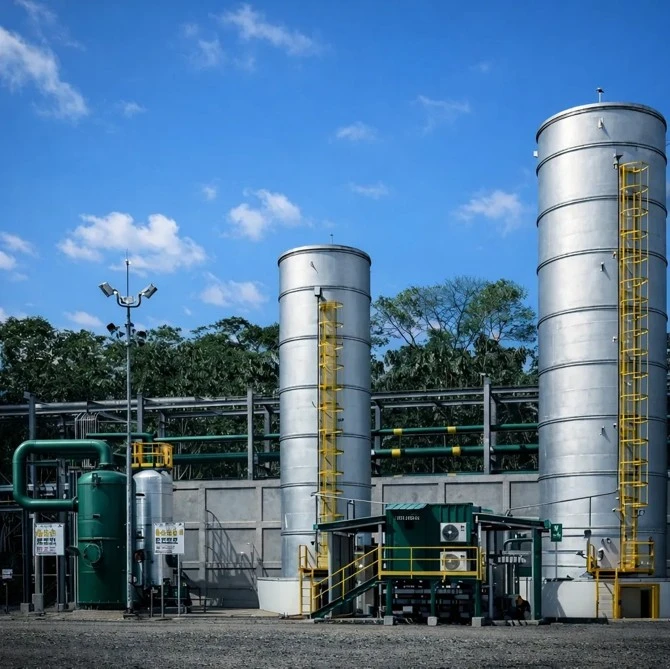
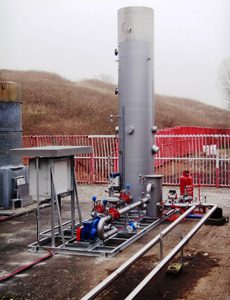
“Biogas Enclosed Flare System | CRA” from www.cra.energy and used with no modifications.
Gas Flaring vs. Gas-to-Energy: A Guide for LFG Professionals
Gas flaring systems and gas-to-energy systems both meet the fundamental EPA mandate of capturing and combusting landfill gas. However, this is where the similarities end. Flaring systems burn the gas and release CO2, a greenhouse gas that is much less potent than methane, into the atmosphere without recovering any energy. Gas-to-energy systems perform the same conversion but also extract usable power, heat, or pipeline-ready fuel from the process.
Long-Term Implications of LFG Utilization Choices
When infrastructure is put in place at a landfill, operators are usually committed to that system for a long time. A flare is less expensive to install initially, but it does not produce any income and does not contribute to community energy.
An energy recovery system requires more investment and planning, but it turns the compliance obligation into a long-term asset.
The growth trajectory of the landfill, the volume of gas, and access to the local energy market all play a significant role in determining which route provides better results over a 10 to 20-year period.
Meeting the EPA’s Clean Air Act Requirements
For larger landfills, the Clean Air Act leaves no room for interpretation — landfill gas must be collected and burned. The EPA’s New Source Performance Standards (NSPS) and Emission Guidelines (EG) rules mandate that landfills of a certain size must install gas collection and control systems once their methane emissions cross a certain threshold.
Options for compliance under the Clean Air Act framework include:
- Burning off gas (thermal oxidation without any energy recovery)
- Generating electricity from the combustion of LFG
- Injecting processed LFG into natural gas pipelines as RNG
- Direct use of LFG for heating or industrial processes
- Supplying compressed or liquefied LFG directly to end users
Flaring meets the minimum legal requirements. Energy recovery not only meets these requirements but also generates value. This is the main difference between the two.
Understanding Landfill Gas and Why It’s Important
A Quick Look at LFG Composition
Component Approximate Concentration Environmental Significance Methane (CH4) ~50% Powerful greenhouse gas; 80x more warming than CO2 over 20 years Carbon Dioxide (CO2) ~50% Less powerful GHG; primary combustion byproduct Non-Methane Organic Compounds (NMOCs) Trace levels Includes hazardous air pollutants and VOCs Other gases (N2, O2, moisture) Trace levels Impacts processing and energy conversion efficiency
Landfill gas is created when organic waste breaks down anaerobically — without oxygen — deep within a landfill. The microbes that break down food waste, paper, and other organics create a continuous stream of methane and carbon dioxide as byproducts. This stream doesn’t stop until the organic material is used up, which can take decades.
If not captured, LFG will move through the landfill cover and vent directly into the atmosphere. Given that methane is a significant contributor to global warming in the short term, the uncontrolled release of LFG is one of the most preventable sources of greenhouse gas emissions in the waste sector.
The Composition of Methane and Its Threat to the Environment
Methane’s part in LFG is what makes it both hazardous and beneficial. Methane is a short-lived but very potent climate forcer — it is much more harmful than CO2 on a per-molecule basis over a 20-year period. The combustion of methane, either through flaring or energy generation, transforms it into CO2 and water, significantly reducing its impact on the climate. However, only energy recovery systems can extract economic value from this combustion process.
Incinerating LFG also eradicates non-methane organic compounds in the gas stream, including hazardous air pollutants and volatile organic compounds (VOCs). This is a significant public health advantage, whether the system is a flare or an energy plant, as uncontrolled NMOCs pose proven health threats to neighboring communities. For more information on the benefits of landfill gas energy projects, visit the EPA’s LMOP page.
The Functioning of LFG Capture Systems
An LFG capture system is made up of a series of vertical wells and horizontal collection pipes that are drilled into the landfill mass. These wells create a vacuum to pull the gas out before it escapes through the cover. The gas that is collected is then transported through the pipe network to a central collection point. From there, it is either sent to a flare or to an energy recovery facility. The design of the system, including the spacing of the wells, the sizing of the pipes, and the capacity of the blower, directly influences how much of the total methane generated at the site is actually captured.
Current Regulations for Captured LFG Usage
After being captured, the EPA and international carbon registries have identified a specific group of end uses for LFG. Flaring is considered compliant, but it doesn’t produce anything. All energy recovery methods — electricity, RNG, heat, and compressed/liquefied LFG — are compliant and productive. Project operators are required to document the intended uses of captured LFG and estimate the amount of gas directed to each end use as part of their monitoring and verification responsibilities.
Gas Flaring Systems: The Basic Compliance Method
Just as the name suggests, a gas flare is a controlled combustion device that continually burns methane from a landfill as it is collected. It is the easiest and least expensive way to meet EPA combustion requirements, and it has become the standard compliance tool at landfills that do not have access to energy markets or enough gas volumes to justify the cost of recovery infrastructure. For more information on the environmental impact of methane gas, you can explore further resources.
Through the process of thermal oxidation, flaring transforms methane (CH4) into carbon dioxide (CO2) and water vapor. Enclosed flares that are well-designed can achieve high destruction efficiency, typically over 98%, which means that almost all of the methane that enters the flare is burned instead of being released. Open flares are not as controlled, but both types meet regulatory combustion requirements.
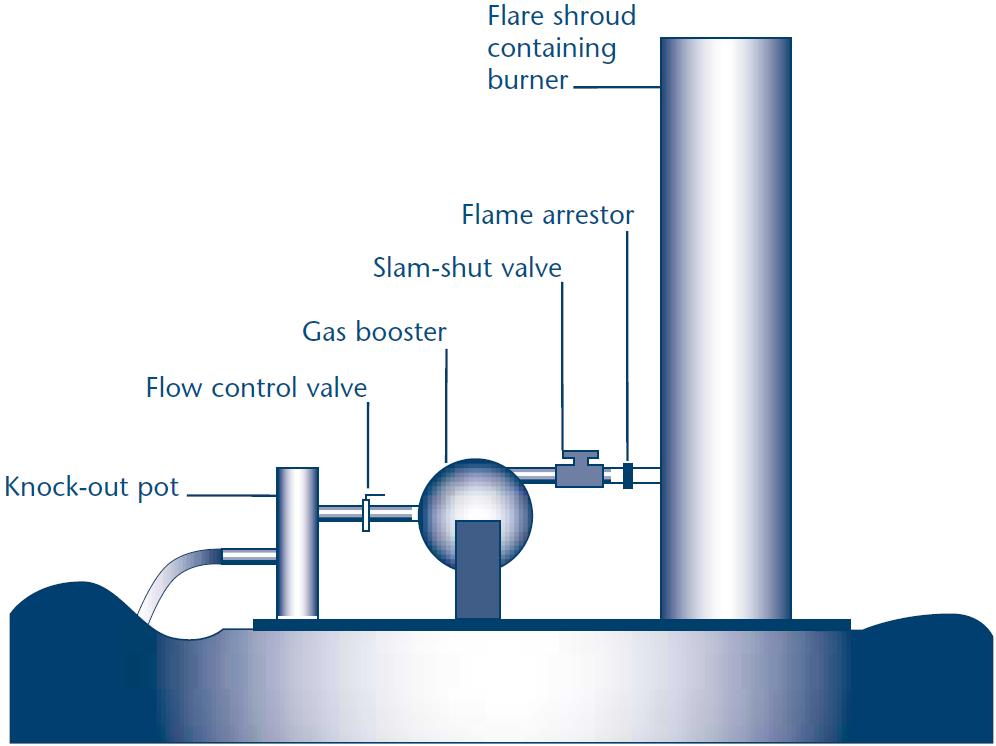
“Flare Units” from www.tecon-group.eu and used with no modifications.
The Process of Flaring and Its Effect on LFG Methane
When inside an enclosed ground flare, LFG is combined with air and then ignited at temperatures that are high enough to ensure complete combustion. The thermal energy that is released is then vented into the atmosphere as waste heat. There is no turbine, no generator, and no heat exchanger — just combustion and stack emissions. Monitoring typically involves measuring the methane concentration in the incoming gas stream and calculating destruction efficiency using the CDM methodological tool for project emissions from flaring. If a site operates more than one flare, emissions are calculated separately for each unit and summed.
When Flaring Is the Best Choice
For some landfills, flaring is honestly the most sensible way to comply. Small landfills that don’t generate enough gas to reliably power a generator, landfills that are too far from utility grid interconnection points, or sites that are still in the early stages of operation where gas flow is still increasing — all of these situations can make it economically unfeasible to recover energy. In these situations, the responsible decision is to use a well-maintained flare system, and it should be designed to be converted to energy recovery in the future as gas volumes increase.
Landfills located in isolated regions may not have the necessary pipeline infrastructure to inject RNG. Additionally, the costs of transporting compressed or liquefied LFG by truck may not be economically viable, depending on the distance to the end users. Until these circumstances change, flaring provides a solution for meeting compliance requirements.
Flaring System Monitoring and Documentation Requirements
Just because you are operating a flare doesn’t mean you can ignore monitoring responsibilities. If you are operating a flare system at your landfill, you need to keep track of the mass flow of methane through the collection system, document how efficiently it is being destroyed, monitor the operating temperature of the flare and how completely it is combusting, and report emissions under any regulatory frameworks that apply. You also need to account for any physical leakage of LFG during transportation within the collection system. These requirements apply whether the gas is ultimately flared or fed into an energy system.
The True Expense of Long-Term Flaring
Every cubic foot of methane that is flared is a cubic foot of potential energy that is not being capitalized on. Over a landfill’s 20-year operational lifespan, this can result in millions of dollars in lost electricity sales, RNG income, or heat credits. Flaring also disqualifies landfills from carbon credit programs that reward proven methane destruction through productive energy use. For landfills with sufficient gas volume and market access to support energy recovery, opting for flaring as a long-term solution is a costly decision.
Gas-to-Energy Systems: Compliance That Pays
Like flares, LFG energy recovery systems combust methane and minimize its climate impact. However, they also harness the energy released during combustion and turn it into something useful. According to the EPA’s Landfill Methane Outreach Program (LMOP), only LFG energy recovery allows communities and landfill owners to offset compliance costs by transforming pollution into a valuable community asset.
The financial benefits of LFG energy projects are not just confined to the landfill. They come from the sale of electricity, RNG contracts, or heat supply agreements. Jobs are created during the design, construction, drilling, piping, and ongoing operations phases. A lot of this money is spent locally. Community organizations, local governments, and private industry often work together on these projects. This creates a shared interest in sustainable infrastructure that will serve the region for many years.
There are four main routes for LFG energy recovery, each one suited to different site conditions, market access, and investment profiles. It is crucial for any operator to understand how they function and how they compare to each other and to flaring when evaluating their compliance strategy.
Overview of LFG Energy Recovery Pathways: System
Recovery Pathway Main Output Required Infrastructure Best For Generating Electricity Grid power (kWh) Generator sets or turbines, connection to the grid Landfills with access to utilities and stable gas flow RNG Pipeline Injection Renewable natural gas Cleanup of gas, compression, connection to pipeline Sites near gas distribution infrastructure Direct Use of Heat Heat for industry/processes Pipeline dedicated to the end user Landfills next to industrial or commercial facilities Compressed/Liquefied LFG CNG or LNG fuel Plant for compression or liquefaction, fleet for transport Remote sites providing fuel for vehicles or consumers off the grid
Generating Electricity From LFG
Generating electricity is the most common LFG energy recovery pathway in the United States. The landfill gas that has been collected is piped to a power plant on-site where it fuels reciprocating engine generator sets or gas turbines. The electricity that is produced is fed directly into the local utility grid through a standard interconnection agreement. Because landfill gas flows continuously — 24 hours a day, 7 days a week — electricity powered by LFG behaves like baseload generation rather than the intermittent output associated with wind or solar. For more information on the equipment involved, you can explore landfill gas engine tendering.
The LFG Energy Benefits Calculator from the EPA’s LMOP allows operators to calculate the exact greenhouse gas reductions their electricity generation project would provide based on site-specific gas flow data. Burning LFG to generate electricity also eliminates non-methane organic compounds that are present in low concentrations in the raw gas stream, including hazardous air pollutants and VOCs, thereby reducing documented health risks to nearby communities.
“ageing landfill gas sites …” from envirotecmagazine.com and used with no modifications.
Supply and Distribution of Renewable Natural Gas Pipelines
Renewable Natural Gas (RNG) production is an advanced form of LFG energy recovery. Raw landfill gas is treated to remove CO2, moisture, and trace contaminants until the methane concentration is high enough to meet pipeline quality standards — usually more than 97% methane. This upgraded gas is then compressed and injected into the existing natural gas distribution network, where it can be used interchangeably with fossil-derived natural gas. The main difference is that RNG carries a renewable fuel standard (RFS) credit value, which significantly increases its market price and project economics compared to just selling electricity.
Heat Generation Uses for LFG
The most straightforward method of LFG energy recovery in terms of infrastructure is direct heat use. A dedicated pipeline transports the gas collected from the landfill to a nearby industrial facility, greenhouse, manufacturing plant, or institutional building. Here, it is burned in boilers or furnaces to generate process heat. This method bypasses the conversion losses associated with electricity generation — the thermal efficiency of direct combustion is significantly higher than the electrical efficiency of a generator set — making it the most energy-efficient recovery method when there is a suitable end user in the vicinity. For more information on this, you can explore landfills and methane gas solutions.
Direct Consumer Supply of Compressed and Liquefied LFG
Landfills without access to grid interconnection or nearby pipeline infrastructure can compress or liquefy processed LFG into CNG or LNG to create a transportable fuel product. This product can then be delivered to end users via truck. This pathway is particularly effective for supplying vehicle fleets — such as waste collection trucks, transit buses, or heavy freight — with low-carbon fuel. The GHG footprint of transporting compressed or liquefied LFG to consumers must be monitored and reported. This includes emissions from the transport vehicles and any physical leakage during the loading and delivery process. For more insights, you can explore the UK landfill gas energy insights.
Although the addition of compression and liquefaction infrastructure costs are associated with CNG and LNG pathways, they provide the opportunity for energy recovery at landfill sites that would otherwise be relegated to continuous flaring due to geographical constraints. The financial feasibility of these options improves dramatically when the landfill operator also controls the end-use fleet, thereby removing the margins of third-party fuel supplies from the equation.
Flaring vs. Gas-to-Energy: A Direct Comparison
Now that we’ve clearly defined both system types, we can directly compare them in terms of compliance performance, economic results, and environmental health impacts. This comparison will show why the EPA and environmental organizations consistently recommend energy recovery over flaring, as long as site conditions permit it.
Meeting Regulatory Standards
Both gas flaring and gas-to-energy systems comply with the EPA’s fundamental requirement to collect and combust landfill gas under the Clean Air Act. An enclosed flare that operates well and achieves 98%+ methane destruction efficiency meets the same regulatory standard as an LFG power plant that achieves the same combustion performance. On paper, the compliance result is the same. The difference between the systems is what happens after compliance — flaring stops at combustion, while energy recovery goes on to verified emissions accounting, carbon credit eligibility, and renewable energy certification. All of these require the same monitoring documentation but provide additional regulatory and financial value.
Profitability and Local Community Effects
Flaring doesn’t bring in any money. Every dollar that goes into running a flare system — maintenance, ignition fuel, monitoring, reporting — is a straight-up compliance cost with no offset. On the other hand, gas-to-energy projects start bringing in money from the sale of electricity, RNG, or heat as soon as they go live. That money can be used to offset the cost of the project, fund landfill operations, or go to programs that benefit the local community, depending on who owns the project and how it’s financed.
There’s more to the community’s financial implications than just the income from the gate. LFG energy initiatives require the participation of engineers, construction companies, equipment suppliers, drilling contractors, pipe providers, and utility or end-user partners. The EPA’s LMOP program has consistently shown that a significant portion of the money spent on LFG energy project construction stays local, through drilling, piping, civil construction, and the ongoing need for operations and maintenance staff. Flaring projects, on the other hand, only generate a small portion of that economic activity.
Health, Safety, and Environmental Outcomes
Both systems are beneficial to public health because they destroy NMOCs and VOCs through combustion, which is significantly better than uncontrolled LFG venting. However, energy recovery systems, especially those that generate electricity, typically operate as enclosed, monitored combustion processes with tighter controls on combustion completeness than open or simple enclosed flares. The tighter combustion control results in more consistent NMOC destruction and lower residual emissions at the fence line.
Both systems transform methane into CO2, which significantly decreases the climatic effect of the captured gas from a net GHG perspective. However, energy recovery systems displace the combustion of fossil fuels at power plants or in natural gas supply chains, resulting in an additional emissions benefit that cannot be claimed by flaring. An LFG power plant that offsets coal-fired generation offers a double climate benefit: destruction of methane and displacement of fossil fuels. A flare only provides the former.
The table above makes it clear: where gas volumes and market access support energy recovery, it’s hard to justify choosing a flare as a permanent solution on any basis other than upfront capital cost.

The Financial Justification for LFG-to-RNG Projects: A Look at the Hard Numbers
RNG has risen to the top as the most valuable LFG utilization method in markets where renewable fuel standard credits are applicable. The blend of the base gas commodity value and RFS Renewable Identification Number (RIN) credits has often made LFG-to-RNG the most economically viable compliance method for eligible landfills. The financial viability of the project is heavily reliant on the volume of gas, the costs associated with processing, and the current RIN credit market, but the revenue advantage over electricity generation has sparked substantial investment in RNG infrastructure at landfills throughout North America.
Landfill gas (LFG) energy projects earn money from selling the LFG, the electricity or renewable natural gas produced from it, or both at the same time in hybrid setups. These projects usually have financial arrangements that include long-term purchase agreements with utilities, gas marketers, or industrial end users. This provides a guaranteed income over the life of the project. This is a big benefit compared to flaring, which only has costs and no income to balance them out.
Economic Impact During the Construction Phase
When an LFG energy project is being constructed, it immediately stimulates the local economy. Drilling contractors are needed to install gas collection wells. Pipe suppliers and civil contractors are hired to set up the collection network and process piping. Electrical contractors are brought in to manage generator interconnection. Equipment vendors are contracted to provide engine generator sets, gas processing skids, and control systems. All of this spending takes place within the region of the project, and it creates skilled construction jobs that the installation of a flare simply cannot match at the same scale.
Continual Income From Landfill Gas Energy Sales
Landfill gas energy projects, once they are up and running, provide a steady stream of income for the entire active gas production period of the landfill, which is typically 20 years or more. The sale of electricity provides a steady cash flow that is indexed to the terms of the power purchase agreement. Sales of renewable natural gas come with additional RFS credit value that can multiply the base revenue from the commodity several times over in markets that are favorable. Contracts for the supply of heat provide a predictable income with minimal costs for processing infrastructure compared to pathways for electricity or renewable natural gas.
Not only does the steady flow of income cover the costs of the project, but it also benefits the community in several ways. In the case of landfills that are owned by cities or regional waste authorities, the revenue from LFG energy has been used to fund community programs, landfill operational budgets, and environmental monitoring funds. This transforms a regulatory compliance obligation into a real financial asset for the community.
Methane Mass Flow Monitoring in Both Systems
Whether a landfill uses a flare or an energy recovery system, methane mass flow monitoring is a mandatory requirement under EPA regulations and carbon registry verification protocols. The aim is the same in both cases: to verify that the gas collection system is capturing methane at the reported rate and that the combustion or utilization system is destroying or converting it at the reported efficiency.
Regulations for monitoring touch on every point in the LFG journey — from the wellhead where it’s captured, through the network of collection pipes, to the point of combustion or utilization. Any physical leaks of LFG during transportation within the collection system have to be found and measured. The fuel and energy used for capture, destruction, and utilization processes also have to be tracked separately, because these numbers are part of the net emissions calculation for compliance and carbon accounting.
The main difference between the monitoring requirements of flaring and energy recovery is the additional data streams produced by energy systems. Energy systems produce a verifiable record of electricity output, heat delivered, or gas injected into a pipeline. These figures are all used in the calculation of carbon credits, the issuance of renewable energy certificates, and the generation of RFS credits. Flaring systems only track destruction, while energy systems track both destruction and productive output.
Here are some of the key monitoring points that need to be tracked:
- Wellhead flow measurement: This measures the amount of gas collected from each well and across the total system.
- Methane concentration monitoring: This involves continuous or periodic sampling of the methane content in the collected landfill gas.
- Flare or combustion temperature: This verifies whether the thermal destruction efficiency thresholds are being met.
- System leakage accounting: This measures the physical losses of landfill gas through collection piping and fittings.
- Energy output metering: This measures the amount of energy generated (in kilowatt-hours), the amount of heat delivered (in millions of British thermal units), or the amount of renewable natural gas injected (in thousand cubic feet) (energy systems only).
- Electricity consumption tracking: This measures the amount of power used by blowers, compressors, and processing equipment.
These monitoring data points are used in the regulatory reports that landfill operators must submit under applicable EPA rules. They are also used in the third-party verification audits required for carbon registry project registration.
Direct Measurement versus Indirect Monitoring Methods
Direct measurement techniques utilize in-line flow meters, usually ultrasonic or thermal mass flow meters, placed at critical locations in the collection system to measure the actual volume of gas passing through the pipe. These meters offer continuous data at a high frequency that facilitates accurate emissions calculations and makes regulatory reporting easier. Ultrasonic flow meters are especially suitable for LFG applications because they can manage the varying moisture content and trace contaminants in raw landfill gas without the measurement drift that impacts some other types of meters.
Indirect monitoring methods estimate methane flow by correlating measurable parameters such as wellhead vacuum, gas composition, landfill age, and waste mass with modeled gas generation rates. These methods are less expensive than installing meters at every collection point, but they also introduce more uncertainty into the emissions calculation. Carbon registries and EPA compliance frameworks usually require operators to quantify and disclose this uncertainty in their reports. For more information on methane flow estimation, you can explore landfill gas production rate calculation.
Energy recovery systems provide a natural verification checkpoint through direct metering at the point of gas delivery to the generation or processing unit. This allows for the gas volume metered into the generator or gas processing skid to be cross-checked against electricity output or RNG production to confirm combustion or conversion efficiency. Flaring systems, on the other hand, lack this independent verification cross-check. This is one reason why some carbon methodologies apply conservative adjustment factors to the emission reduction credits of flared systems.
Keeping Track of Electricity Usage
Flaring systems and energy recovery systems both require electricity to function. Blowers are used to keep the pressure in the collection system negative, compressors are used to move gas through the processing equipment, and control systems are always running. The amount of electricity used by these systems needs to be subtracted from the total amount of energy produced when calculating the net emissions benefits or the net energy output for the purposes of compliance and carbon accounting.
When it comes to energy recovery projects, the parasitic load of gas collection and processing equipment is a significant factor in the project’s economic feasibility. A large LFG power plant might use 10 to 15% of its gross generation for collection blowers, gas compression, and on-site facility loads. This internal consumption is metered separately from gross generation and reported as a project emission — since it typically draws from the grid and carries an emissions factor — in the net GHG reduction calculation.
Flaring systems have a simpler power usage profile, consisting mainly of the power used by the collection blower. However, the monitoring requirement is the same. The power used by the blowers, instrumentation, and control systems must be tracked and included in the emissions accounting for the project. If these auxiliary loads are not accurately tracked, it can undermine the entire emissions reduction claim and can lead to compliance findings during regulatory inspections or third-party verification audits.
- Collection blower power: Primary parasitic load in both flaring and energy recovery systems
- Gas compression energy: Significant load in RNG and CNG/LNG pathways
- Gas processing equipment: Chillers, membrane separators, and scrubbers in RNG systems
- Control system and instrumentation power: Continuous low-level load across all system types
- Lighting and facility loads: On-site facility electricity for operator buildings and equipment enclosures
Tracking these loads is not just a compliance formality — it provides operators with the data needed to optimize system efficiency, identify underperforming equipment, and demonstrate the true net carbon benefit of their LFG management program to regulators, carbon verifiers, and community stakeholders.
Picking the Best System for Your Landfill
The decision between flaring and gas-to-energy isn’t a one-size-fits-all solution. Conditions specific to the site — such as gas volume, location, access to infrastructure, and regulatory baseline — dictate which system offers the best blend of compliance performance and financial return. Operators who view this as a simple capital cost comparison almost always undervalue the long-term difference in value between the two methods.
Operators can make a system selection decision that is defensible and supported by data by following five core evaluation criteria in order. Each criterion builds on the previous one, and if any one of them is skipped, there is a risk of being stuck with the wrong infrastructure for the next 20 years.
1. Evaluate Your Landfill Gas Quantity and Speed
The amount of gas is the most crucial factor in choosing a system. The speed of LFG flow dictates whether the location can sustain constant baseload energy production, whether the gas quantities are enough to warrant RNG processing infrastructure, or whether the location is below the limit where energy retrieval is economically feasible.
By using the EPA’s LMOP LFG Energy Benefits Calculator, operators can input specific site details — such as the tonnage of waste-in-place, the age of the landfill, and estimates of gas collection efficiency — to predict the flow rates of LFG and potential energy output. This calculation provides a factual foundation for operators before they commit to any infrastructure, rather than relying on guesswork.
Landfills that produce less than about 150 to 200 standard cubic feet per minute (scfm) of landfill gas (LFG) often do not generate enough gas to make electricity production economically feasible using reciprocating engine generator sets. However, these same sites may still be suitable for direct heat use or compressed natural gas (CNG) production, depending on how close they are to end users. The volume of gas produced does not rule out the possibility of recovering energy; it simply limits the options available, as discussed in this article on methane gas solutions.
2. Assess the Local Energy Market and Accessibility to the Grid
A landfill that is located next to a high-voltage transmission corridor and has an active utility willing to enter into a power purchase agreement is in a completely different situation than a remote rural site that is miles away from the nearest substation. The costs and timeline for grid interconnection, local electricity prices, proximity to an RNG pipeline, and the availability of industrial or commercial heat buyers all directly impact the economics of each energy recovery pathway. Operators should secure preliminary interconnection studies and assessments of pipeline proximity before finalizing system selection, as the costs of accessing this infrastructure can make or break the feasibility of the project.
3. Understanding the Baseline Scenario and Possible Upgrade Pathways
Both carbon registry methodologies and EPA compliance frameworks necessitate that operators establish a baseline, which is a documented description of what LFG management would look like in the absence of the proposed project. If landfills are currently venting uncontrolled LFG, the baseline is atmospheric release. If sites are already operating a flare, the baseline is the current destruction rate of that flare. Understanding the baseline is crucial because it determines the emissions reduction credit that the project can claim, which directly impacts potential carbon credit revenue. It also shows whether the current infrastructure can be upgraded instead of replaced – a flare that was designed with future conversion in mind can sometimes be repurposed as a backup combustion device while the primary energy recovery equipment handles the baseload gas flow.
4. Consider the Potential for Carbon Credit and Verification
Landfill gas (LFG) energy recovery projects are eligible for verified emissions reductions under several carbon accounting frameworks. These include voluntary carbon markets, the EPA’s emissions reduction programs, the California Low Carbon Fuel Standard (LCFS), and the federal Renewable Fuel Standard (RFS). Each of these frameworks necessitates third-party verification of monitoring data. They also assign varying credit values to different LFG utilization pathways.
Renewable Natural Gas (RNG) that’s injected into a pipeline and qualifies under the Renewable Fuel Standard (RFS) can generate D3 RIN credits. These credits have historically been worth a lot on the market. Electricity generation projects can create Renewable Energy Certificates (RECs), which have their own market value. This is on top of the revenue from selling the electricity. On the other hand, flaring projects can generate a small amount of carbon credit value. Some methodologies on the voluntary market allow for credits for flaring when the baseline is atmospheric venting. However, the value of each credit is lower than energy recovery pathways. The requirements for verification are almost the same. This means that energy recovery can bring in significantly more total revenue for each unit of methane destroyed. This is true once the value of the carbon credit is included in the comparison.
5. Determine Total Lifecycle Emissions and Project Decommissioning Costs
A comprehensive lifecycle emissions assessment includes not only the methane destruction during operation but also the emissions from the production and installation of the system, the continuous electricity use of collection blowers and processing equipment, and the decommissioning footprint at the end of life. For energy recovery systems, lifecycle assessments also take into account the avoided emissions from displaced fossil fuel generation — a credit that flaring cannot claim.
Often, end-of-life costs are not considered when comparing systems initially. There are costs associated with decommissioning an LFG collection system, removing generation equipment, and closing regulatory permits that accrue at the end of the landfill’s gas production life. Energy recovery systems that generate sustained revenue over their operational life are structurally in a better position to fund decommissioning from accumulated project returns. Flaring operations, which have generated no revenue throughout their service life, leave operators entirely reliant on reserve funds or operational budget allocations to cover closure costs.
Gas-to-Energy: A More Intelligent Long-Term Compliance Approach
For any landfill with enough gas volume and reasonable market access, the evidence consistently indicates one path. Gas-to-energy systems achieve the same EPA compliance standard as flaring, while also generating income, creating local jobs, reducing fossil fuel consumption, qualifying for carbon credits and renewable energy certificates, and providing measurable public health benefits through tighter combustion controls. Flaring only meets the minimum legal requirement and nothing more. When the complete lifecycle economics, environmental results, and community impacts are compared, the argument for permanent flaring as a strategic option — rather than a temporary compliance bridge — becomes very hard to maintain.
Common Questions
These questions are the ones most often asked by operators, environmental professionals, and community stakeholders when they’re weighing their options for LFG management systems.
Does gas flaring still meet current EPA legal requirements?
Indeed, gas flaring continues to be a legally compliant LFG management method under the EPA’s Clean Air Act structure, which includes the New Source Performance Standards and Emission Guidelines for municipal solid waste landfills. A well-designed and properly operated enclosed flare that achieves the necessary methane destruction efficiency meets the collection and combustion requirement for eligible landfills. Compliance necessitates continuous combustion performance monitoring, regular methane mass flow data reporting, and system operating parameter documentation. Flaring, on the other hand, does not qualify for renewable energy incentives, RFS credits, or the full spectrum of carbon market revenues that energy recovery systems do.
What’s the smallest landfill size that justifies a gas-to-energy system instead of flaring?
There’s no one-size-fits-all answer, but a good rule of thumb is that landfills that generate around 150 to 200 scfm or more of collected LFG are generally good candidates for electricity generation using reciprocating engine generator sets. Smaller sites may still be good candidates for direct heat use or CNG production if there are compatible end users nearby. The EPA’s LMOP program provides site-specific feasibility screening tools and maintains a database of LFG energy project case studies that operators can use to compare their site to similar projects. The key variables are gas flow rate, gas quality, distance to market, and prevailing energy prices — and these should all be evaluated together, not separately.
Is it possible for a landfill to run both a flaring system and a gas-to-energy system at the same time?
Indeed, it is not only possible but also quite common for most LFG energy facilities to do so. A flare is typically used as a backup combustion device to handle gas when the main energy recovery system is not operational due to maintenance, startup, or operational adjustments. This setup ensures that the landfill remains in continuous regulatory compliance even when the energy system is not in operation. If the gas cannot flow to the generator or processing unit, it is automatically directed to the flare instead of being vented into the atmosphere. For more insights, you can explore landfill gas production rate calculations to better understand how these systems manage gas flow.
Here is a typical layout for a dual-system LFG facility:
Typical LFG Facility Layout with Dual Systems
System Component Main Job Backup Job LFG Collection Network Collects methane from landfill mass N/A — must operate continuously Gas-to-Energy Unit (generator, RNG plant) Main methane use and revenue source Offline during maintenance times Enclosed Ground Flare Backup burning during energy system downtime Permanent compliance device if energy system removed Gas Flow Control Valves Direct gas to energy system during normal operation Automatically switch to flare when energy system shuts down
It is standard practice in LFG energy project engineering to design the flare into the system from the beginning, rather than adding it later. The flare is usually sized to handle the site’s maximum gas flow rate, ensuring full burning capability is always available, no matter what is happening with the energy system.
When it comes to monitoring and reporting, operators have to keep a separate record of the gas volume that each combustion or utilization pathway handles. The hours of flare operation, the gas volume that the flare burns, and the operating hours and output of the energy system are all documented separately and reported as part of the facility’s overall LFG management record. This dual-pathway tracking gives regulators and carbon verifiers a full picture of the facility’s performance in destroying methane under all operating conditions.
What makes LFG energy a baseload renewable energy source?
LFG energy is considered a baseload renewable energy source because it is a constant source of energy. This is because the landfill gas is constantly being produced, 24 hours a day, as a result of the ongoing anaerobic decomposition of organic waste in the landfill. This is unlike solar power, which only produces power when the sun is shining, or wind power, which depends on the wind. LFG production is not dependent on the weather or the time of day. The only factor that affects the rate of gas flow is temperature, as the decomposition process speeds up in warmer conditions. However, this occurs within predictable seasonal ranges, allowing utility operators to model LFG generation capacity as a reliable baseload contributor. This makes LFG-powered electricity especially valuable in grid contexts where intermittent renewable generation requires balancing resources.
What paperwork do I need to monitor for Landfill Gas (LFG) utilization compliance?
For LFG utilization compliance, you need to keep track of both regulatory reporting and, if applicable, carbon registry verification. To meet regulatory requirements, landfill operators need to keep a record of LFG collection system operating parameters, which include wellhead pressures, gas flow rates, methane concentrations, and collection system temperature. You also need to keep track of combustion or utilization system performance data, like flare operating temperature, generator output, or Renewable Natural Gas (RNG) injection volumes.
Carbon registry projects require more comprehensive documentation. Operators are required to keep a full monitoring plan that outlines each measurement point, the tools used, how often measurements are taken, and the quality assurance processes used for each data stream. All raw monitoring data must be kept for the length of the project’s crediting period plus any additional post-project data retention window, which is typically five to ten years after the project is finished. Third-party verification auditors check this documentation during regular site visits to ensure that the reported emissions reductions are backed up by actual measured data.
Both flare and energy recovery systems must keep specific documentation categories, such as records of methane mass flow at the collection system header, data on destruction or utilization efficiency for each combustion or conversion device, electricity consumption records for auxiliary systems like collection blowers and gas compression equipment, records of any periods of system downtime or reduced operation, and corrective action documentation for any failures of monitoring equipment or data gaps. In addition, energy recovery systems maintain output metering records—logs of electricity generation, confirmations of RNG injection, or heat delivery records—that provide independent verification of the gas volumes reported as utilized instead of flared or vented.