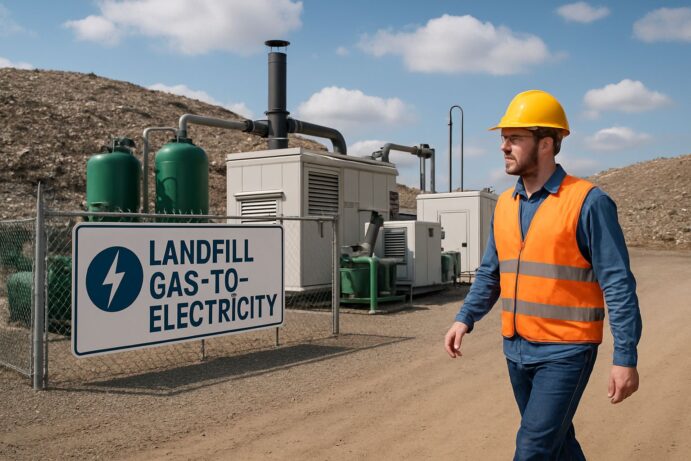
Comparing landfill gas-to-electricity and direct pipeline injection reveals differences in processing needs, efficiency, and market application. While pipeline injection transforms gas into pure biomethane for the commercial grid, site-collected gas is burned in engines to generate electricity.
Summary of the Article
- Landfill gas (LFG) is a byproduct of the anaerobic decomposition of organic waste and primarily consists of methane, a greenhouse gas that is at least 25 times more potent than CO2 when released without control.
- There are two established methods for turning LFG into a source of income: transforming it into grid electricity or upgrading it to pipeline-quality biomethane for injection into natural gas networks.
- Only 382 of the 2,300 active landfills in the U.S. (16.6%) are currently producing energy (2025), indicating that there is a huge untapped potential lying beneath thousands of sites.
- Choosing between generating electricity and injecting into the pipeline depends on the size of the landfill, local energy prices, access to the grid, and proximity to pipeline infrastructure, and the numbers tell a clear story.
- Time-of-Load tariff strategies can significantly increase revenue from electricity generation, a detail that most landfill operators completely overlook.
Two Methods to Convert Landfill Gas into Income – Here’s What You Need to Understand
Every active landfill is sitting on top of a goldmine of renewable energy – the question is whether anyone is taking the trouble to exploit it.
Landfill gas-to-energy (LFGTE) is a process where non-recyclable solid waste materials that are buried underground naturally produce biogas during decomposition. This gas, if captured and processed correctly, can be used to power homes, heat buildings, and fuel vehicles. Despite this potential, the vast majority of landfills worldwide still flare their gas directly into the atmosphere — wasting both energy and a critical opportunity to reduce greenhouse gas emissions.
Those who are passionate about renewable energy and project developers who want to make a difference, grasping the complete technical and financial aspects of each conversion route is the crucial first step. The two main paths — direct electricity production and pipeline injection — each have unique infrastructure requirements, revenue models, and payback periods that must be carefully considered before investing.
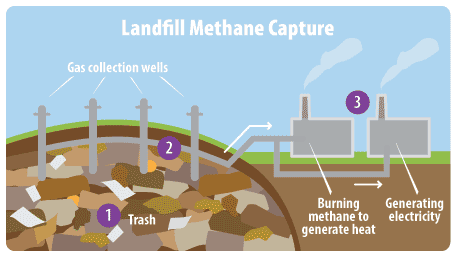
“Methane Capture and Use | A Student’s Guide to Global Climate Change | US EPA” from archive.epa.gov and used with no modifications.
Understanding Landfill Gas and Its Importance
Landfill gas is a byproduct of the decomposition of organic material in a municipal solid waste landfill (MSWL) by microorganisms under anaerobic (without oxygen) conditions. As organic materials such as food waste, paper, wood, and others decompose, they release a steady stream of biogas that builds up beneath the surface of the landfill. If this gas is not managed, it migrates upward and is released into the atmosphere, contributing to climate change and local air pollution. For more detailed information on managing landfill gas, you can refer to the International Best Practices Guide.
How does Landfill Gas Form Inside a Waste Site?
The decomposition process inside a landfill goes through several unique biological stages. Initially, aerobic bacteria use up all available oxygen. Once that oxygen is used up — which happens quite quickly in a sealed, compacted landfill — anaerobic bacteria take over and start producing the methane-rich biogas that makes up LFG. This anaerobic stage can last for decades, meaning a single landfill site represents a long-term energy resource, not a short-term one.
Let’s put this into perspective: each ton of municipal solid waste (MSW) that ends up in a landfill could generate around 0.78 MW of electricity. Now think about the billions of tons of MSW that are dumped in landfills worldwide every year. This results in an estimated 75 billion Nm³ of methane being produced annually. That’s a lot of energy that’s going to waste in most places.
Why the Methane Content of Landfill Gas is Valuable
Landfill gas isn’t purely methane. It generally contains about 45–60% methane (CH₄) and 40–45% carbon dioxide (CO₂), as well as small quantities of nitrogen, oxygen, water vapor, and various non-methane organic compounds (NMOCs). The methane component is what gives landfill gas its energy value — and makes it a risk to the environment if it’s not properly controlled.
Methane, a greenhouse gas, is roughly 25 times more powerful than carbon dioxide over a century. This implies that capturing and transforming LFG isn’t merely a chance for energy — it’s one of the most economical strategies for mitigating greenhouse gases that cities and private landfill operators have at their disposal.
Why Landfills Continue to Burn LFG Instead of Utilizing It
The main issue is financial feasibility. LFG collection systems are increasingly being mandated by regulations, especially in the U.S. under EPA emission standards. However, transitioning from simply collecting gas to using it productively requires more capital investment, which many operators have been hesitant to make. In Malaysia, for instance, only 4 out of 310 total landfill and sanitary landfill sites have LFG utilization systems in place. The remaining sites burn their gas, contributing approximately 40% of the country’s total methane production to the atmosphere. The situation in the U.S. is slightly better, with only 16.6% of active landfills functioning as energy producers.
Understanding the Landfill Gas-to-Electricity Process
Turning landfill gas into electricity is the most common way to use landfill gas around the world. This involves taking raw gas from the landfill, cleaning it to remove any impurities, and then burning it in a power generation system that’s connected to the electricity grid. While this may sound simple, the details of how it’s done are very important for making the process efficient and profitable.
How Landfill Gas is Converted into Electricity: A Simple Breakdown
The process of turning landfill gas (LFG) into electricity starts by drilling a network of vertical extraction wells into the landfill. These wells are connected by a piping header system to a central collection point. Here, a blower or compressor pulls the gas from the ground. This creates a negative pressure. The raw gas is then sent through a condensate removal system. This is because LFG is usually saturated with water vapor. After this, the gas enters a treatment train. This removes hydrogen sulfide (H₂S), siloxanes, and other contaminants that could damage power generation equipment. For more information on the differences between gas flaring systems and gas-to-energy systems, you can read further insights.
After treatment, the gas is directed into the power generation system. The electricity that is produced is then conditioned to meet the standards for grid interconnection and is exported to the local utility network. The entire system, from the wellhead to the meter, requires careful engineering to maintain consistent gas quality and flow rates, which directly affect the amount of electricity that is produced and the revenue that is generated.

“Landfill gas utilization – Wikipedia” from en.wikipedia.org and used with no modifications.
Gas Engines, Gas Turbines, or Steam Turbines: Which is the Best Converter?
There are three main technologies used to convert LFG into electricity, each of which is best suited to different project sizes and gas volumes. For a deeper understanding of these technologies, you can refer to the Global Methane Initiative document.
- Reciprocating Gas Engines: The most common choice for small-to-medium landfills. They handle variable gas quality well, have relatively low capital costs, and are straightforward to maintain. Most efficient at smaller scales (under 3 MW).
- Gas Turbines: Better suited to larger landfills with higher, more consistent gas flows. They produce cleaner exhaust and can be paired with heat recovery systems for combined heat and power (CHP) configurations, improving overall efficiency.
- Steam Turbines: Used in the largest installations where gas volumes are substantial enough to justify the infrastructure. LFG combustion generates steam, which drives a turbine — a more indirect but scalable conversion pathway.
Research applying Linear Programming optimisation to the Seelong landfill in Johor, Malaysia, evaluated all three technologies head-to-head. The analysis selected the most promising utilisation option based on gas volume, capital cost, and energy output — a methodology that is increasingly being adopted in feasibility studies worldwide.
Periodic vs. Steady Power Generation
When it comes to landfill gas (LFG) electricity projects, one of the most critical yet often underestimated operational choices is deciding whether to run the generation equipment on a steady basis or periodically. Running the equipment continuously maximises the total energy output and ensures that the equipment operates under steady conditions. On the other hand, periodic operation schedules the generation to coincide with peak demand times when electricity prices are at their highest.
Main Takeaway: The HAGAL municipal solid waste landfill project showed that generating power at intermittent intervals, specifically during peak demand times to take advantage of Time-of-Load (TOL) tariff premiums, resulted in significantly improved economic results compared to continuous generation. This was true even though less total electricity was generated over the same time frame. The key to project returns is optimizing revenue, not maximizing output.
This key distinction has a direct impact on how a project is designed. A facility that is designed solely to maximise kilowatt-hour output may actually be less profitable than a facility that is designed with grid tariff structures and peak demand times in mind. For those who are modeling project returns, incorporating TOL tariff capture into the generation dispatch strategy is an absolute must.
Requirements for Connecting to the Grid and Reductions in Greenhouse Gas Emissions
Connecting a landfill gas electricity project to the utility grid involves meeting specific interconnection standards set by the local grid operator. These include power quality requirements, protection relay systems, and metering infrastructure. While these requirements add cost and time to project development, they are unavoidable for installations tied to the grid. For more detailed guidelines, refer to the Global Methane Initiative’s best practices.
From an environmental perspective, each unit of electricity produced from LFG replaces grid power that is based on fossil fuels, while also preventing methane from being released into the atmosphere. This double emissions benefit, which includes both avoided methane and displaced carbon, is what qualifies LFG electricity projects for renewable energy credits and carbon offset revenue streams in many places, adding an extra financial component that boosts project ROI.
Return on Investment for Landfill Gas-to-Electricity Projects
Capital Costs: What You’re Really Paying For
Several individual components make up the capital cost of a landfill gas-to-electricity project, and each one needs to be considered in a serious feasibility study. The base is the wellfield infrastructure, which includes vertical extraction wells, piping headers, condensate knock-out systems, and blowers. The gas treatment system, power generation equipment, and grid interconnection infrastructure are added on top of that. The costs can add up quickly for a typical small-to-medium installation that uses reciprocating gas engines.
One of the most common oversights for project developers is the continuous need for capital. Landfill gas (LFG) wellfields need to be continuously expanded as waste settles and new cells are added to a landfill. As the landfill ages, the gas flow rates and quality also change over time. This means that the generation equipment that was perfectly matched to the gas supply in the first year may be too large or too small by the tenth year. It is not optional to build adaptive capacity into the initial capital plan – it is a basic requirement for a solid project economy.
How Time-of-Load Tariffs Can Increase Profits
Time-of-Load (TOL) tariffs are a type of electricity pricing where the cost per kilowatt-hour changes based on the time the electricity is delivered to the grid. Peak demand times, usually from mid-morning to early evening on weekdays, have much higher rates than off-peak times. For a Landfill Gas (LFG) electricity project, planning the generation to run mostly during these high-rate times can greatly increase profits without generating any more power. When analysing the HAGAL MSWL project, it was found that this intermittent, tariff-optimized dispatch strategy was a major way to improve economic viability compared to continuous generation.
What Linear Programming Models Show Us About Profitability
Linear Programming (LP) optimization has risen to prominence as a potent tool for LFG project planning. It lets developers systematically assess various technological options and operational strategies against a defined objective. The objective is usually to maximize profits. LP was applied to the Seelong landfill in Johor, Malaysia. It modelled gas engine, gas turbine, and steam turbine configurations at the same time. This identified the optimal technology mix, based on site-specific gas volumes and local energy prices.
Linear programming models consistently show that the most profitable landfill gas projects aren’t necessarily the ones with the highest raw energy output. Instead, the most profitable projects are the ones that align most closely with local grid tariff structures, infrastructure constraints, and gas supply projections. For project developers, running a linear programming optimisation before committing to a technology pathway isn’t just an academic exercise. It’s the difference between a project that pays for itself in 6 years and one that struggles to ever become profitable.
Understanding the Process of Direct Pipeline Injection
Direct pipeline injection uses a different strategy for turning LFG into profit. Instead of transforming the gas into electricity at the landfill site, the raw LFG is improved to meet the standards of natural gas pipelines and directly injected into the current gas distribution network. The improved product, also known as biomethane or renewable natural gas (RNG), is chemically almost identical to natural gas from fossil fuels. This means it can be transported through existing infrastructure and used for anything that currently uses natural gas.
Refining Raw LFG into Biomethane Suitable for Pipeline Transport
Raw LFG is not suitable for pipeline transport in its collected form. It must first be refined, a process which removes carbon dioxide, hydrogen sulfide, water vapor, oxygen, nitrogen, and trace contaminants until the methane concentration is within the 95–98% range required by most pipeline operators. Several refining technologies are commercially available, including pressure swing adsorption (PSA), water scrubbing, membrane separation, and amine scrubbing. These technologies vary in terms of capital costs, operating costs, and methane recovery efficiencies.
Getting rid of hydrogen sulfide, or desulfurization, is a crucial and expensive step. Hydrogen sulfide is corrosive to pipeline infrastructure and toxic at high levels, so its removal is a must. The desulfurization system is one of the biggest expenses in a pipeline injection project’s budget, and its operating costs directly affect the project’s overall payback period.
Steps in Biomethane Upgrading
Step 1 — Removing Condensate: Water vapor is taken out from raw LFG before it enters the treatment system.
Step 2 — Desulfurization: Hydrogen sulfide (H₂S) is removed through chemical or biological scrubbing. The sulfur that is recovered can be sold as a byproduct revenue stream.
Step 3 — CO₂ Separation: Carbon dioxide is removed using PSA, membrane, or scrubbing technology to increase the methane concentration to pipeline specification (95–98% CH₄).
Step 4 — Trace Contaminant Polishing: Siloxanes, NMOCs, and residual oxygen are removed to meet the final gas quality standards.
Step 5 — Compression and Injection: The upgraded biomethane is compressed to pipeline pressure and injected into the distribution network.
The choice of upgrading technology has implications beyond just the capital cost. Methane slip, which is the percentage of methane lost during the upgrading process, varies by technology and directly reduces the volume of gas that can be sold. A system with high methane slip might have lower upfront costs but will underperform financially over a 10- to 20-year project life. Minimizing methane slip is both an environmental priority and a commercial one.
Additionally, the CO₂ stream that is separated during the upgrading process isn’t necessarily waste. In some project configurations, high-purity CO₂ can be captured and sold for industrial use, such as food-grade carbonation, greenhouse horticulture, or industrial processes. This adds another potential revenue layer to the already complex project economics picture.
Supplying Homes and Businesses with a Natural Gas Alternative
When biomethane is introduced into the pipeline network, it is identical to fossil natural gas in terms of distribution. It can be used for heating and cooking in residential homes, for temperature control in commercial buildings, and for process heat in industrial facilities, all without the need to modify existing appliances or infrastructure. This ability to seamlessly integrate with existing gas networks is one of the most persuasive reasons to consider pipeline injection as a method of use, especially in areas with dense, well-maintained gas distribution systems.
Another use for biomethane is as a vehicle fuel when it is compressed or liquefied. This can be done in the form of compressed renewable natural gas (CNG) or liquefied renewable natural gas (LNG), which allows the transportation sector to be an additional market. Landfills that are located near major freight corridors or municipal vehicle fleets have been increasingly exploring this pathway as a premium-value outlet for their upgraded gas. This often commands higher prices per unit of energy than standard pipeline injection rates.
Direct Pipeline Injection Project ROI
Direct pipeline injection projects have a higher initial capital cost than comparable electricity generation projects. This is mainly due to the complexity of the gas upgrading train. However, the revenue profile is also different. In many market conditions, it’s more favorable over the long term. The financial case for pipeline injection depends a lot on local natural gas prices, available biomethane premium pricing or RNG credits, and the specific costs of desulfurization at the site in question.
Desulfurization Costs and Payback Periods of 5.7 to 6.9 Years
Desulfurization is a major cost factor in pipeline injection project economics. The capital and operating costs of H₂S removal systems fluctuate based on the sulfur concentration in the raw LFG. The concentration itself is dependent on the composition and age of the landfill. Studies of LFG pipeline injection projects at discount rates of 2% to 10% over 10-year project timelines found payback periods ranging from 5.7 to 6.9 years. This takes into account revenues from sulfur sales and local heat supply in addition to the main gas sales revenue.
Income Sources: Selling Gas, Providing Heat, and Recovering Sulfur
The financial structure of a pipeline injection project is more varied than a project that only produces electricity. The main source of income is from selling gas — either at regular pipeline prices or at a higher price for biomethane where there are markets and credits for RNG. Extra income from providing local heat, where waste heat from compression or upgrading processes is captured and sold, can significantly improve the financial viability of a project depending on local demand and prices for heat.
Recovering sulfur can provide a third source of income that is usually overlooked in the early stages of project analysis. The process of desulfurization, when set up to recover sulfur in its elemental form rather than just neutralising it, results in a byproduct that can be sold and used in the production of fertilizers and industrial chemicals. While the income from sulfur alone won’t make or break a project, it does add to the overall financial case and helps to offset the costs of operating the desulfurization process. Research has specifically mentioned this as a factor that increases the chances of a project being viable, in the 2-10% range of discount rates.
Comparing Electricity Generation and Pipeline Injection
Both methods transform the same raw materials into valuable resources, but they do it in different ways, serve different markets, and have different risk profiles. Electricity generation is the more established and widely used method, with a larger global installed base and more standardized project development frameworks. Pipeline injection is the more complex option, but it can also be more rewarding, especially in markets where RNG can be sold at a premium price through low-carbon fuel standards or renewable gas incentive programs.
There’s no one-size-fits-all solution. The best option always depends on the specifics of the site, including how much gas the landfill generates, the quality of that gas, the structure of the local energy market, how close the necessary infrastructure is, and how much risk the operator is willing to take on. What the data does show, however, is that both options are significantly better than flaring, both in terms of economics and the environment. This makes the underutilization of LFG on a global scale one of the most frustrating missed opportunities in the renewable energy sector.
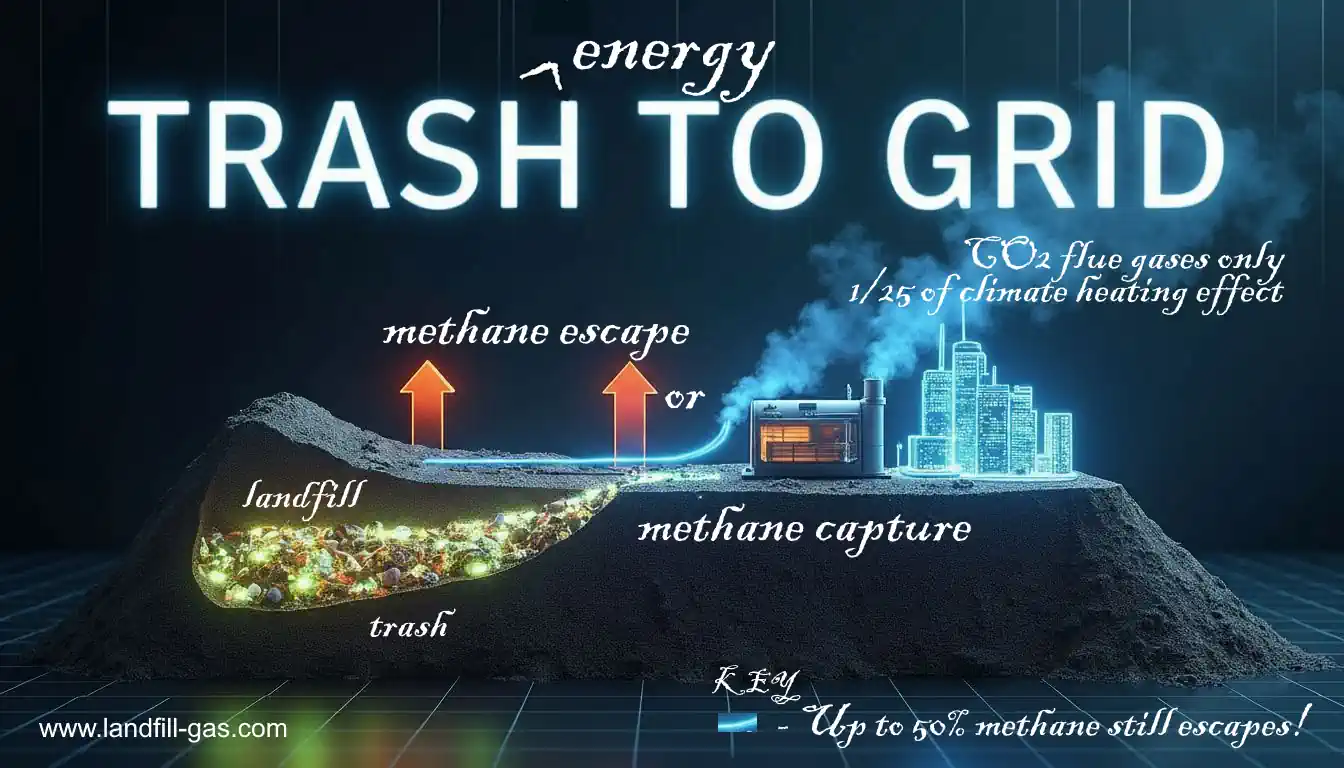
Comparing Initial Capital Investment
| Cost Component | Electricity Generation | Pipeline Injection |
|---|---|---|
| Gas Collection Wellfield | Required | Required |
| Basic Gas Treatment | Required | Required |
| Desulfurization System | Partial (equipment protection) | Full (pipeline specification) |
| CO₂ Removal / Upgrading | Not required | Required (major cost item) |
| Power Generation Equipment | Required (engines/turbines) | Not required |
| Grid Interconnection | Required | Not required |
| Pipeline Interconnection | Not required | Required |
| Compression Equipment | Blowers only | High-pressure compression |
Environmental Impact: Which Method Reduces More Emissions?
Both methods provide significant reductions in greenhouse gas emissions compared to flaring, and vastly better results than uncontrolled methane venting. Electricity generation replaces grid power derived from fossil fuels while also capturing methane that would otherwise be released into the atmosphere. This dual benefit can be measured in both avoided methane (CO₂-equivalent) and reduced grid carbon intensity. Pipeline injection, by substituting biomethane for fossil natural gas in the distribution network, achieves similar methane capture benefits while also reducing emissions from fossil gas combustion at the point of end use.
Which Option Provides the Best Long-Term ROI?
When looking at a 10-year project horizon with discount rates between 2% and 10%, pipeline injection projects have shown payback periods ranging from 5.7 to 6.9 years. This is when you take into account revenues from sulfur sales and heat supply in addition to primary gas sales. Electricity generation projects, especially those that use TOL tariff optimisation and intermittent dispatch strategies, can achieve similar or quicker payback timelines. This depends on local electricity pricing. However, the revenue cap is usually lower than a well-structured pipeline injection project. This is especially true if it operates in a market with RNG premium pricing.
There is no one-size-fits-all answer to which option yields the best long-term ROI. In areas with high electricity costs, a robust grid, and little to no pipeline infrastructure, generating electricity is usually the best option. On the other hand, in areas with thriving RNG markets, low-carbon fuel regulations, or incentives for premium biomethane, pipeline injection tends to offer the best long-term returns despite its higher initial capital costs. The data consistently shows that the projects that don’t take the time to carefully model this site-specific calculus are the ones that underperform. It’s not that LFG-to-energy isn’t profitable; it’s that the wrong pathway was chosen for the local conditions.
How to Choose the Best Option for Your Landfill
The decision to choose between a landfill gas-to-electricity project or a direct pipeline injection project depends on three main factors: the amount of gas your landfill produces, the state of the local energy market, and the existing infrastructure. If you can accurately assess these three factors, your decision will be much easier.
Landfill Size and Gas Volume Limits
The volume of gas is the key factor. Smaller landfills with low gas production rates – usually less than 150,000 cubic feet per day – may not produce enough gas to warrant the initial cost of either a full electricity generation system or a pipeline upgrading train. At these levels, basic flare destruction (which at least stops methane from entering the atmosphere) may be the only economically viable option until the landfill expands. Medium-to-large landfills producing above this limit can support electricity generation using reciprocating gas engines. The largest sites – producing millions of cubic feet of gas per day – are the best candidates for gas turbine electricity generation or full pipeline injection upgrading, where the economies of scale strongly favor more capital-intensive setups.
Energy Costs and Grid Access in Your Area
Whether or not it’s profitable to generate electricity from landfill gas (LFG) depends heavily on the cost of power in your area. If your market has high electricity rates or if there are feed-in tariffs that benefit renewable energy, the revenue you get for each kilowatt-hour could make these projects very competitive. This is especially true if you use tariff optimisation at the top of the line (TOL) as part of your dispatch strategy from the very beginning.
Access to the grid is just as important. A landfill situated in a remote area with little transmission infrastructure will have to deal with high interconnection costs that can drastically affect the project’s economics. In these scenarios, even if local electricity prices are attractive, the capital cost of connecting to the grid could make pipeline injection more appealing – assuming there’s a gas main nearby – or using the energy on-site, like powering the landfill operations directly.
On the other hand, landfills located near industrial plants or commercial areas with a high demand for electricity on-site offer a compelling alternative: direct power purchase agreements (PPAs) that completely avoid grid interconnection. Selling electricity directly to a nearby industrial purchaser at a negotiated price can provide better financial returns than exporting to the grid, while significantly simplifying the regulatory and interconnection process.
Distance to Pipeline Infrastructure
Direct pipeline injection is only feasible if a gas distribution main is within a reasonable distance from the landfill site. The cost of installing a new gas interconnection pipeline increases directly with distance — and after a certain point, those connection costs wipe out the economic benefit of injection completely. Generally speaking, landfills that are a few miles from an existing gas main are strong candidates for a pipeline injection feasibility study. Those that are farther away need to carefully consider connection costs against expected biomethane revenues before deciding to go down this route.
Conclusion: Electricity or Pipeline Injection?
For most medium-to-large landfills with grid access and favourable local electricity pricing, electricity generation with TOL tariff optimisation represents the most accessible, lowest-complexity entry point into LFG monetisation. For larger landfills in markets with active RNG premium pricing, low-carbon fuel standards, or proximity to gas pipeline infrastructure, pipeline injection offers a stronger long-term revenue profile despite higher upfront costs. The most important decision any landfill operator or project developer can make is to stop flaring and start modelling — because virtually any productive use of LFG outperforms wasting it, both financially and environmentally.
Common Questions
Those who are new to landfill gas-to-energy projects, including developers, municipal operators, and renewable energy advocates, often have a similar set of questions. The answers provided below are designed to simplify the complex nature of these projects and provide the key information needed to take the next step.
Whether you’re looking at a particular site or just trying to get a handle on the LFG energy scene, these are the questions you should be asking at the start of a project evaluation.
How much methane is usually in landfill gas?
Landfill gas usually has a methane (CH₄) content of 45% to 60% by volume. The rest is mainly carbon dioxide (CO₂), which makes up 40–45%, with small amounts of nitrogen, oxygen, water vapor, and trace non-methane organic compounds (NMOCs). The methane concentration is usually higher in well-established landfills where active decomposition is taking place and lower in newer or older, post-peak landfills where biological activity has slowed down.
The concentration range of methane is crucial as it is well above the minimum threshold needed to maintain combustion in gas engines and turbines. This makes raw LFG directly usable for electricity generation after basic treatment. On the other hand, pipeline injection requires an upgrade to 95–98% methane. This means that the CO₂ and contaminants must be removed before the gas meets the specifications of the distribution network.
How long does it take for a landfill gas-to-electricity project to recoup its investment?
The payback periods can fluctuate depending on the size of the landfill, the amount of gas, local electricity costs, and the effectiveness of the generation dispatch strategy. Pipeline injection projects evaluated at 2–10% discount rates over 10-year periods have demonstrated payback periods of 5.7 to 6.9 years when considering all revenue sources such as gas sales, heat supply, and sulfur recovery. Electricity generation projects with TOL tariff optimisation can achieve similar timelines in favourable electricity pricing environments, although projects without strategic dispatch planning tend to take longer to recoup capital.
Is it possible for a landfill to generate electricity and inject into a pipeline simultaneously?
Technically, yes — and there are some large landfills that operate hybrid configurations where a portion of the gas stream is directed to electricity generation while the remainder is upgraded for pipeline injection. However, this dual-pathway approach adds significant complexity to both the technical design and the financial modelling. Each pathway requires its own treatment and conversion infrastructure, and splitting the gas stream reduces the economies of scale available to each individual pathway. Hybrid configurations are generally only justified at very large landfills generating gas volumes substantial enough to support both systems at efficient operating scales simultaneously.
Understanding Time-of-Load Tariff and its impact on landfill gas revenue
Time-of-Load (TOL) tariff is a pricing structure used by utility companies where the rate paid for electricity supplied to the grid changes based on the time of day and day of the week. The periods of peak demand, which are usually weekday mornings through early evenings, attract the highest per-kilowatt-hour rates. On the other hand, nights, weekends, and holidays attract lower off-peak rates. For a landfill gas electricity project, it is possible to significantly increase revenue by strategically scheduling generation to run mainly during peak pricing periods compared to continuous flat-rate generation, even if the total kilowatt-hours exported over a certain period are less.
The HAGAL MSWL project showed that intermittent generation based on TOL tariff structures is more economically viable than continuous generation at the same location. This is significant for the design of LFG electricity projects: the generation dispatch strategy must be built into the project from the start, rather than added later. For developers looking at new projects, it should be standard to model TOL tariff capture scenarios and continuous generation scenarios as part of the financial feasibility process.
Can landfill gas be classified as a renewable energy source?
Indeed, landfill gas is generally recognised as a renewable energy source. This is because it is continuously produced by the ongoing biological breakdown of organic waste materials. These materials come from recently living matter. Unlike fossil fuels, which represent carbon stored over geological timescales, landfill gas is part of the current carbon cycle.
- LFG qualifies as renewable energy under U.S. EPA definitions and is eligible for Renewable Energy Credits (RECs) in most U.S. states.
- Biomethane upgraded from LFG qualifies as Renewable Natural Gas (RNG) in jurisdictions with low-carbon fuel standards, often commanding premium pricing.
- LFG-to-electricity projects can generate carbon offset credits through verified emission reduction programs, adding a secondary revenue stream to electricity sales.
- The dual GHG benefit — methane capture plus fossil fuel displacement — makes LFG projects eligible for incentives under multiple regulatory frameworks simultaneously.
It is worth noting that LFG’s renewable classification comes specifically from the organic fraction of municipal solid waste. Not all landfill waste is organic — plastics, metals, and other non-biodegradable materials contribute to overall waste volumes but do not generate biogas. The renewable energy credit frameworks that govern LFG projects typically recognize this distinction and apply it in how generation volumes are certified.
In practical terms, the renewable nature of LFG means that project developers can tap into a wider variety of financing mechanisms, incentive schemes, and premium off-take contracts than a conventional fossil gas project could. In markets where renewable energy premiums and carbon credit revenues are available, these extra sources of income can make the difference between a project that’s just breaking even and one that’s clearly financially viable.
Being classified as renewable also plays a significant role in public opinion and local government support. When landfill operators propose LFG projects to local governments or community stakeholders, they can convincingly present these projects as renewable energy infrastructure, not just waste management. This often leads to quicker permits, increased community support, and easier access to green financing tools like green bonds and sustainability-linked loans.
Landfill gas (LFG) is a natural byproduct of the decomposition of organic material in landfills. It consists primarily of methane and carbon dioxide, both potent greenhouse gases. Effective management of landfill gas is crucial to minimise environmental impact and harness its potential as a renewable energy source. There are various technologies available for landfill gas utilisation, including gas-to-energy systems and direct pipeline injection. Each option has its own set of advantages and challenges, and the choice between them often depends on factors such as the size of the landfill, local regulations, and economic feasibility.