- Landfill gas (LFG) is roughly 50% methane and 50% CO2 — that methane is powerful enough to run gas engines that feed electricity directly into the UK grid.
- Hundreds of UK landfill sites are actively generating electricity from decomposing waste, including many sites that stopped accepting rubbish years ago.
- Capturing landfill gas is one of the most cost-effective greenhouse gas interventions available — methane is over 80 times more potent than CO2 over a 20-year period, making every cubic metre captured a meaningful climate win.
- UK landfill gas output is in long-term decline as stricter waste policies reduce the amount of biodegradable material going to landfill — but existing sites will continue producing gas for decades.
- There’s a narrow but critical window to maximise energy recovery from legacy landfill sites before gas production drops too low to be economically viable — and the decisions being made now will determine how much of that energy is captured or lost.
Methane from Rubbish is Powering UK Homes Right Now
Beneath the capped surfaces of thousands of former rubbish tips across Britain, something remarkable is happening — organic waste is slowly rotting, producing a steady stream of gas that is being piped away and turned into electricity.
Landfill gas energy isn’t a future technology or a theoretical concept. It’s working right now, quietly contributing to the UK’s renewable energy mix. Drax Energy Solutions, which operates across multiple energy sectors in the UK, recognises landfill gas as one of the more established forms of waste-derived power generation — a technology that has been commercially deployed in the UK for decades. For anyone interested in how the UK generates power from its waste legacy, Drax’s insights on landfill gas energy generation offer a solid starting point.
What makes this energy source genuinely interesting — and genuinely complex — is the tension at its heart. Landfill gas is both an environmental hazard and a usable fuel. Getting that balance right is where the real story lies.
What is Landfill Gas and Where Does It Come From?
Landfill gas is a natural byproduct of biological decomposition. When organic materials — food waste, paper, garden waste, timber — are buried in a landfill and cut off from oxygen, anaerobic bacteria break them down. That process releases a mixture of gases over many years, sometimes decades after a site has closed.
How Decomposing Waste Produces Methane
The decomposition process inside a landfill goes through several stages. Early on, aerobic bacteria consume available oxygen and produce CO2. Once oxygen is depleted — which happens relatively quickly in a densely packed landfill — anaerobic bacteria take over. This is when methane production begins in earnest. The rate of gas production depends on several factors including the moisture content of the waste, the temperature inside the landfill, and the composition of the buried material. Landfills rich in food and garden waste tend to produce more gas, more quickly, than those dominated by inert or construction waste.
The Composition of Landfill Gas
The gas that comes out of a landfill isn’t pure methane. It’s a mixture, and understanding that mixture matters for how it’s treated and used. For more information, you can explore the basic information about landfill gas provided by the EPA.
Component Approximate Proportion Significance Methane (CH₄) ~50% Primary fuel for energy generation Carbon Dioxide (CO₂) ~50% Greenhouse gas, must be managed Non-methane organic compounds (NMOCs) Trace amounts Potentially hazardous, require treatment Nitrogen, oxygen, hydrogen sulphide Trace amounts Affect gas quality and engine performance
That roughly 50/50 split between methane and CO2 is significant. It means landfill gas has a lower calorific value than natural gas, which is typically over 90% methane. This affects how it can be used and what infrastructure is needed to handle it efficiently.
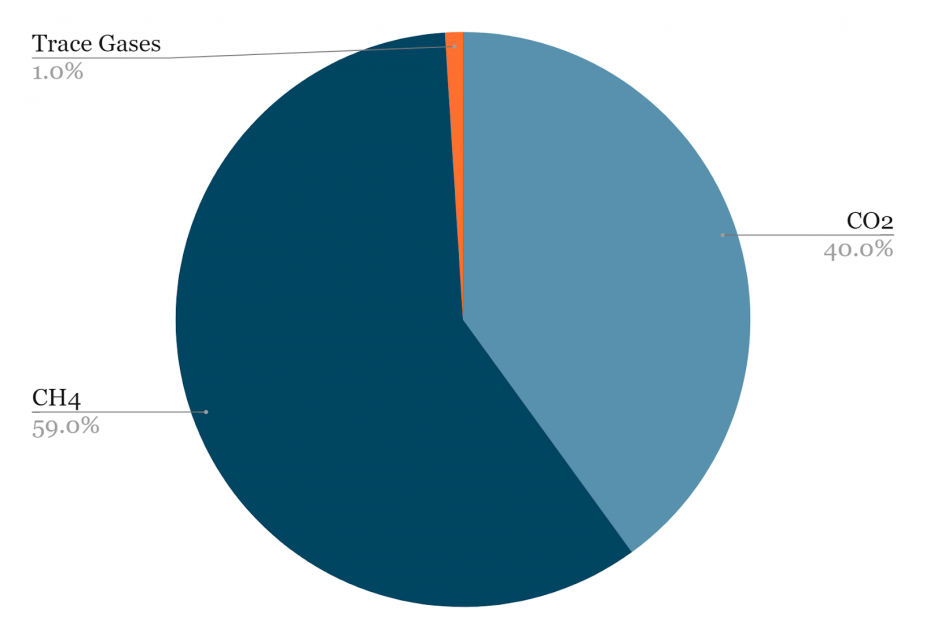
“Trace Gases in Landfill Gas from a UK …” from landfill-gas.com and used with no modifications.
Why Methane is Both a Danger and an Opportunity
Uncontrolled methane from landfill sites poses serious environmental and safety risks. It can migrate through soil, accumulate in enclosed spaces, and create explosion hazards in nearby buildings. More critically for the climate, methane is more than 80 times more potent than CO2 as a greenhouse gas over a 20-year timeframe. Left to vent into the atmosphere, landfill methane is one of the more damaging emission sources the UK has to manage. Captured and burned — even if just flared — it’s converted to the far less potent CO2. Captured and used for energy generation, it becomes a resource.
How Landfill Gas is Captured and Converted to Energy
Turning decomposing rubbish into usable electricity requires a carefully engineered collection and conversion system. It’s not a passive process — active infrastructure is needed to extract the gas, clean it up, and feed it into an engine or turbine.
The Gas Collection System Inside a Landfill
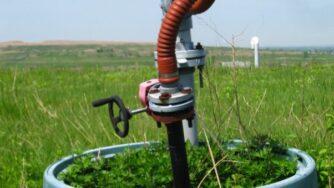
Collection starts with a network of vertical wells drilled down into the waste mass, typically spaced at regular intervals across the landfill footprint. These wells are connected by a series of horizontal pipes that channel the gas towards a central extraction point. A vacuum pump or blower system applies negative pressure to draw the gas through the network. The extracted gas then passes through moisture separators and basic filtration before reaching the power generation equipment. On larger sites, this infrastructure can be extensive — dozens of wells, hundreds of metres of pipework, and multiple monitoring and control points to manage gas flow and composition. For more detailed insights, you can explore producing power using landfill gas.
From Gas to Electricity: The Role of Gas Engines
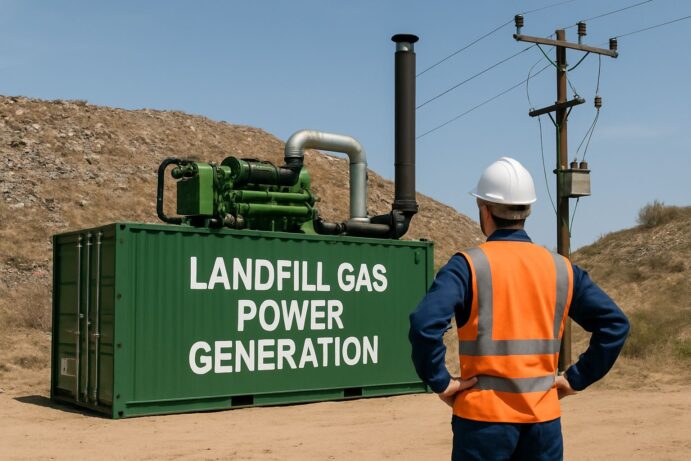
The most common way landfill gas is converted to electricity in the UK is through reciprocating gas engines — essentially large internal combustion engines adapted to run on lower-calorific-value gas. These engines drive generators that produce electricity, which is then exported to the grid. Gas turbines are also used on larger sites where gas volumes are high enough to justify the capital cost.
The efficiency of these systems is meaningful but not exceptional. A typical landfill gas engine converts around 35–40% of the gas’s energy content into electricity, with the remainder lost as heat. That heat loss is exactly what Combined Heat and Power systems are designed to recover.
Combined Heat and Power (CHP) Applications
Combined Heat and Power (CHP) systems capture the waste heat from gas engines and put it to use — typically for heating nearby buildings, industrial processes, or sometimes to dry sludge at adjacent water treatment sites. This pushes the overall energy efficiency of landfill gas use from around 35–40% (electricity only) to as high as 70–80% when heat is also recovered.
Not every landfill site is well-positioned for CHP. The economics depend on having a nearby heat demand — a hospital, housing estate, or industrial facility within practical piping distance. Where that demand exists, CHP is the most efficient use of landfill gas by a considerable margin.
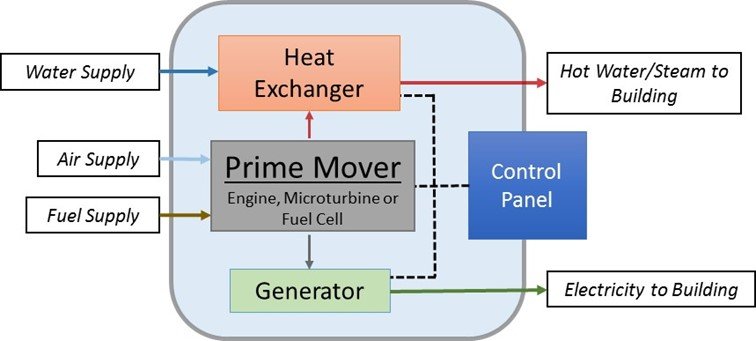
“What Is CHP? | US EPA” from www.epa.gov and used with no modifications.
The Scale of Landfill Gas Energy in the UK
The UK has one of the more developed landfill gas energy sectors in Europe, a legacy of both the scale of historical landfill use and the policy environment that incentivised gas capture and utilisation from the 1990s onwards. For more detailed insights, explore this article on producing power using landfill gas.
How Many UK Sites Currently Generate Landfill Gas Energy
The UK has hundreds of landfill sites with active gas-to-energy infrastructure. Many of these are closed sites — landfills that stopped accepting waste years or even decades ago but continue to produce commercially viable quantities of gas. The continued productivity of closed sites underscores a critical point: landfill gas energy is not just about current waste management, it’s about managing the long tail of decades of historical landfill use.
Landfill Gas Contribution to UK Renewable Energy Output
Landfill gas has historically been one of the larger contributors to UK renewable electricity generation. While solar and wind have grown dramatically and now dominate the renewable mix, landfill gas represented a significant baseload renewable source through the 2000s and into the 2010s. Unlike wind and solar, landfill gas generation is continuous — gas doesn’t stop flowing when the sun sets or the wind drops — which gave it a reliability advantage that variable renewables can’t match without storage. That steady, 24-hour output made it particularly valuable to grid operators managing supply and demand balance. For more on the process, explore the landfill gas to energy process.
Environmental Impact: The Case for Capturing Landfill Gas
The environmental argument for capturing landfill gas is straightforward and compelling. The gas is going to be produced regardless of whether anyone captures it — the decomposition process is already underway in thousands of sites across the UK. The only question is whether that methane is put to work or allowed to escape into the atmosphere. Capturing it for energy generation addresses both sides of the equation: it reduces a potent greenhouse gas emission and displaces fossil fuel generation on the grid.
Methane vs. CO2: Why Landfill Gas is a Priority Emission to Tackle
Methane’s potency as a greenhouse gas makes landfill emissions a high-priority target. Over a 20-year period, methane is more than 80 times more warming than CO2 by weight. Over 100 years, that figure is around 28–36 times more potent. The Intergovernmental Panel on Climate Change (IPCC) has consistently highlighted methane reduction as one of the fastest-acting levers available for near-term climate impact. Landfill sites represent one of the largest anthropogenic methane sources in the UK, making gas capture not just an energy opportunity but a climate imperative.
How LFG Capture Reduces Greenhouse Gas Emissions
When landfill gas is captured and combusted in a gas engine, the methane is converted to CO2 and water vapour. While CO2 is still a greenhouse gas, the conversion from methane to CO2 represents a dramatic reduction in warming potential. The US Environmental Protection Agency (EPA) has noted that CO2 emissions from more than 13.1 million homes’ energy use for one year could be offset by effective landfill gas capture programmes — illustrating the scale of the opportunity at a national level.
Beyond the direct methane conversion benefit, using landfill gas to generate electricity displaces power that would otherwise come from fossil fuel sources. Every megawatt-hour of electricity generated from landfill gas is a megawatt-hour that doesn’t need to come from gas-fired or coal-fired generation, delivering a second layer of carbon benefit on top of the methane capture itself.
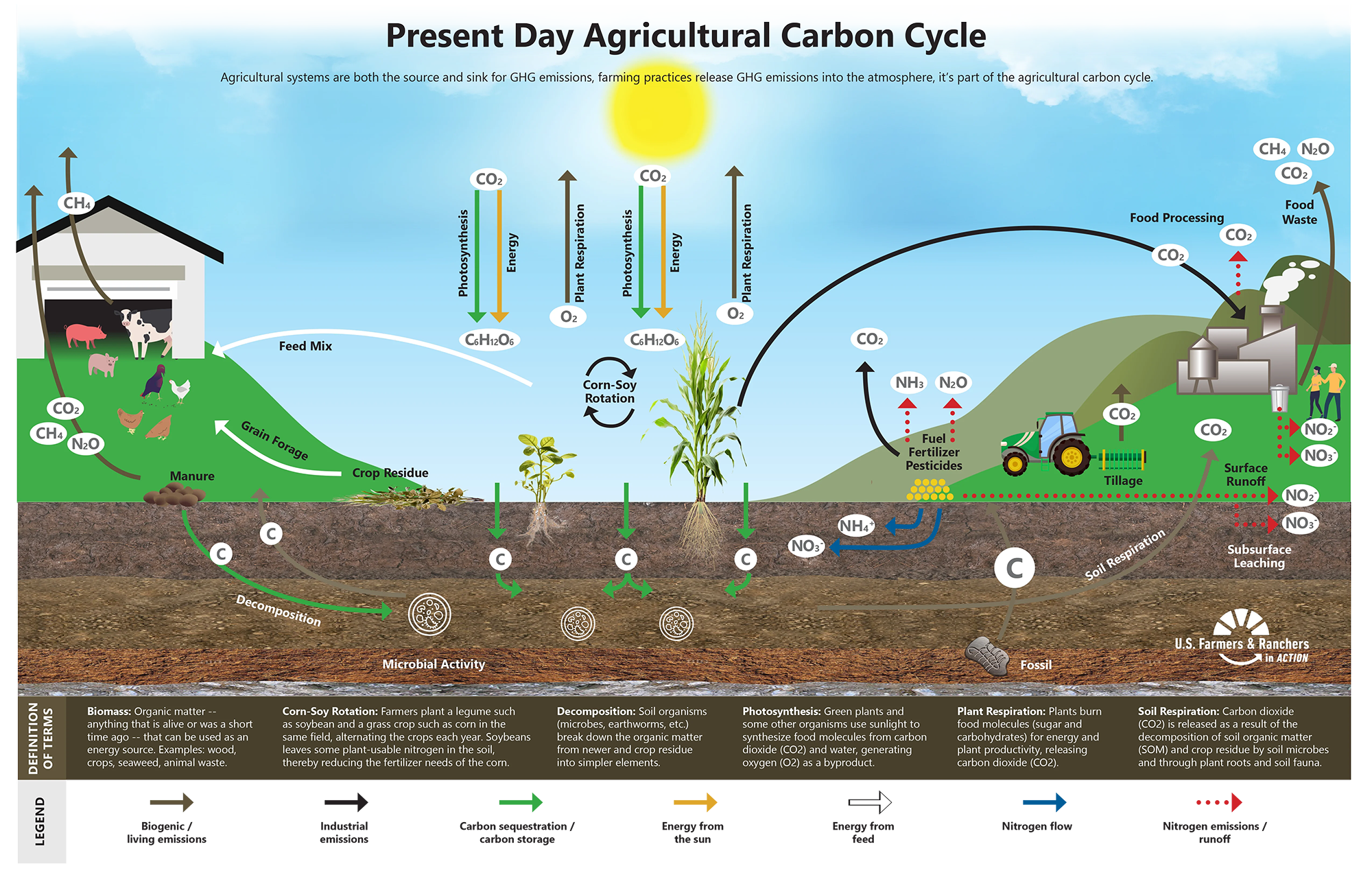
“Greenhouse Gas Negative …” from councilgreatlakesregion.org and used with no modifications.
The Limits of Landfill Gas as a Green Energy Source
Landfill gas energy is not without its complications. Describing it as straightforwardly “green” requires some nuance. The underlying activity that produces the gas — burying organic waste in landfill — is itself environmentally damaging. Landfill leachate can contaminate groundwater, and the long-term management of closed sites carries ongoing environmental and financial obligations. Capturing and using the gas mitigates the methane problem but doesn’t undo the wider environmental footprint of landfill.
There’s also the question of what landfill gas energy competes against. In a world increasingly supplied by zero-carbon wind and solar, the CO2 produced by combusting landfill gas in an engine — even if it replaces methane — is still a real emission. As the UK grid decarbonises, the relative benefit of landfill gas generation diminishes. It remains a net positive today, but the margin narrows as the grid gets cleaner.
UK Regulations and Government Policy on Landfill Gas
The UK’s regulatory environment has shaped landfill gas energy development significantly. A combination of landfill restrictions, carbon pricing, and renewable energy support mechanisms created the conditions for the sector to grow through the late 1990s and 2000s. Understanding this policy landscape helps explain both why the UK developed such a substantial landfill gas sector and why its future trajectory is constrained. For more on the environmental impact of landfills, explore landfills and methane gas solutions.
The Environment Agency regulates landfill gas management in England, requiring sites above certain thresholds to actively collect and manage landfill gas rather than allowing it to vent passively. Similar requirements apply under the devolved regulatory frameworks in Scotland, Wales, and Northern Ireland. These regulations set the floor — operators must do something with the gas. The financial incentives determine whether that something is energy generation or simple flaring.
The Landfill Tax and Its Role in Reducing New Sites
Introduced in 1996, the UK Landfill Tax was a pivotal policy intervention. By making landfill disposal progressively more expensive, it drove waste up the hierarchy — towards recycling, composting, and energy recovery — and away from burial. The standard rate of Landfill Tax has risen significantly over the decades, making landfill economically unattractive for biodegradable waste. The result has been a substantial reduction in the volume of organic material going to landfill, which directly translates to less future landfill gas production. The tax was effective at its primary goal, but that success creates a long-term challenge for landfill gas energy: the feedstock for future gas production is diminishing by design.
Renewable Obligation Certificates (ROCs) and Support Mechanisms
Landfill gas electricity generation was eligible for support under the UK’s Renewables Obligation (RO) scheme, receiving Renewable Obligation Certificates (ROCs) per megawatt-hour of electricity generated. This financial support was instrumental in making landfill gas projects commercially viable through the 2000s and into the 2010s. Landfill gas received a lower ROC banding than technologies like offshore wind or solar — reflecting its relatively lower cost and more established nature — but the support was sufficient to underpin significant investment in gas capture and generation infrastructure.
The Renewables Obligation closed to new applicants in 2017, replaced by Contracts for Difference (CfDs) as the primary support mechanism for large-scale renewables. Landfill gas has not featured prominently in CfD auction rounds, partly because the declining gas volumes at most sites make the long-term revenue certainty required for CfD contracts difficult to demonstrate. Existing RO-accredited projects continue to receive support for the duration of their accreditation periods, but the pipeline of new landfill gas projects receiving government financial support has narrowed considerably.
The Future of Landfill Gas Energy in the UK
The long-term trajectory of UK landfill gas energy is one of managed decline — not collapse, but a gradual, predictable reduction in output as the legacy of historical landfill use is progressively exhausted. The sites producing gas today are doing so from waste buried in some cases 20, 30, or 40 years ago. As that material completes its decomposition cycle, gas production tapers off and eventually reaches the point where energy recovery is no longer economically viable.
Why Landfill Gas Output is Declining Over Time
The decline in UK landfill gas output is a direct and predictable consequence of successful waste policy. As the Landfill Tax progressively made burial of biodegradable waste more expensive, less organic material entered the ground. Less organic material in the ground means less decomposition, which means less gas. The sites that are producing today are drawing down a finite reserve of buried organic matter, and that reserve is not being replenished at anywhere near the historical rate. According to data tracked by the Department for Energy Security and Net Zero, landfill gas has followed a declining output trend as a proportion of UK renewable electricity generation over the past decade — a trend that will continue regardless of what happens to energy prices or policy.
How Long Closed Landfills Continue to Produce Gas
A closed landfill site can continue producing commercially viable quantities of gas for 20 to 30 years after it stops accepting waste, and may produce detectable quantities of methane for considerably longer. The production curve typically peaks within the first five to ten years after closure, then gradually declines as the most readily decomposable organic material is consumed. For more information on this topic, you can read about landfill methane emissions. What remains continues to break down more slowly, producing lower concentrations of gas over an extended tail period.
This long production tail is both an opportunity and a management challenge. It’s an opportunity because it means closed sites can continue generating revenue and environmental benefit for decades. It’s a challenge because as gas volumes decline, the economics of maintaining extraction infrastructure become increasingly marginal. Operators face difficult decisions about when to scale back or decommission energy generation equipment, transition to simple flaring, or invest in upgrades that might extend the viable energy generation period. Some sites have explored upgrading their landfill gas to biomethane quality for grid injection as an alternative to declining electricity generation economics — a shift that can extend the commercial life of a capture system even as raw gas volumes fall. For more information on this process, you can read about the landfill gas to energy process.
Landfill Gas vs. Other Waste-to-Energy Technologies
Landfill gas sits within a broader ecosystem of waste-to-energy technologies, and understanding how it compares helps clarify where it fits in the UK’s energy and waste strategy going forward. The main competitor technologies are Energy from Waste (EfW) incineration, anaerobic digestion (AD), and biomethane production. EfW plants burn residual waste directly to generate electricity and heat, achieving higher energy recovery rates from the same quantity of waste than landfill gas capture can deliver. Anaerobic digestion takes specific organic feedstocks — food waste, sewage sludge, agricultural material — and deliberately ferments them in controlled conditions, producing biogas at much higher methane concentrations than landfill gas and without the environmental downsides of landfill burial.
Landfill gas energy has one significant advantage over both: the waste is already in the ground. There’s no new environmental footprint to create, no new facility to build from scratch, and no feedstock logistics to manage. It’s a form of legacy resource recovery — extracting value from decisions made decades ago. For that reason, even as it declines in relative importance, landfill gas remains one of the most cost-effective greenhouse gas mitigation options available to the UK, precisely because the alternative to capturing it is simply letting it escape.
Landfill Gas Still Has a Role to Play, But Its Days Are Numbered
Landfill gas energy occupies a unique and time-limited position in the UK’s renewable energy landscape. It doesn’t require new land, new feedstock, or new waste streams — it requires intelligent management of a problem that already exists. Every year that an active landfill gas capture system operates is a year in which a potent greenhouse gas is being converted into usable electricity rather than warming the atmosphere. That’s a straightforward win, and it’s one the UK has been delivering at meaningful scale for over 30 years.
But the window is narrowing. Stricter waste policies mean the buried organic reserves that fuel landfill gas generation are not being topped up. The sites active today are working through a finite legacy, and as gas volumes decline, some will inevitably reach the point where energy generation is no longer economically viable. The challenge for operators, policymakers, and investors alike is to extract maximum value — both economic and environmental — from that legacy before the opportunity closes.
The smart money is on maximising recovery now: upgrading collection infrastructure on productive sites, exploring biomethane grid injection where gas quality and volumes support it, and integrating CHP where heat demand exists nearby. Landfill gas won’t power the UK forever, but it still has years of productive life ahead — and wasting that resource would be a missed opportunity the UK can ill afford.
Frequently Asked Questions
Here are direct answers to the most common questions people ask about landfill gas energy in the UK.
How long does a landfill site produce gas after it closes?
A landfill site typically produces commercially viable quantities of gas for 20 to 30 years after it closes. Peak production usually occurs within the first five to ten years post-closure, after which output gradually declines as the most readily decomposable organic material is exhausted. Detectable methane production can continue well beyond this window, but at concentrations too low to support efficient energy generation.
Is landfill gas considered a renewable energy source in the UK?
Yes, landfill gas is classified as a renewable energy source in the UK and was eligible for support under the Renewables Obligation scheme, receiving ROCs for each megawatt-hour of electricity generated. The classification reflects the biological origin of the gas — decomposing organic material — rather than fossil fuel combustion. However, it sits at the lower end of the renewable energy hierarchy, and its classification has attracted debate given the environmental downsides of landfill as a waste management method.
What percentage of UK electricity comes from landfill gas?
Landfill gas has historically contributed a meaningful percentage to UK renewable electricity generation, but its share has declined as wind and solar capacity has expanded rapidly. While precise current figures shift year to year, landfill gas has moved from being one of the leading renewable electricity sources in the early 2000s to a progressively smaller share of an increasingly large renewable total. It remains a consistent baseload contributor, but no longer commands the prominence it once held in the UK’s renewable generation mix.
Can landfill gas be injected into the national gas grid?
Yes, but not directly in its raw form. Raw landfill gas is approximately 50% methane and 50% CO2, with trace contaminants — this is far below the quality specification required for the national gas grid, which demands gas that is predominantly methane (typically above 95%). To be injected into the grid, landfill gas must be upgraded to biomethane quality through a process that removes the CO2 and cleans out impurities, leaving a high-methane gas functionally similar to natural gas.
Grid injection of upgraded landfill gas — sometimes called biomethane from landfill — is technically viable and has been demonstrated at a number of UK sites. It offers an alternative revenue route for landfill gas operators, particularly as electricity generation economics become more challenging with declining gas volumes. Upgraded biomethane also attracts support under the UK’s Green Gas Support Scheme, which replaced the previous Renewable Heat Incentive for biomethane injection projects, providing a financial incentive that can make upgrading infrastructure worthwhile on sites with sufficient gas production. For more information on the process, you can explore the landfill gas to energy process.
What happens to landfill gas that is not captured for energy?
When landfill gas is not captured for energy generation, there are two main outcomes. In the best case, the gas is collected and flared — burned off at a controlled flare stack. Flaring converts methane to CO2, which is a significantly less potent greenhouse gas, so even simple flaring delivers a meaningful climate benefit compared to uncontrolled venting. In the worst case, gas that is not collected migrates through the soil and vents directly to the atmosphere as raw methane — the most environmentally damaging outcome. For more insights, explore the environmental impact of methane gas.
UK regulations require active gas management at sites above defined thresholds, which means uncontrolled venting is not legally permitted at regulated sites. However, the regulatory framework cannot eliminate all fugitive emissions — some methane escapes from the edges of collection systems, through the landfill cap, or from areas with lower well density. Minimising these fugitive losses is an ongoing operational challenge, and advances in monitoring technology — including drone-mounted gas sensors and satellite-based methane detection — are making it increasingly possible to identify and address emission hotspots with greater precision.
Outcome for Uncaptured LFG Environmental Impact Regulatory Status in UK Captured and used for electricity generation Best outcome: methane converted, fossil fuel displaced Encouraged; eligible for renewable energy support Captured and upgraded to biomethane for grid injection High value: renewable gas displaces natural gas Eligible for Green Gas Support Scheme Captured and flared Methane converted to CO₂; no energy value recovered Permitted; required where energy recovery not viable Fugitive emissions through landfill cap Direct methane release; significant warming impact Minimised through regulation; not fully eliminable Uncontrolled venting Worst outcome: raw methane to atmosphere Not permitted at regulated sites
The hierarchy above makes the case for energy generation clearly. Flaring is far better than venting, but energy generation — whether for electricity or grid-injected biomethane — extracts real value from an emission that is going to occur regardless. The gap between the best and worst outcomes is enormous, both in climate terms and in economic terms, which is why maximising capture and utilisation at every viable site remains a priority.
For communities near active landfill sites, the presence of a well-managed gas capture system is also a direct safety benefit. Controlled extraction reduces the risk of methane migration into nearby buildings — a genuine hazard at poorly managed sites — and reduces the odour issues associated with uncontrolled gas movement through soil.
Drax Energy Solutions continues to provide insight and expertise across the UK’s evolving renewable energy landscape, including the waste-to-energy technologies that are shaping how Britain powers itself in the decades ahead — explore their resources to stay informed on how energy from unexpected sources is contributing to a cleaner grid.