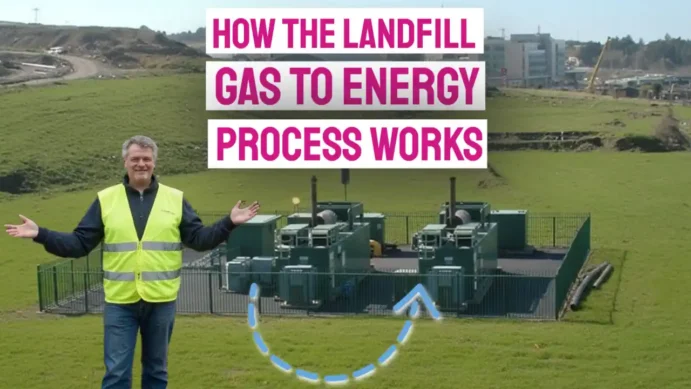
For those that ever wondered how the landfill gas to energy process (also known as LFGTE) works? This article takes you through how waste management companies convert naturally occurring landfill gas into clean, renewable energy at their LFGTE facilities.
Every day, millions of tonnes of rubbish end up in landfills across the United Kingdom. This waste breaks down over time and releases gases into the atmosphere.
This natural decomposition contributes significantly to climate change.
The truth is that landfills produce valuable gases that we can capture and transform into something beneficial. 1
Understanding the impact of these emissions is critical. Methane is the primary gas released from decomposing organic waste, and it is 21 times more effective as a greenhouse gas compared to carbon dioxide.
This means that capturing methane from landfills is one of our greatest tools for environmental protection. The Landfill Gas To Energy Process transforms this problem into a powerful opportunity.
 Instead of allowing these gases to escape, we collect them, treat them, and convert them into electricity and heat that power homes and businesses. 2
This process reduces harmful emissions whilst generating clean energy from waste that would otherwise be discarded. 3
This guide will break down exactly how this innovative technology works. We will show you how engineers turn everyday waste into a reliable energy source.
Key Takeaways
- Landfill gas to energy systems capture methane, which is 21 times more potent as a greenhouse gas than carbon dioxide, and convert it into electricity and heat for homes and businesses whilst preventing harmful emissions from escaping into the atmosphere.
- Engineers extract landfill gas through networks of up to approximately 300 borehole extraction wells that reach deep underground, where perforated plastic pipes surrounded by gravel allow methanogenic bacteria byproducts to flow freely into collection systems powered by vacuum blowers.
- Treatment facilities remove contaminants, including hydrogen sulphide, siloxanes, and moisture through knockout pots and filtration systems, then condition the gas to acceptable methane levels before combustion engines and turbines convert it into electricity at approximately 11,000 volts or higher.
- Landfill gas to energy processes reduce global warming potential by up to 75 per cent compared to spontaneous methane emissions, with biocover systems achieving methane oxidation efficiencies between 70 and 90 per cent, and facilities across the United States already powering approximately 400,000 homes through this renewable energy source.
- The process displaces fossil fuel energy consumption, controls odours affecting local communities, minimises flaring waste, and transforms landfill gas into renewable natural gas (RNG) that serves multiple purposes, including electricity generation, industrial heating, and vehicle fuel in compressed or liquefied forms.
Overview of the Landfill Gas to Energy Process
Landfill gas to energy (LFGTE) is a systematic process that captures harmful emissions and converts them into usable power. Landfills produce methane and carbon dioxide as organic matter breaks down underground, and energy recovery systems capture these gases to generate electricity and heat.
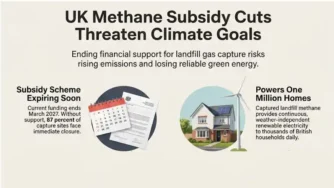
Companies like Infinis Energy lead this sector in the UK. They currently operate over 100 landfill gas sites, generating approximately 255 megawatts (MW) of baseload power from captured methane.
To achieve this, engineers collect the landfill gas through a network of pipes and treat it to remove impurities. They then convert it into usable energy through combustion engines or fuel cells, strictly following Environment Agency guidelines to minimise environmental impact.
How is landfill gas collected?
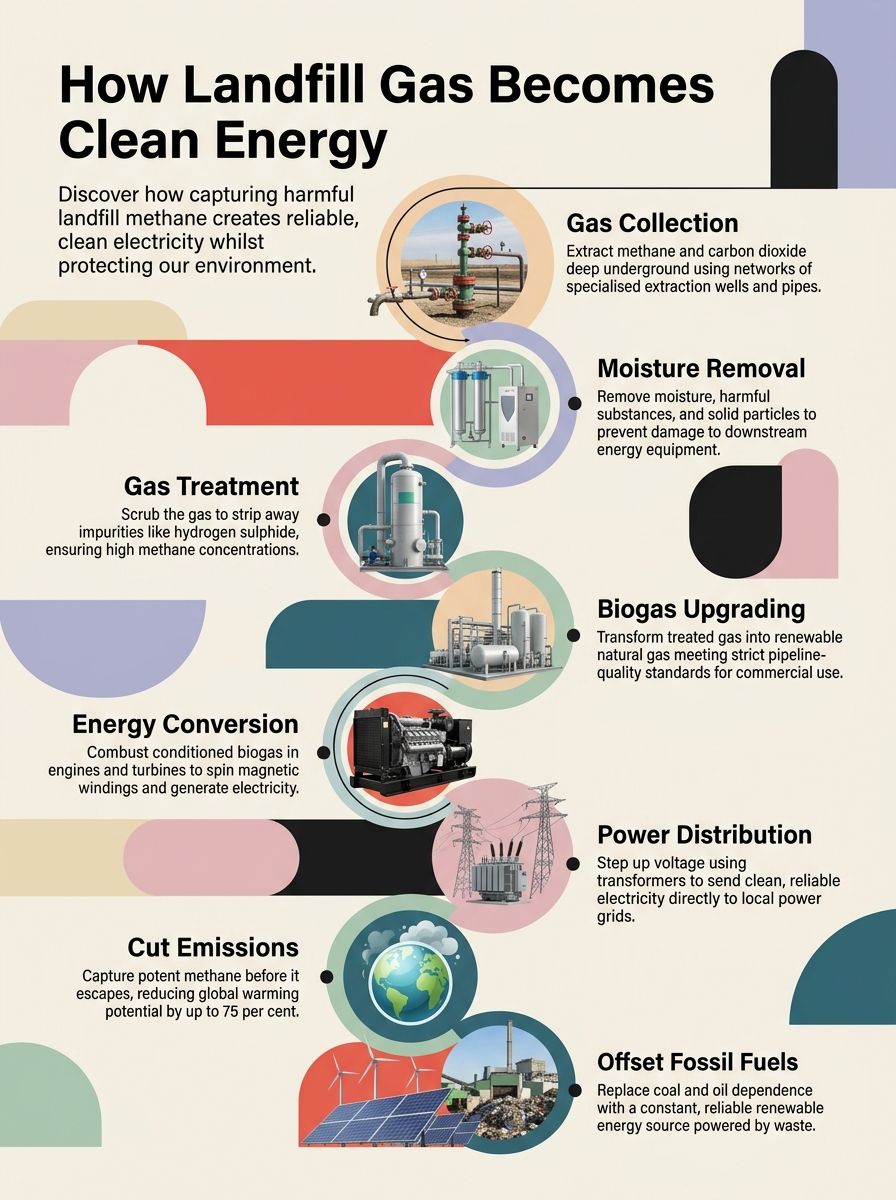
Landfill gas collection systems work by extracting methane and carbon dioxide from decomposing waste deep underground. 1
Engineers use specialised equipment and strategic well placement to capture these valuable gases before they escape into the atmosphere. The UK Environment Agency provides strict guidance, known as LFTGN 03, which dictates how operators must assess and control these emissions.
The collection process relies on a carefully engineered underground network:
- Vertical and horizontal extraction wells penetrate the waste material. An average site might contain around 300 borehole extraction wells that reach depths of up to 40 metres.
- Perforated plastic pipes sit inside each well, surrounded by medium-grade gravel to prevent blockages and allow steady gas flow.
- Methanogenic bacteria naturally break down organic matter through anaerobic digestion, producing the raw methane.
- Vacuum blowers operate at the central facility, creating a negative pressure that pulls the gas upwards.
- Small feeder pipes connect directly to larger header pipes to transport the collected fuel to the main treatment plant.
This vacuum pressure differential is crucial. It forces the gas to travel upward through the well system, overcoming natural resistance.
During this journey, oxygen and nitrogen naturally present in the waste get filtered out, ensuring only the methane and carbon dioxide reach the treatment stage. 2
Because municipal solid waste decomposition continues for decades, these wells remain highly productive. They supply a consistent, renewable energy feedstock to the facility throughout their operational lifespan.
How is landfill gas treated and conditioned?
Treating and conditioning landfill gas requires several important steps to make it safe and suitable for energy generation. 3
Raw gas is full of moisture and particulates. Engineers must remove these contaminants and adjust the gas composition so that electricity generation and renewable natural gas production can proceed effectively.
The treatment phase focuses on protecting machinery and meeting strict quality standards:
- A knockout pot separates liquid contaminants from the captured gas immediately after collection, preventing water from damaging downstream equipment.
- The gas is often cooled to around 5 degrees Celsius to force moisture condensation and remove suspended liquids.
- Filtration systems extract harmful substances such as siloxanes and sulphur compounds, which would otherwise corrode the engine components.
- Technicians constantly monitor oxygen concentration to ensure methane levels remain high enough for efficient combustion.
If the methane content proves insufficient for electricity generation, operators redirect the gas to a flare stack where it burns safely rather than entering the atmosphere. 4
Removing hydrogen sulphide is particularly critical. This compound causes severe odour complaints in local communities even at concentrations as low as 0.5 parts per billion.
Once the methane content reaches acceptable levels, companies like Clarke Energy and Waga Energy employ proven upgrading technologies. This biogas upgrading transforms the treated gas into renewable natural gas, preparing it for injection into national grid networks.
How is landfill gas converted into energy?
Landfill gas conversion transforms waste into valuable electricity and fuel through a series of engineered processes. 1
This renewable energy source captures methane and carbon dioxide that would otherwise escape into the atmosphere. It serves as an incredibly effective tool for sustainable waste management.
The conversion process relies on heavy-duty generation equipment:
- Internal combustion engines from manufacturers like Caterpillar ignite the treated biogas to start the generation process. A single large engine can produce up to 4.5 MW of power.
- These engines rotate a shaft that drives magnetic windings inside large electricity generators.
- The spinning magnetic windings produce alternating current, which flows through transformers to increase the voltage to approximately 11,000 volts or higher.
- LFG turbines operate alongside the combustion engines to maximise the kinetic energy extracted from the pressurised gas stream. 3
Safety systems constantly monitor pressure levels, temperature readings, and gas composition throughout the entire conversion process.
For operations focused on fuel, Renewable Natural Gas production involves further purification of the biogas to remove carbon dioxide and nitrogen. This concentrates the methane content and creates a higher-quality fuel product.
This concentrated methane can fuel electric generators, supply industrial heating systems, or serve as vehicle fuel when compressed. By integrating turbines, generators, and compressor skids, facilities maximise energy recovery whilst offsetting our reliance on fossil fuels.

What are the key stages in the landfill gas to energy process?
Landfill sites produce methane and carbon dioxide through the continuous breakdown of organic waste materials. Engineers capture these emissions using sophisticated collection systems installed throughout the facility.
The captured gas then moves through intensive treatment and conditioning stages. Finally, conversion systems transform it into usable energy or renewable natural gas for homes and businesses.
In the UK, facilities must ensure any upgraded gas meets the strict Wobbe Index standards set by the Gas Safety Regulations before it can be injected into the national grid.
How is methane and carbon dioxide collected from landfills?
Landfill gas collection systems capture methane and carbon dioxide through strategically placed networks of wells and pipes that engineers install deep within waste sites. 4
These collection systems work by drawing gases upward through the waste layers, where decomposing organic matter continuously produces emissions. Waste age, landfill design, and the total amount of waste disposed all influence how much gas the systems can extract.
Older landfills typically produce lower collection rates because gas production naturally declines over time. However, international initiatives like the Landfill Methane Outreach Program help facilities optimise their gas capture operations globally.
Recent statistics show that the UK waste sector reduced its greenhouse gas emissions by 4% in 2024, a drop directly attributed to improved landfill gas capture technologies.
Capturing landfill gas transforms waste into valuable energy while protecting our environment.
Biocover systems offer an innovative alternative approach that facilities can use alongside traditional collection wells.
These systems facilitate the microbial oxidation of methane. They achieve methane oxidation efficiencies between 70 and 90 percent, which significantly outperforms conventional methods.
Microorganisms within the biocover layer consume methane as it rises through the waste, converting it into carbon dioxide and water before it reaches the air. This dual approach ensures operators capture more renewable natural gas for conversion, making waste sites highly productive energy sources.
How is the collected gas treated and conditioned?
Once the landfill gas reaches the LFGTE facility, it undergoes rigorous treatment to ensure quality and safety. Filtration removes solid particles and moisture that could damage delicate generation equipment.
Scrubbing processes strip away hydrogen sulphide and other impurities that negatively affect gas performance. Using advanced technology from suppliers like QED Environmental Systems, operators check the methane content continuously.
If methane levels fall below acceptable thresholds, automated systems divert the gas to a flare stack for safe destruction. 5
This quality control step proves essential. Only gas meeting strict standards can power energy generation systems effectively without causing excessive engine wear.
Additional purification transforms the treated gas into biomethane, or RNG, which meets commercial pipeline requirements. This conditioning process removes remaining trace elements, ensuring that landfill gas utilisation delivers reliable energy output for communities.
How does energy conversion and upgrading work?
Treated landfill gas enters energy conversion systems where heavy-duty generators and turbines transform it into electricity. These machines combust the conditioned gas and produce power that reaches approximately 11,000 volts.
The conversion process is tightly controlled to ensure maximum efficiency:
- Control and HMI packages manage the entire operation to ensure regulatory compliance stays intact.
- Compressor skids pressurise the gas for optimal combustion.
- Integrated safety mechanisms protect equipment and personnel from hazards.
Renewable Natural Gas (RNG) production requires even more advanced upgrading steps. Specialised treatment equipment strips out carbon dioxide and nitrogen from the raw landfill gas.
This intensive purification continues until the gas reaches a purity of roughly 97% to 99% methane, meeting strict utility-grade biomethane specifications.
The final energy product serves multiple vital purposes. Operators can use it to generate electricity, provide industrial heat, or serve as a low-carbon vehicle fuel in the form of CNG or LNG.
What are the benefits of the landfill gas to energy process?
Converting landfill gas into energy brings real, measurable advantages that protect our environment and cut our reliance on imported fossil fuels. It also drives significant job creation across the renewable energy sector, offering skilled roles in engineering and environmental science.
Read on to discover how this process transforms everyday municipal solid waste into reliable power.
How does this process reduce greenhouse gas emissions?
Landfills produce methane, a greenhouse gas that is far more potent than carbon dioxide. Uncaptured methane accounts for 18% of global emissions from landfill sites. 6
In the UK alone, landfill still accounts for roughly 55% of all waste sector emissions. Landfill gas to energy systems capture this methane before it escapes into the upper atmosphere, making them essential for meeting national Net Zero targets. Energy recovery from landfill gas directly displaces fossil fuel energy consumption, creating net greenhouse gas emission reductions across entire communities.
Effective management practices and improved landfill design greatly lower total emissions. Early gas recovery using modern extraction technologies stops methane from entering the air, whilst biocover systems achieve oxidation efficiencies of up to 90%.
Each tonne of methane captured equals a massive environmental benefit. Advanced biogas treatment conditions the gas to power generators, supplying renewable electricity to the grid and providing communities with cleaner air.

Why is landfill gas a reliable renewable energy source?
Landfill gas utilisation offers a highly dependable energy supply that operates continuously. Unlike intermittent solar or wind power, decomposing waste produces methane steadily 24 hours a day, creating a constant fuel source for electricity generation.
This continuous output offers several distinct grid advantages:
- Landfill gas plants often operate at capacity factors exceeding 85%.
- They provide the stable baseload power that national grids require to prevent blackouts.
- Harnessing this gas reduces global warming potential by up to 75 per cent compared to spontaneous emissions. 7
Technological improvements in conversion systems continue to enhance electricity output. Organisations using predictive modelling tools like LandGEM can accurately forecast gas production, ensuring projects remain economically viable for decades.
This reliability is recognised globally. The Korean government actively promotes LFG electricity generation to foster a climate-friendly energy system, demonstrating a shared international commitment to this renewable resource.
How does landfill gas to energy control odours and reduce flaring?
Capturing landfill gas prevents unpleasant smells from spreading across neighbourhoods located near waste sites. 8 Methane and carbon dioxide escape naturally from decomposing waste, carrying foul-smelling trace compounds that heavily affect local communities.
Odour control is a strict legal requirement under the UK’s Environmental Protection Act 1990. By actively extracting these gases through vacuum collection systems, operators stop harmful volatile organic compounds from entering the air, meaning residents experience fresher air and fewer health hazards.
Reducing gas flaring represents another major advantage of this process. 3 Historically, facilities burned excess gas through open flaring, which wasted valuable energy and released secondary emissions.
Modern energy conversion systems capture this gas and convert it into electricity or heat instead. By minimising flaring, operators ensure landfill gas becomes a productive resource rather than an environmental nuisance.
How does this process help offset the use of fossil fuels?
Landfill gas to energy systems directly substitute fossil fuels by converting raw methane into usable power. 6 Gas collection technologies lower methane emissions by up to 90 percent.
More importantly, every megawatt-hour (MWh) of electricity generated from this captured gas directly offsets the need to burn imported natural gas or coal. LFG-derived energy powers homes, supplies heat for industrial processes, and fuels commercial vehicles.
By treating leachate and managing gas collection efficiently, landfill operators create sustainable alternatives that permanently displace fossil fuels from our energy mix.
This comprehensive approach generates jobs in the green energy sector, lowers local carbon dioxide emissions, and transforms an unavoidable waste stream into a powerful renewable resource.
Conclusion
Transforming waste into electricity represents one of the most practical solutions to climate change and energy production today.
Energy facilities harness methane from decomposing rubbish, powering hundreds of thousands of homes whilst preventing harmful gases from entering our atmosphere.
This renewable energy source removes the need for imported fossil fuels. It cuts greenhouse gas emissions significantly and creates green jobs in local communities.
Operators extract the gas through extensive well networks, treat it to remove all contaminants, and convert it into power through massive combustion engines.
By choosing to develop these systems, society gains cleaner energy, reduced landfill odours, and a highly sustainable path for meeting future power demands.
FAQs
1. What is landfill gas and how is it created at waste sites?
Landfill gas forms when organic waste decomposes without oxygen in a landfill. This anaerobic process produces a mixture that typically contains 50 to 60 per cent methane and 40 to 50 per cent carbon dioxide, along with trace amounts of other gases.
2. How does the landfill gas-to-energy process work?
The system collects LFG through wells and pipes installed throughout the waste mound. Once gathered, the gas travels to a treatment facility where it is cleaned and processed before fuelling engines or turbines that generate electricity for the grid or local use.
3. Does converting landfill gas help with job creation?
Yes, LFG-to-energy projects create employment opportunities across engineering, operations, and maintenance roles. According to the UK’s Environmental Services Association, the waste-to-energy sector supports thousands of jobs across collection, processing, and facility management.
4. Why is leachate treatment important in this process?
Leachate forms when rainwater percolates through waste and dissolves pollutants. Treating this liquid prevents contamination of groundwater and soil whilst ensuring the landfill meets UK Environmental Permitting Regulations for safe, long-term operation.
References
- ^ https://www.mdpi.com/2071-1050/15/20/14782
- ^ https://www.sciencedirect.com/science/article/abs/pii/S0956053X23007791
- ^ https://www.researchgate.net/publication/374678112_A_Sustainable_Approach_to_the_Conversion_of_Waste_into_Energy_Landfill_Gas-to-Fuel_Technology
- ^ https://www.sciencedirect.com/science/article/pii/S0956053X2300291X
- ^ https://landfill-gas.com/to-energy-process [Jan 2013 vn.]
- ^ https://pmc.ncbi.nlm.nih.gov/articles/PMC11531075/
- ^ https://www.sciencedirect.com/science/article/abs/pii/S0301421503003690
- ^ https://www.epa.gov/lmop/basic-information-about-landfill-gas
[Published 1 January, 2013. Rewritten April 2026.]