Landfill Renewable Natural Gas (RNG) is a sustainable fuel produced by capturing the methane in landfill gas—a potent greenhouse gas—from decomposing organic waste in landfills, which is then purified and upgraded to pipeline-quality standards
Transforming your facility’s waste into a highly profitable energy commodity is now a straightforward reality.
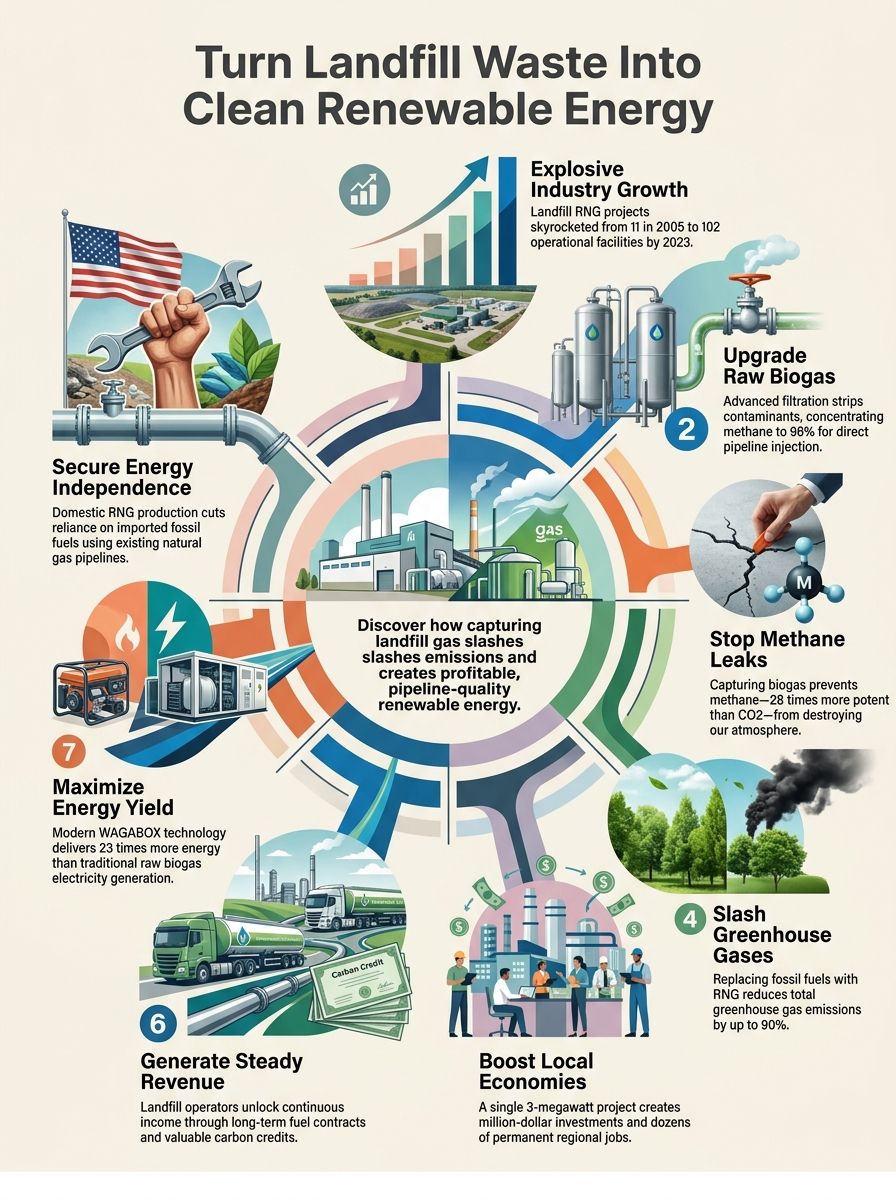
Landfill RNG projects have grown from just 11 facilities in 2005 to 102 projects by 2023, proving this clean energy model is highly lucrative for waste management professionals. 3
This guide breaks down exactly how raw landfill gas becomes pipeline-grade renewable natural gas (RNG).
We will show you how these upgrades reduce emissions by up to 90% and open up massive economic opportunities for your specific operation. 1
Read on to master the facts and turn your daily waste into a continuous revenue stream.
Key Takeaways
- Landfill RNG projects capture methane emissions that would escape into the atmosphere. This reduces greenhouse gas emissions by up to 90%. The process transforms waste into pipeline-quality renewable natural gas that replaces fossil fuels in existing infrastructure without requiring new distribution investments.
- The U.S. landfill RNG sector grew massively from 11 facilities in 2005 to 102 projects by 2023, along with 135 agricultural RNG initiatives. Waste management professionals now treat methane emissions as valuable energy resources rather than environmental liabilities.
- Advanced technologies use membrane filtration and cryogenic separation to produce 98%-pure biomethane. This delivers 23 times greater energy yield compared to traditional biogas methods. These units achieve 95% uptime while removing contaminants like siloxanes, volatile organic compounds, and hydrogen sulfide.
- A single 3-megawatt RNG engine project generates roughly $3.74 million in direct economic impacts and creates 9.6 construction jobs. It also produces indirect economic output between $8.35 million and $9.54 million, supporting 34.5 to 44.6 local industry positions.
- Landfill operators secure steady revenue through long-term RNG sales contracts, emissions avoidance credits, renewable thermal credits, and vehicle fuel sales. Companies use specialist renewable energy financers for up to 100% of project costs to remove capital barriers. This allows waste facilities to participate in climate change mitigation and strengthen energy independence.
What is Renewable Natural Gas (RNG)?
Renewable Natural Gas, or RNG, is biogas upgraded to seamlessly replace fossil natural gas in your existing infrastructure.
The US market for RNG reached an estimated $15.17 billion in 2024 and is projected by Grand View Research to surpass $30 billion by 2033. This massive financial growth means operators have proven, scalable models to follow rather than taking on the risk of being early adopters.
Biogas originates from the decomposition of organic matter in anaerobic conditions. This process produces a raw gas containing primarily methane and carbon dioxide. Your facilities can harvest this valuable gas from municipal solid waste landfills, anaerobic digesters at wastewater treatment plants, livestock farms, and food production sites.
The upgrading process concentrates the methane content to 90% or greater. This makes the final product chemically almost identical to conventional natural gas. RNG is interchangeable with natural gas, meaning it can be injected directly into natural gas pipelines without requiring new infrastructure investments. Methane concentrations of 96 to 98% are normal for injection into US natural gas distribution systems.
RNG transforms waste into a climate solution while maintaining the energy infrastructure we already have in place.
By 2025, the North American RNG industry reached a major milestone by reaching 500 operational facilities ahead of schedule. RNG deployment offers three distinct pathways for your landfill gas operations. You can use the gas locally at the creation site, pipe it to a specific end user, or inject it into distribution pipelines for broader market access.
In 2023, the United States operated 102 landfill RNG projects alongside 135 agriculture RNG initiatives. This captures methane emissions that would otherwise increase global warming potential. It converts a climate liability into a valuable energy commodity that supports fuel diversity and energy independence.
How is RNG Made from Landfills?
Engineers capture raw biogas produced by anaerobic digestion and upgrade it to pipeline-quality renewable natural gas that utilities use as clean fuel.
The EPA’s Landfill Methane Outreach Program database tracks over 2,600 municipal solid waste landfills across the country. They noted that 542 landfill gas energy projects were fully operational by late 2024. This massive database offers you crucial benchmarking data to assess if your own site is a prime candidate for an upgrade.

How does anaerobic digestion produce landfill gas?
Microbes break down organic municipal solid waste in the absence of oxygen to produce biogas as a byproduct. Landfills account for roughly 70% of the US RNG supply because they receive billions of tons of municipal solid waste annually.
The sheer volume of this feedstock makes landfills the most stable and dominant source for gas conversion. This guarantees long-term project viability for your facility. This microbial action occurs deep within the waste layers.
Landfill gas composition typically includes methane and carbon dioxide, with methane content ranging between 45-65% of the total volume. A 2025 assessment by the American Gas Foundation shows the biomass supply available to produce RNG has increased 17% since 2019. This raw biogas is a potent greenhouse gas that increases global warming potential.
Waste management professionals know that capturing this gas prevents direct venting into the atmosphere. Collection systems installed throughout the site gather the biogas, and operators pipe this gas to treatment facilities for processing and upgrading. Advanced gas treatment technologies remove contaminants to provide a massive methane emissions reduction for operations and their local communities.
How is landfill gas upgraded to pipeline-quality RNG?
Specialized upgrading processes strip away impurities to transform raw biogas into a compliant, pipeline-quality fuel. 2
For example, Landfill Gas to Energy (LFGtE) company Waga Energy recently announced a new unit in Wicomico County, Maryland, designed to process up to 1,600 cubic meters of biogas per hour. This high processing capacity allows mid-sized landfills to efficiently inject pipeline-quality gas directly into the local grid. The upgrading sequence requires three main phases.
Phase 1: Initial Extraction and Pre-Treatment
- Raw landfill gas emerges from anaerobic digestion containing only 40-60% methane mixed with carbon dioxide, nitrogen, oxygen, and various contaminants that operators must remove. 1
- Moisture removal happens first to prevent water vapor from damaging equipment and reducing gas quality in the distribution network.
- Carbon dioxide separation is a critical step because elevated CO2 levels prevent the gas from meeting strict pipeline specifications.
- Operators strip away siloxanes, volatile organic compounds, and hydrogen sulfide to stop these contaminants from corroding pipes and harming downstream equipment.
Phase 2: Advanced Upgrading and Separation
- WAGABOX technology, is an example of the technology now available that uses membrane filtration to separate carbon dioxide from methane while actively expelling impurities.
- Cryogenic separation modules utilize nitrogen to divide methane from air gases, achieving exceptional purity levels that older methods cannot match.
- Nitrogen and oxygen content drops significantly to ensure the final product meets exact natural gas supply pipeline quality requirements for gas composition.
- Upgraded RNG contains 96-98% methane. The supplier of WAGABOX LFGtE units states that their units specifically produce 98%-pure biomethane that operators inject directly into natural gas distribution networks.
Phase 3: Operations and Environmental Gains
- The energy yield from the WAGABOX process is stated to be 2 to 3 times greater than traditional electricity generation and heat solutions from raw biogas.
- Specialized operators manage the production process using predictive, preventive, and corrective maintenance protocols to maintain consistent output.
- Pipeline-quality RNG achieves lower carbon intensity than fossil natural gas to support strict climate change mitigation goals.
- Treatment systems reduce particulate matter and nitrogen oxides, driving serious air quality improvement in communities surrounding the landfill.
- This upgrading infrastructure allows operators to access existing natural gas pipelines instead of building separate distribution systems for renewable fuel standard compliance.
Environmental Benefits of Landfill RNG
By converting landfill gas into pipeline-quality renewable natural gas, waste facilities transform a potent greenhouse gas into clean energy that cuts carbon dioxide emissions.
The EPA reported that over its 30-year history, assisted projects have collectively reduced and avoided more than 714 million metric tons of CO2 equivalent. This massive historical data proves to regulators that RNG is a highly effective, long-term climate solution. Presenting these facts actively smooths out your local permitting process.
How does landfill RNG reduce greenhouse gas emissions?
Capturing this gas and converting it to renewable natural gas eliminates methane that would otherwise enter the air. A 2025 assessment by the American Gas Foundation found that utilizing the full US RNG potential could cut greenhouse gas emissions by more than 300 million metric tons every year.
This scale of reduction demonstrates exactly why state governments aggressively incentivize these projects. It offers your operation a lucrative pathway to monetize emission reductions. U.S. landfills emit approximately 3.7 million metric tons of methane annually, which massively increases greenhouse gas emissions and global warming potential.
The conversion process intercepts dangerous emissions before they reach the atmosphere. Waste management professionals redirect this captured gas toward productive use rather than letting it escape. Substituting fossil natural gas with RNG in pipelines and vehicle fleets reduces carbon intensity substantially.
RNG production creates closed-loop systems that align energy generation with actual consumption needs. Organizations like the Coalition for Renewable Natural Gas and the Environmental Research and Education Foundation promote these projects because they deliver measurable emission reductions. Facilities across the nation prove that capturing landfill gas eliminates methane while providing clean fuel alternatives. This approach addresses climate change mitigation directly, turning a glaring environmental liability into a highly prized renewable energy asset.
Methane has a heat-trapping potential 28 to 36 times greater than carbon dioxide over 100 years, making landfill RNG capture essential for climate protection.

How does landfill RNG help mitigate methane’s environmental impact?
Facilities equipped with collection systems destroy methane before it escapes, preventing explosive accumulation while generating renewable energy. Methane possesses a global warming potential 28 times greater than carbon dioxide, making its capture critical for climate change mitigation. 4
The Coalition for Renewable Natural Gas noted in 2026 that municipal solid waste RNG facilities grew by 26% year-over-year. This rapid growth highlights the financial viability of mitigating methane at the source. RNG projects capture 60 to 90 percent of methane emissions from landfills.
They convert this potent greenhouse gas into less harmful carbon dioxide through controlled combustion. This transformation dramatically reduces the climate impact of waste decomposition since methane remains in the atmosphere for roughly 12 years. Waste management professionals recognize that this approach addresses a massive source of anthropogenic greenhouse gas emissions.
The conversion process neutralizes a major climate threat. RNG production delivers measurable environmental research and education benefits that extend beyond simple emissions reduction.
The conversion process provides several key environmental benefits:
- Capturing and upgrading the gas eliminates hazardous compounds like nitrogen oxides and particulate matter that damage air quality.
- These projects improve local air conditions while reducing reliance on fossil natural gas extraction. 5
- Methane emissions reduction through RNG facilities supports compliance with EPA regulations and demonstrates proactive environmental stewardship.
Economic Advantages of Landfill RNG Projects
Landfill RNG projects transform waste into a profitable resource that generates continuous income streams while strengthening local economies through infrastructure investment.
Kinder Morgan allocated $84 million towards energy transition projects recently, with 92% dedicated specifically to RNG development. This massive level of institutional investment signals a highly stable market. It reassures smaller operators that capital funding and gas off-takers are readily available.
How do landfill RNG projects create jobs and boost local economies?
These facilities require skilled workers to design systems, build infrastructure, and manage daily operations, creating permanent employment opportunities. A typical 3-megawatt engine project creates direct economic impacts of approximately $3.74 million in expenditures and produces about 9.6 jobs in construction and engineering roles. 4
Waga Energy’s 2026 financial report highlighted a 23% year-over-year growth in RNG production revenue, reaching €52.8 million. These strong financials demonstrate that RNG is a powerful profit center, not just a compliance cost. Ongoing maintenance demands create reliable employment that supports local families and strengthens your regional workforce.
Indirect economic benefits create ripple effects across your entire local economy. A single 3-MW project generates indirect economic output ranging from $8.35 million to $9.54 million. It creates between 34.5 and 44.6 jobs in supporting industries.
RNG fueling stations, like the facility at Seneca Landfill in Pennsylvania, allow local fleets to access compressed natural gas vehicles. This access boosts business activity throughout your entire service area. Local partnerships formed through these projects enhance sustainable planning and environmental management.
These projects transform your landfill into an economic engine that actively supports:
- Engineering firms designing the new energy infrastructure.
- Construction companies building the treatment facilities.
- Equipment suppliers providing the advanced upgrading tech.
- Transportation services managing local municipal fleet operations.
How do landfill operators generate steady revenue from RNG?
Landfill operators secure consistent income streams through long-term contracts with energy off-takers, emissions avoidance credits, and vehicle fuel sales. The American Gas Foundation notes a median RNG production cost of $20 per MMBtu, making it highly competitive against alternative clean energies.
By stacking these revenue streams, operators achieve a return on investment much faster than traditional waste management models allow. Landfill Gas to Energy and other developers will often market the gas directly or provide operational services so you can take a royalty payment and focus on core waste recycling and landfilling activities.
Operators generate steady revenue through multiple channels:
- Securing long-term contracts with energy off-takers and direct vehicle fuel sales.
- Generating bonus income from emissions avoidance credits and renewable thermal credits.
- Leveraging programs like the California Low Carbon Fuel Standard (LCFS) for lucrative fuel production credits.
LFtE finance companies like Waga Energy finance up to 100 percent of project costs, completely eliminating capital risk for operators. This financing model removes the financial burden that traditionally prevented operators from investing in gas capture infrastructure. Operators in South Jersey and across the Central USA have proved that landfill gas functions as a valuable resource that produces steady revenue.
Technological Innovations in RNG Production
Advanced gas treatment systems maximize the energy value of waste-derived fuel, making RNG production faster and more cost-effective than ever before. The North American RNG industry added a record 130 operational facilities in 2025 alone. This rapid deployment is possible because standardized, modular upgrading technologies drastically cut down construction timelines.
Membrane Filtration and Cryogenic separation technology and its role in improving RNG efficiency
Current technology employs membrane filtration and cryogenic separation to produce 98%-pure biomethane that meets strict pipeline standards. In early 2026, Hillsborough County, Florida, announced that it had selected Waga Energy to deploy a unit capable of processing 3,000 standard cubic feet per minute (SCFM) of landfill gas.
This high-capacity processing means even the largest municipal landfills can fully capture their methane output without bottlenecking daily operations. This advanced system delivers 2 to 3 times greater energy yield compared to traditional biogas methods. It is a true game-changer for waste management professionals seeking to maximize returns on their landfill gas projects.
Over 200 sensors monitor each unit continuously to ensure optimal performance. The produced RNG gets injected directly into the gas distribution network for local use. This approach enables operators to generate steady revenue streams while advancing climate change mitigation goals.
Systems like the WAGABOX system may offer distinct advantages for operators:
- Adapts across various capacities starting from 500 SCFM, making it highly accessible to sites of different sizes.
- Achieves 95% uptime during operation and maintenance cycles to guarantee reliability. 6
- Gets financed up to 100% by Waga Energy to remove the financial barriers that slow greenhouse gas emissions reduction efforts.
Advances in gas treatment and upgrading technologies
Waga Energy’s recent LFGtE deployment in Cape May County, New Jersey, is designed to produce 205,000 MMBtu of RNG annually from just 1,000 scfm of gas. This extreme efficiency allows smaller regional landfills to participate profitably in the market, which was previously dominated only by mega-facilities.
Standardized components enable much quicker construction and installation of gas upgrading units. Advanced monitoring systems give operators real-time control over landfill gas collection and processing. Specialized teams manage predictive, preventive, and corrective maintenance to maximize efficiency and minimize downtime.
These technological improvements make landfill gas conversion highly reliable and cost-effective. The integration of these innovations positions operators as key players in climate change mitigation.
Modern upgrading facilities utilize several advanced processes:
- Membrane filtration technology separates carbon dioxide from methane while expelling impurities like siloxanes, volatile organic compounds, and hydrogen sulfide.
- Cryogenic separation with nitrogen perfectly isolates the methane from other air gases.
- This process removes moisture, nitrogen, and oxygen content to deliver upgraded renewable natural gas with a 96-98% methane content. 2
- Remote adjustment capabilities allow facilities to rapidly optimize treatment conditions based on incoming gas composition.
- The separated CO2 is available as an additional product where a market is available locally for this product type.

How Does RNG Compare to Traditional Fuels?
RNG fuels vehicles and powers facilities with substantially lower carbon dioxide emissions than traditional diesel or fossil natural gas. RNG used as a compressed natural gas (CNG) vehicle fuel acts as a direct drop-in replacement for diesel.
According to the American Gas Foundation, using RNG can reduce emissions at one-third to one-tenth the cost of fully electrifying homes. This cost-effectiveness makes RNG a far more practical transition fuel for heavy fleets and industrial applications compared to immediate electrification.
Why does RNG have a lower carbon footprint?
By extracting this biogas from landfills and wastewater treatment plants, operators prevent dangerous methane emissions from reaching the air. The captured gas undergoes upgrading to pipeline-quality RNG, transforming waste into highly usable energy. This process eliminates the need to extract fossil natural gas from the ground, which requires drilling and processing that generate massive greenhouse gas emissions.
Your facility converts a climate liability directly into a climate asset by choosing RNG. Methane remains in the atmosphere for roughly 12 years, so capturing it now delivers an immediate, measurable climate impact.
Since RNG is predominantly methane with minimal trace hydrocarbons, the fuel burns cleanly and produces lower nitrogen oxides and particulate matter. Projects like the Atlantic RNG facility show how operators generate steady revenue while reducing global warming potential. Your operation directly supports climate change mitigation when you develop RNG capacity at your site.
RNG provides massive carbon footprint reductions through several mechanisms:
- RNG achieves a lower carbon footprint by actively capturing methane that would otherwise trap heat 80 times more effectively than carbon dioxide over a 20-year period. 7
- RNG from dairy manure or food waste blended with traditional gas can reduce lifecycle greenhouse gas emissions by up to 100%.
- RNG production reduces emission intensity significantly compared to diesel fuel, earning valuable California Low Carbon Fuel Standard credits. 2
How does RNG support fuel diversity and energy independence?
Landfill RNG projects strengthen America’s energy independence by creating reliable domestic fuel sources straight from local waste streams. 1 Waste management professionals recognize that renewable natural gas production completely eliminates costly new infrastructure investments.
This approach taps local resources, slashes transportation expenses, and keeps energy dollars within communities. South Jersey Industries and similar operators demonstrate how landfill gas capture transforms waste into pipeline-quality fuel that powers vehicles and heats homes.
The renewable fuel standard heavily encourages this shift, making RNG a powerful tool for national energy security. Opal Fuels and other producers prove that RNG serves as a consistent power supply, not just an intermittent alternative. Your operations easily convert methane emissions into revenue streams while strengthening regional energy security.
Integrating RNG into America’s energy mix diversifies fuel sources perfectly:
- The US utilizes 2.8 million miles of existing natural gas pipelines, easily accommodating all new domestic supply.
- Agricultural waste and wastewater treatment plants also contribute to production, vastly expanding the available feedstock.
- Facilities like the Atlantic RNG Project showcase how multiple waste sources combine to create stable, baseload energy that supports grid reliability.
Success Stories: Landfill RNG Projects in Action
Landfill RNG facilities across the United States cut greenhouse gas emissions by millions of tons each year while generating massive local revenue. The RNG Coalition’s Sustainable Methane Abatement and Recycling Timeline specifically targets 1,000 operational facilities by 2030.
These regional success stories provide an exact blueprint for operators to secure financing by pointing to proven, profitable models.
What are some notable RNG facilities in the U.S.?
Across America, waste management professionals operate highly innovative renewable natural gas facilities that transform raw biogas into valuable fuel sources. 8 Emerald People’s Utility District in Lane County, Oregon, recently transitioned its Short Mountain Landfill from electricity generation to a WAGABOX RNG facility.
This site will produce 407,000 MMBtu annually, illustrating how older landfill-gas-to-electricity projects can be profitably upgraded to take advantage of higher fuel market prices.
- St. Landry Parish, Louisiana, hosts a community-driven project using landfill gas as vehicle fuel to drive greenhouse gas emissions reduction.
- Sauk Trail Hills in Michigan provides renewable natural gas for nationwide vehicle fuel, contributing directly to the renewable fuel standard through compressed natural gas production.
- Riverview Landfill in Michigan produces R-CNG for local vehicle fleets, generating steady revenue while slashing atmospheric methane content.
- Altamont Landfill in California houses a massive R-LNG plant, producing millions of gallons of fuel annually through extreme technological innovation.
- Janesville Wastewater Project in Wisconsin converts biogas into R-CNG, showing how wastewater treatment plants actively lower carbon dioxide emissions from transportation.
- DeKalb County Renewable Fuels Facility in Atlanta produces RNG for local fleet consumption, helping municipalities crush their environmental research and education foundation sustainability goals.
- Fair Oaks Dairy in Indiana creates net-carbon-negative vehicle fuel through the anaerobic digestion of agricultural waste.
- CR&R Perris Biodigester in California processes organic materials into renewable natural gas while preventing massive methane emissions.
What real-world emission reductions have been achieved?
Landfill RNG facilities have delivered measurable emission reductions that prove the technology works flawlessly in practice. 8 These projects actively displace fossil fuels and cut dangerous greenhouse gases significantly. 9
Waga Energy’s upcoming Wicomico County, Maryland facility is projected to offset 12,200 metric tons of CO2e annually. This equals the emissions from 3.7 million liters of diesel fuel. Translating abstract metric tons into “gallons of diesel displaced” gives waste management professionals a powerful, easily understood metric to share with local community boards during permitting.
| Facility Name | Location | Emission Reduction Achievement | Key Impact Metric |
|---|---|---|---|
| Altamont Landfill | California | Displaces 4,000,000 gallons of fossil fuels annually | Equivalent to removing 4,800 cars from roadways each year |
| St. Landry Parish Landfill Gas Project | Louisiana | Converts landfill gas into vehicle fuel | Produces significant emission reductions for municipal fleet operations |
| Fair Oaks Dairy RNG Project | Indiana | Generates net-carbon-negative vehicle fuel | Contributes to substantial decreases in total emissions output |
| Riverview Landfill | Michigan | Upgrades landfill gas to renewable compressed natural gas (R-CNG) | Lowers emissions for regional vehicle fleet consumption |
| Janesville Wastewater Project | Wisconsin | Converts biogas into renewable electricity and R-CNG fuel | Reduces total emissions through dual energy production |
| DeKalb County Renewable Fuels Facility | Atlanta, Georgia | Produces RNG from municipal landfill operations | Lowers emissions for local government fleet consumption |
| CR&R Perris Biodigester | California | Aids in reducing emissions through biodigestion processes | Promotes environmental sustainability in waste management sector |
| Chicago Urban RNG Project | Illinois | Captures more greenhouse gases than it emits | Creates jobs and supports educational initiatives in community |
Facility operators capture methane that would otherwise heavily pollute the atmosphere. Landfill gas treatment systems rigorously extract biogas from decomposing waste materials. These systems upgrade the raw gas into pipeline-quality renewable natural gas.
Municipal fleets switch to RNG fuel and immediately see their carbon footprint drop. Private waste management companies partner with energy providers to fully monetize their gas streams. Energy independence increases significantly when communities reduce their reliance on imported fossil fuels.
Vehicle emissions decline as more local trucks and buses run entirely on RNG. Local air quality improves rapidly when fewer diesel-powered vehicles operate on city streets. Renewable energy certificates generate massive new revenue streams for smart landfill operators.
Investment in gas upgrading technology pays immediate dividends through steady fuel sales. Environmental compliance becomes much easier when facilities demonstrate tangible emission reductions.
What Does the Future Hold for RNG Projects?
The Renewable Fuel Standard (RFS) and EU RED II Directive actively push industries to adopt cleaner energy sources, fueling massive expansion. The Coalition for Renewable Natural Gas reported a 54% increase in operational food waste-to-RNG facilities in 2025.
This rapid diversification of feedstocks ensures the RNG market will remain robust even if landfill volumes eventually decrease due to better municipal recycling programs.
How are landfill and agricultural RNG projects growing?
The renewable natural gas sector has experienced explosive growth over the past two decades. In 2005, the U.S. had only 11 landfill and 2 agricultural RNG projects combined. That number skyrocketed to 102 landfill projects and 135 agricultural projects by 2023.
This expansion proves the waste management industry recognizes that organic waste decomposition generates highly valuable landfill gas. Population growth and rising living standards fuel clear projections for increased landfill gas generation in the coming years. The steady growth demonstrates that landfill sites recognize the dual advantage of greenhouse gas emissions reduction and major revenue generation.
This expansion is driven by several key factors:
- The North American market added a record 130 facilities in 2025, beating the previous record set in 2024.
- Technological advancements in capture and conversion systems make these projects highly economically viable for facility operators. 3
- Operators integrate RNG into natural gas pipelines easily, meeting fossil natural gas specifications without expensive infrastructure overhauls.
What are the opportunities for RNG expansion and innovation?
Landfill RNG projects continue to expand at a remarkable, highly profitable speed across the United States. 10 Investment in renewable thermal credits offers corporate decarbonization pathways that generate steady, predictable revenue streams.
RNG plants transform methane emissions directly into pipeline-quality natural gas. South Jersey Gas and regional distributors constantly seek reliable RNG supplies to meet heavy customer demand. Compressed natural gas applications for fleet vehicles create massive additional market channels.
Agricultural waste and wastewater treatment plants represent huge untapped feedstock sources beyond traditional recovery. Opportunities exist right now to secure climate change mitigation funding and access highly lucrative emerging carbon markets.
Global trends strongly amplify expansion prospects for your operations:
- Companies like Kinder Morgan are aggressively acquiring RNG assets to reach 6.4 billion cubic feet of annual production.
- Over 50 new policies worldwide have supported biogas development since the 2022 energy crisis.
- WAGABOX technology rapidly enhances methane content recovery and minimizes nitrogen oxides and particulate matter emissions.
- RNG transforms unavoidable waste into a highly reliable domestic energy source that permanently strengthens energy independence. 11
Conclusion
Renewable natural gas from landfills represents a highly lucrative shift in how waste management professionals approach energy production.
By converting methane emissions into pipeline-quality fuel through advanced technologies like WAGABOX units, facilities achieve up to 90% reductions in greenhouse gas emissions. They generate massive, steady revenue streams in the process.
This dual benefit makes RNG projects incredibly attractive across the United States. Landfill facilities expanded from just 11 projects in 2005 to 102 by 2023. Waste professionals who embrace this renewable natural gas (RNG) solution position their operations at the forefront of sustainability.
They contribute directly to highly profitable climate change mitigation efforts.
Landfill RNG delivers exactly that promise.
FAQs
1. What is renewable natural gas (RNG) from landfills and how does it help reduce greenhouse gas emissions?
Renewable natural gas (RNG) is upgraded landfill gas (LFG) generated through anaerobic digestion, a process that intercepts escaping biogas before it enters the atmosphere. Capturing this gas drives massive methane emissions reduction, which is critical since the US Environmental Protection Agency notes methane has a global warming potential 28 times greater than carbon dioxide (CO2).
2. How does using landfill RNG improve air quality?
Replacing fossil natural gas with RNG as compressed natural gas (CNG) for heavy-duty waste fleets drastically reduces local tailpipe pollution, driving measurable air quality improvement. Studies evaluating heavy-duty natural gas engines show this fuel switch cuts nitrogen oxides by up to 90 percent and nearly eliminates harmful particulate matter.
3. Can wastewater treatment plants also produce renewable natural gas?
Yes, wastewater treatment plants utilize anaerobic digestion to convert biosolids into biogas with a high methane content that can be conditioned for direct injection into local natural gas pipelines.
4. What role does landfill RNG play in climate change mitigation efforts in places like New Jersey?
In densely populated states like New Jersey, advancing landfill RNG infrastructure is a primary climate change mitigation strategy that offsets fossil fuel reliance and minimizes local environmental impact. Facilities that upgrade LFG displace thousands of tons of carbon dioxide equivalent annually, aligning directly with state mandates to achieve a 100 percent clean energy grid by 2035.
5. Who studies the benefits of turning agricultural waste or municipal refuse into clean energy sources like RNG?
The Environmental Research & Education Foundation leads rigorous data-driven studies on converting agricultural waste and municipal solid waste into viable low-carbon fuels. Their published research provides waste management professionals with the exact metrics needed to prove how RNG prevents greenhouse gas (GHG) accumulation, specifically targeting fugitive methane (CH₄) emissions.
References
- ^ https://www.epa.gov/lmop/renewable-natural-gas (2026-01-22)
- ^ https://gasfoundation.org/wp-content/uploads/2025/07/AGF-RNG-Study_FINAL-09022025.pdf
- ^ https://www.mdpi.com/2071-1050/15/20/14782
- ^ https://www.epa.gov/lmop/benefits-landfill-gas-energy-projects (2025-04-18)
- ^ https://pmc.ncbi.nlm.nih.gov/articles/PMC11531075/
- ^ https://waga-energy.com/en/upgrading-landfill-gas-into-renewable-natural-gas/
- ^ https://pmc.ncbi.nlm.nih.gov/articles/PMC10334722/
- ^ https://energy-vision.org/case-studies/
- ^ https://daneclimateaction.org/initiatives/Landfill-Natural-Gas
- ^ https://fugitive-emissions-journal.com/significant-growth-potential-for-rng/
- ^ https://www.aga.org/research-policy/resource-library/the-renewable-natural-gas-rng-advantage/ (2025-07-15)
Note: A horizontal line across the links shown above usually indicates that site access is restricted to humans.