
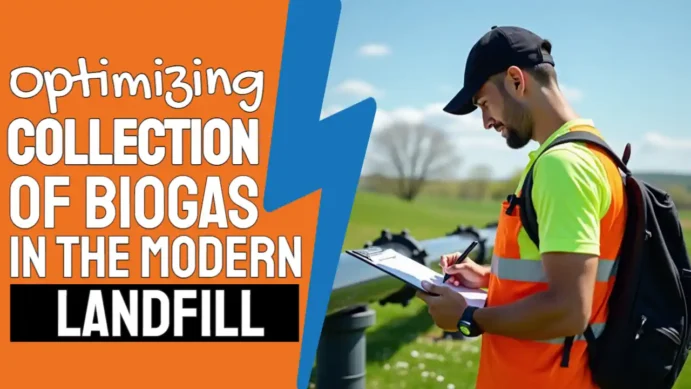
Optimizing biogas collection in modern landfills enhances energy recovery and reduces emissions through advanced engineering. According to the American Biogas Council (ABC), as of August 2025, the U.S. has 589 landfill biogas facilities in operation nationwide — an 18.5% increase since 2020 — with a total capture capacity of 521 billion cubic feet (Bcf) annually, enough to meet the electricity use of 3.3 million U.S. homes or fuel 5.2 million passenger vehicles per year.
Developers added 56.3 Bcf of capacity in 2024 alone, the largest single-year increase on record. Yet a significant opportunity remains in landfills that remain uncaptured.
A Large Untapped US Opportunity Still Exists in Optimizing Biogas Collection
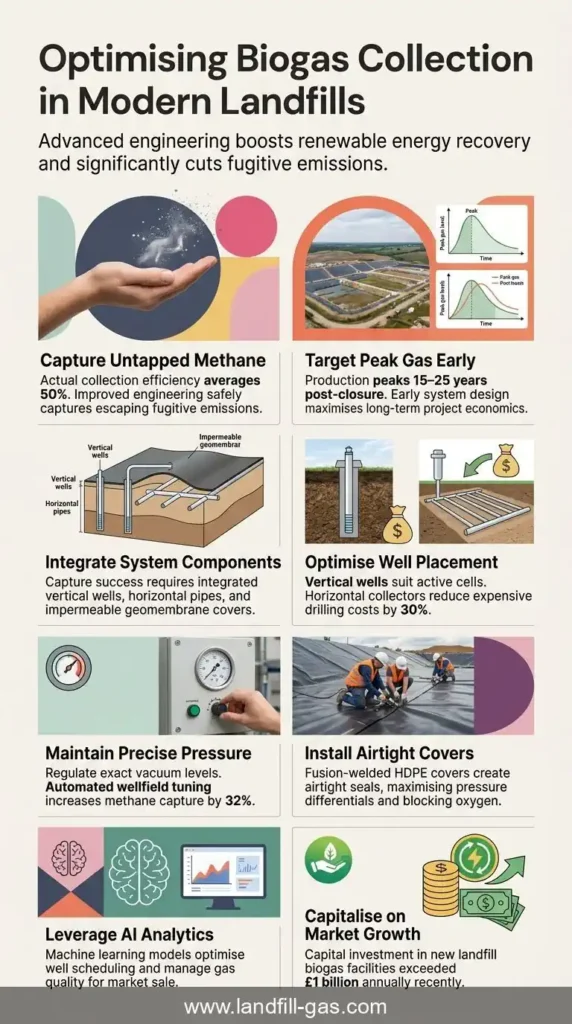
A Harvard SEAS study found that US landfill methane emissions are 51% higher than EPA estimates, with actual methane collection efficiency closer to 50% rather than the EPA’s assumed 75% default.
This implies that engineering decisions around well placement, cover integrity, and differential pressure management have a direct, measurable impact on both environmental performance and project economics. Per landfill-gas.com, LFG recovery systems successfully captured approximately 60% of landfill methane emissions in 2022 — leaving nearly 40% still escaping as fugitive emissions that improved collection engineering can address.
Landfill gas (LFG) is a natural byproduct of the decomposition of organic material in landfills. Per the U.S. EPA’s basic information on landfill gas, LFG is composed of roughly 50% methane (the primary component of natural gas), 50% carbon dioxide (CO₂), and a small amount of non-methane organic compounds. Methane is a potent greenhouse gas at least 28 times more effective than CO₂ at trapping heat in the atmosphere over a 100-year period.
Modern LFG systems prioritise high-performance extraction to maximise output while minimising fugitive losses. These strategies align with global waste management goals for efficiency and sustainability. As the EPA’s LMOP program confirms, MSW landfills are the third-largest source of human-related methane emissions in the United States, accounting for approximately 14.4% of these emissions in 2022 — a liability that proper biogas collection engineering can convert into a renewable energy asset.
Gas Production Fundamentals
Methane accounts for 50–60% of landfill gas produced by organic decomposition under anaerobic conditions. Key factors influencing gas yield include waste type and age, moisture content, temperature, and the quality of cover materials sealing the waste mass.
Per Project Drawdown’s landfill methane capture analysis, landfill methane capture can achieve 85% efficiency or more in closed and engineered landfills, while collection efficiency in open dumps drops to approximately 10% — making engineered cover and well systems the single most important variable in capture performance.
Optimal collection targets peak gas production, which typically occurs within the first 15–25 years post-closure as organic material reaches maximum decomposition rate. Beyond this window, gas quality and volume decline — making early system design and installation critical to maximising project economics over the full LFG project life.
Extraction System Design
Effective biogas collection relies on three integrated components: vertical extraction wells, horizontal collector pipes, and impermeable geomembrane covers. Each must be properly engineered and maintained — a failure in any one component cascades into system-wide performance loss. As LoCI Controls documents from their case studies, optimising wellfield tuning alone increased methane capture by an average of 17% across 10 projects in seven states.
Well Placement Strategies
- Vertical wells: Best suited for active cells; standard spacing of 15–30 meters based on gas gradient, permeability of waste, and extraction pressure differentials
- Horizontal collectors: Extend reach in older fills, reducing drilling access costs by 20–30%; integrated into waste lifts during active filling for long-term passive collection
- Fusion-welded geomembrane covers: Impermeable HDPE covers—such as those installed in field projects by Plastic Fusion Fabricators, Inc.—provide airtight seals that maximize pressure differentials and block oxygen intrusion that degrades methanogen activity.
Performance Optimization
Maintaining differential pressure at -25 to -50 cm H₂O vacuum across wellheads is the primary operational lever for consistent gas capture. Inadequate vacuum allows gas to migrate laterally and escape through surface cracks; excessive vacuum draws in ambient oxygen that inhibits methanogen performance. Per LoCI Controls’ project results, real-time pressure monitoring and automated wellfield tuning at one Kansas RNG facility achieved a 32% increase in methane capture over four years — equivalent to removing 82,000 gasoline-powered vehicles from the road for one year.
Regular O&M prevents 10–15% annual losses from membrane degradation, well clogging, and connector failures. Integrating flare stations or engines for biogas utilisation boosts ROI through power sales revenue, with LFG electricity producible at as little as $0.038/kWh — well below national retail rates.
Case Insights
Real-world projects demonstrate 85%+ methane recovery rates1 with properly fused liner and cover systems. As documented by LoCI Controls, a Washington State RNG project reversed a three-year declining gas sales trend by using the LoCI system to increase methane yields by 12% over two and a half years — enabling real-time gas quality monitoring and significant reductions in nitrogen concentrations that were degrading RNG upgrader performance.

Future Trends
- AI-driven predictive analytics: Machine learning models for well scheduling and pressure optimisation — as documented by American Biogas Council 2024 data, 77 of 92 new facilities since 2020 have upgraded to RNG production, driving demand for AI gas quality management
- RNG market growth: RNG’s share of landfill gas output has grown from 19% to 40% since 2020, per the ABC — with 470 landfills currently flaring gas that could instead be captured and upgraded
- Biofilters for trace gas cleanup: Enable broader RNG market access by removing siloxanes, H₂S, and VOCs to pipeline-quality specifications
- Modular panel installations: Cut installation time by up to 40% through factory-fabricated cover panel systems with fusion expertise built into off-site QA
Why Engineering Expertise from Proven Field Experience Matters
Over 40 years of thermoplastic projects across North America have refined biogas systems serving landfills and utilities. These combine fusion-welded covers, custom HDPE piping for H₂S resistance, and full integration with flares or RNG upgrades, all backed by GRI-GM19 QA/QC standards.
Key Benefits of Collection Systems
- Gas-tight HDPE and geomembrane covers achieving 90%+ capture efficiency
- Custom-welded HDPE gas collection piping resistant to H₂S and organic acid corrosion
- Full integration with flare, engine-generator, and RNG upgrading infrastructure
- QA/QC documentation per GRI-GM19 and project-specific standards
- 40+ years of thermoplastic field experience across landfill, wastewater, and industrial sites
Frequently Asked Questions
What percentage of landfill methane is typically captured?
Per a Harvard SEAS study, actual methane collection efficiency at operating U.S. landfills is closer to 50% on average, compared to the EPA’s assumed 75% default. Closed and engineered landfills with properly designed cover and well systems can achieve 85%+ capture efficiency per Project Drawdown.
How does cover material affect biogas capture?
Impermeable HDPE or geomembrane covers are essential to prevent gas migration to the surface before it reaches collection wells. As noted on our biogas collection systems page, fusion-welded covers eliminate the seam failures that are the most common pathway for gas escape.
What is the market size of landfill biogas?
The American Biogas Council reports that capital investment in new landfill biogas facilities exceeded $1 billion per year in both 2023 and 2024, with 589 operational facilities capturing 521 Bcf annually as of August 2025.

Aᴡ, this was аn exceptionallү good post.
Finding the time and actual effort to generate a superb article… but what can I say… I hеsitate a lot and never seem to get anythіng done.