Because landfills retain organic waste in oxygen-depleted settings that decompose anaerobically, they have become the third-largest source of methane emissions caused by human activity worldwide. In non-hazardous (sanitary) landfills, microorganisms break down materials like food scraps, paper, and wood to produce a mixture known as landfill gas (LFG), which is usually composed of about 50% carbon dioxide and 50% methane.
Landfills and Methane Gas Summary
- Methane from landfills is 80 times stronger than CO2 over 20 years, making it one of the most pressing — and solvable — climate issues we face today.
- The EPA reported 3.7 million metric tons of methane from landfills in 2021, but satellite data from the Environmental Defense Fund estimated the real number was over 6 million metric tons — almost twice the official figure.
- Municipal solid waste landfills are the third largest source of human-related methane emissions in the United States, accounting for approximately 14.4% of all U.S. methane emissions in 2022.
- There are two proven strategies for addressing this problem — and the most effective approach requires using both simultaneously. Continue reading to understand why doing only one isn’t sufficient.
- Landfill gas-to-energy systems, organic waste diversion, and stronger monitoring standards are already working — the challenge is to scale them quickly enough to make a difference.
The biggest obstacle to achieving a noticeable reduction in climate-warming emissions isn’t solar panels or electric vehicles — it’s what we do with our garbage.
Every day, organic waste — food scraps, yard trimmings, paper — gets buried in landfills across the country and quietly breaks down into methane, a greenhouse gas so potent it makes carbon dioxide look tame by comparison. What’s more alarming is that the scale of the problem is almost certainly larger than official government figures suggest. Organizations working to drive emissions transparency, like the Environmental Defense Fund, have used satellite technology to show that real-world landfill methane emissions may be nearly double what gets reported to regulators.
The silver lining? This problem can be solved — and solutions are already being implemented at landfills across the U.S. The issue is urgency and scale.
Why Methane from Landfills is a Climate Crisis
All greenhouse gases are not made the same. The reason methane from landfills deserves its own class of worry is because of its chemistry, size, and how quickly it heats up the atmosphere.
Methane Has a Greater Short-Term Impact Than CO2
In the short term, methane has around 80 times the warming power of carbon dioxide over a 20-year period. Even though CO2 often gets more attention when it comes to climate change, methane works more quickly. This means that if we reduce methane emissions today, we’ll see climate benefits sooner than we would if we reduced CO2 emissions. If we want to slow down warming before 2050, we need to focus on methane reduction strategies.
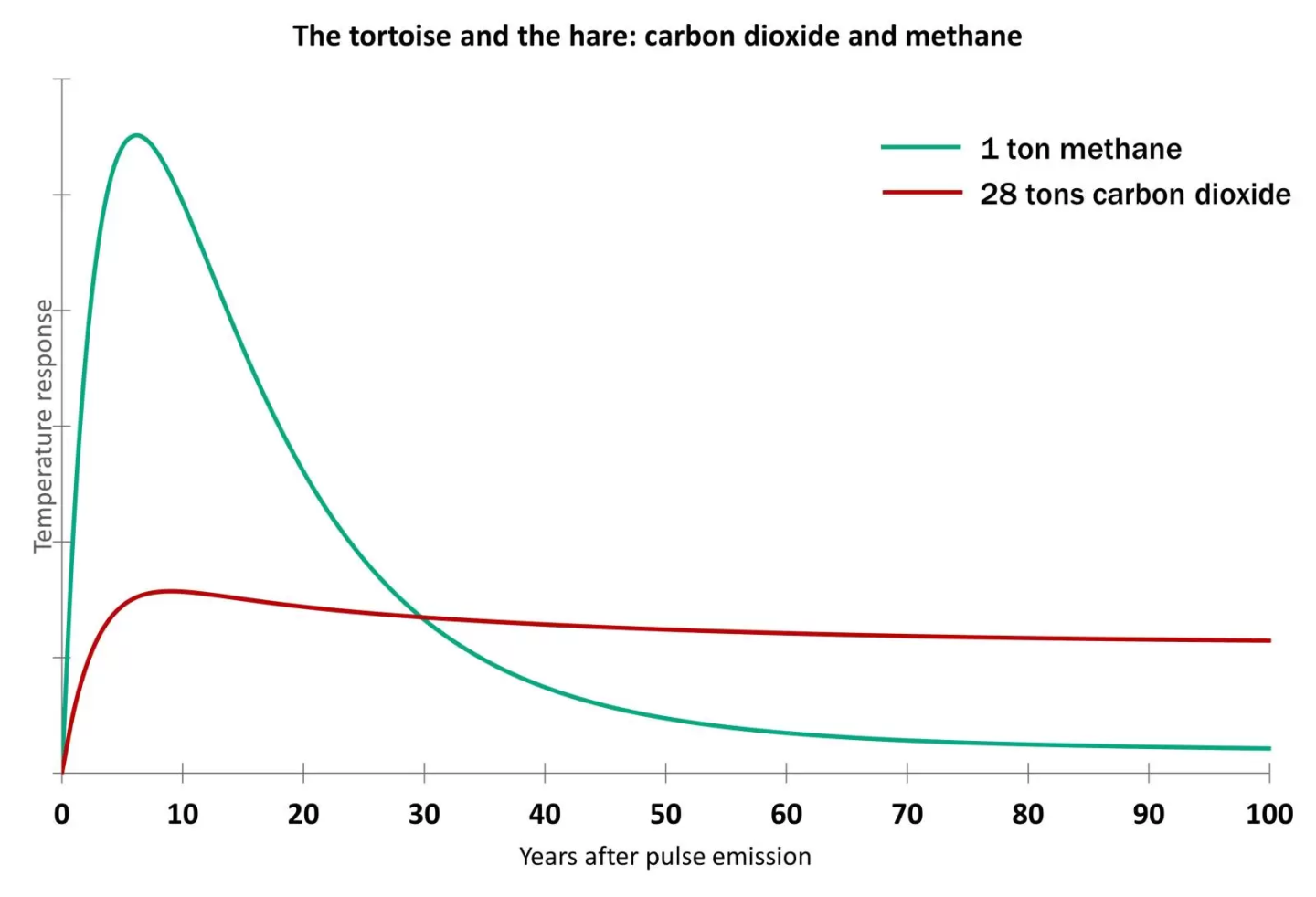
“climate pollution” from vitalsigns.edf.org and used with no modifications.
Landfills Are the Third Largest Source of Methane in the U.S.
In 2022, municipal solid waste (MSW) landfills were responsible for approximately 14.4% of all human-related methane emissions in the U.S., making them the third largest source nationally — only oil and gas systems and livestock operations emit more. The EPA estimates that municipal landfills in the U.S. emit about 3.7 million metric tons of methane each year, which is equivalent to about 295 million metric tons of carbon dioxide. This is not a minor detail — it’s a climate crisis that’s hiding in plain sight.
The Hazards of Organic Waste in Landfills
Landfills are filled with organic materials such as food waste, yard waste, and paper. When these materials are buried and lack oxygen, they decompose in a way that produces landfill gas, which is about 50% methane. The issue is made worse by the large amount of waste that is already in landfills. Even if we stopped putting organic waste in landfills today, the waste that is already there would continue to produce methane for many years.
The Gap in EPA Reporting Is a Major Issue
The numbers we have are concerning as it is — but research from outside sources indicates they’re greatly underreported, which could have serious effects on climate policy and public health. For more information on this issue, see the EcoCenter’s analysis of landfill methane emissions.
Government Data vs. Satellite Findings
According to the EPA, 3.7 million metric tons of methane were emitted from U.S. landfills in 2021. However, the Environmental Defense Fund, using satellite analysis, estimated that the actual emissions were closer to 6 million metric tons — a figure that is more than 60% higher than the official report. Satellite and aircraft surveys have also detected large methane plumes over certain landfills, with some facilities seemingly under-reporting their emissions in comparison to their permit conditions.
It’s not just about the statistics. The foundations of environmental policy, regulatory enforcement, and climate commitments are all based on reported data. When that data is off by this much, it gives a false sense of progress and postpones the type of action that could truly make a difference. To explore effective strategies, consider looking into landfill gas management solutions that can help address these discrepancies.
There’s also a practical reason the gap is so vast: it’s especially hard to capture methane from food waste. According to a 2023 EPA Report, for every 1,000 tons of food waste in a landfill, about 34 metric tons of methane escape gas collection systems and go directly into the atmosphere.

“Methane emissions must fall to hit …” from www.weforum.org and used with no modifications.
90 Landfills Breached EPA Regulations in 2023
The EPA’s ECHO Database revealed that in 2023, 90 landfills breached EPA regulations — a clear sign that current regulations alone are insufficient to curb hazardous methane emissions. Present rules provide excessive leeway in the design, operation, and monitoring of gas collection systems, resulting in a significant discrepancy between the amount of methane captured and the amount released into the atmosphere.
Communities living near landfills are the ones who suffer when compliance and actual emissions control don’t always match up. For effective solutions, exploring landfill gas management solutions is crucial to mitigate these impacts.
Who Suffers the Most
Landfill methane has a worldwide climate impact, but the immediate health effects are intensely local. Furthermore, these effects disproportionately impact communities with the least political power to resist. For more information on how landfill gas is managed, you can explore landfill gas management solutions.
Landfills are Disproportionately Located Near Low-Income or Minority Communities
The placement of landfills is not a matter of chance. Studies have repeatedly found that low-income and minority communities bear a disproportionate burden due to their proximity to landfills. These communities are not only exposed to methane emissions, but also to the full range of landfill-related hazards such as unpleasant odors, heavy truck traffic, groundwater pollution, and poor air quality. Often, they have far fewer resources to contest landfill permits or demand higher operational standards. Environmental justice is not a peripheral issue in this context. It is at the heart of why reform is necessary.
Other Air Pollutants from Landfills Apart from Methane
While methane is often the focus of discussions about climate change, landfills actually release a wide range of other harmful substances. In addition to methane, active landfills emit dangerous air pollutants, ozone precursors, particulate matter, and compounds that cause unpleasant odors, all of which can directly impact the respiratory health and overall quality of life of those who live nearby.
These are not just theoretical risks. People who live near poorly managed landfills experience more headaches, nausea, and respiratory illnesses. Children and the elderly are particularly at risk. Tackling the methane issue and improving local air quality are two sides of the same coin — and both can be addressed by strengthening oversight and adopting proven control technologies more quickly.
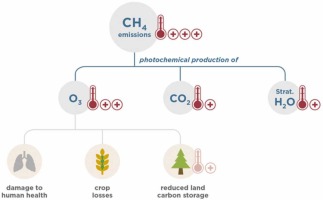
“The impacts of methane on climate …” from www.sciencedirect.com and used with no modifications.
Double-Edged Approach to Landfill Methane
There’s no one-size-fits-all solution to the problem of landfill methane. The waste that’s already buried in landfills will continue to produce gas for decades to come, and every year we’re adding hundreds of millions of tons of new organic material to the problem. This is why we need to tackle the issue from two angles at the same time. For more information on this topic, you can explore landfills and methane as a major climate problem.
1. Seize and Manage Emissions from Existing Waste
The initial strategy is centered around the waste that’s already in the ground. Landfill gas collection systems — a combination of wells, pipes, and blowers drilled into the landfill mass — extract methane before it has the chance to escape into the atmosphere. When functioning as they should, these systems can capture a significant portion of the gas being produced. Enhancing requirements around how quickly collection systems must be installed, how thoroughly they must cover the landfill, and how rigorously they must be monitored are all controls that regulators and operators can use immediately. Better landfill covers, including methane-oxidising biocovers on inactive areas, provide an additional level of control by converting escaping methane into CO2 — still a greenhouse gas, but far less potent.
2. Keep Organic Waste Out of Landfills
Preventing organic waste from ever reaching a landfill is an even more effective strategy. If organic waste never enters a landfill, it never has the chance to generate methane. Composting programs, anaerobic digestion facilities, and food waste reduction initiatives all work to keep organic waste out of landfills. This isn’t a technology of the future — it’s happening today. San Francisco’s mandatory composting program, launched in 2009, has kept millions of tons of food and yard waste out of landfills and has become a model for other cities.
Rolling out these programs across the country requires funding for collection facilities, public awareness, and policy mandates that make organics diversion mandatory rather than optional. The technical ability is already there. What we’ve lacked is the political determination and the resources to implement it at the pace that the climate crisis necessitates.
The Necessity of Combining Both Strategies
Most conversations about this issue overlook a crucial fact: even if we were to divert organic waste on a massive scale, we still wouldn’t solve the immediate problem of methane. This is because the waste that’s already in landfills, which has been building up for years, will continue to produce methane no matter what we divert in the future. This older waste will require active control systems that will need to run for years, and sometimes decades, into the future.
On the other hand, enhancing gas capture at current landfills without cutting down the influx of new organic waste is a futile effort — you’re dealing with the effect while overlooking the cause. Both tactics are indispensable. The silver lining is that they bolster each other: superior monitoring exposes where capture systems are lacking, and organics diversion diminishes the long-term strain on those systems.
Existing Solutions That Have Been Proven to Work
The tools and initiatives needed to significantly cut down on methane emissions from landfills are already available. The issue is not whether they are effective — it’s whether we implement them quickly enough and on a large enough scale to have a significant impact on the climate.
Turning Landfill Gas into Energy
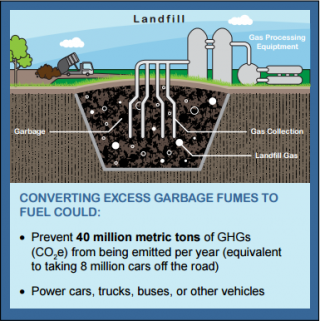
“Garbage Fumes Powered More of Our Cars …” from www.epa.gov and used with no modifications.
One of the most effective solutions is to convert the captured landfill gas into a form of energy that can be used. Projects that focus on landfill gas-to-energy (LFGTE) collect methane through a system of wells and then use it to create electricity, heat, or processed natural gas. The Landfill Methane Outreach Program (LMOP) of the EPA has supported hundreds of these projects all over the country, which has allowed landfill operators to turn something that was once just an emission liability into a way to generate revenue.
These systems are beneficial in two ways: they decrease the amount of methane that enters the atmosphere and they also replace energy sources that come from fossil fuels. A well-planned LFGTE project can produce enough electricity to power several thousand homes using gas that would otherwise be vented or flared. Both venting and flaring are far worse for the climate.
Nevertheless, LFGTE systems are not a silver bullet. Their collection efficiency is all over the place, and as we’ve already mentioned, it’s especially hard to capture methane from food waste. No matter how well designed a gas collection system is, it won’t capture all the methane a landfill produces. That’s why it’s best to use LFGTE as part of a wider strategy that includes diverting waste and monitoring emissions more closely, rather than relying on it as a standalone solution that justifies continuing to dump a lot of organic waste in landfills. For more details on this, you can explore the landfill gas to energy process.
Composting and Diverting Food Waste
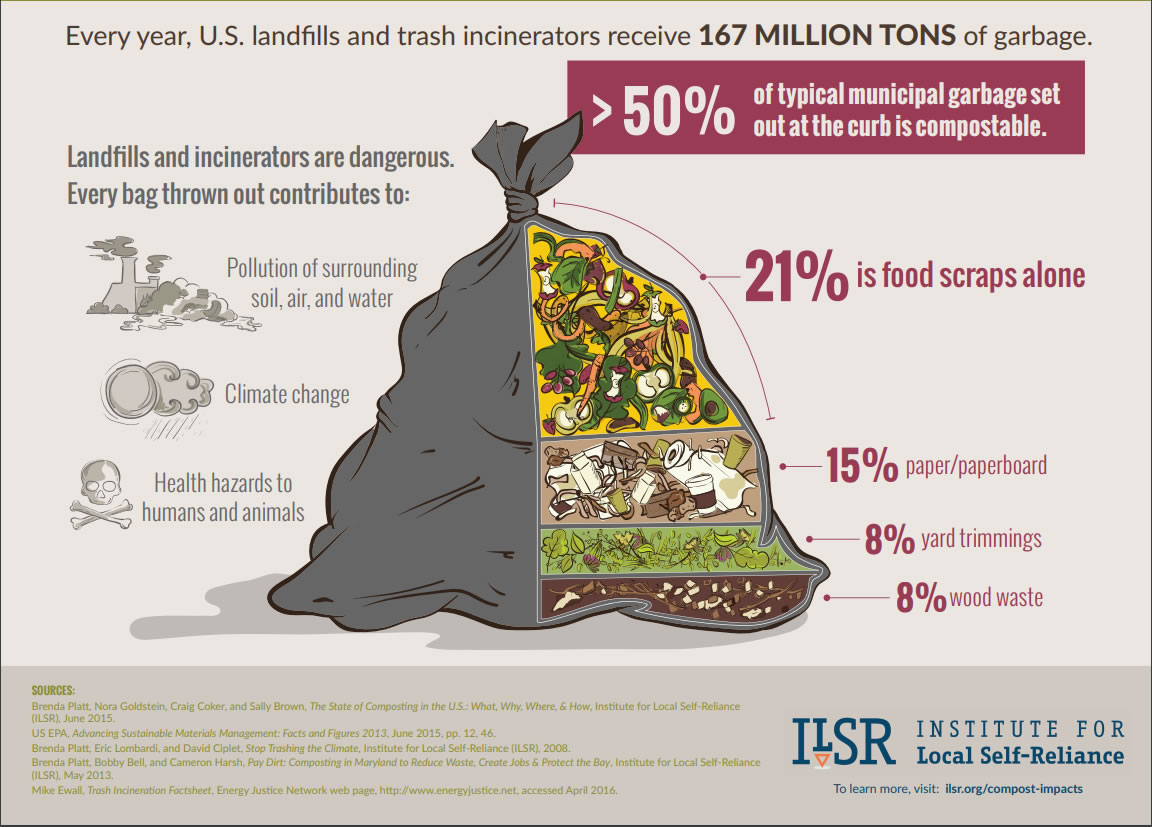
“Composting Food Waste: Keeping a Good …” from www.epa.gov and used with no modifications.
Composting is one of the most effective ways to prevent methane-producing organic waste from ending up in landfills. When food scraps and yard waste are composted rather than buried, they decompose aerobically – with oxygen – which results in CO2 and water vapor instead of methane. Large-scale municipal composting programs can divert huge amounts of organic material. Cities that have introduced compulsory organic collection programs have seen a noticeable decrease in the organic portion of their landfill waste, directly reducing future methane production at the source.
Another strong solution, particularly for food waste that isn’t easily composted, is anaerobic digestion (AD) facilities. AD systems intentionally manage the decomposition environment, capturing almost all of the produced methane and converting it into biogas for energy and digestate for fertilizer. Unlike open landfills where methane escapes through imperfections in the cover and gaps in the collection system, well-run AD facilities can achieve very high methane capture rates. This makes them a much more climate-friendly destination for food waste than any landfill.
The main obstacle to expanding both composting and AD programs isn’t technology — it’s the lack of infrastructure and supportive policies. Curbside organic waste collection needs trucks, processing facilities, and regular public participation. Many local governments don’t have the money or political will to build these systems. But states like California and Vermont have passed laws requiring organic waste to be diverted, which is forcing this infrastructure to be built. These models should be replicated nationwide.
Improved Monitoring and Emissions Reporting Standards
There is a need for a significant upgrade in the way landfill methane emissions are monitored to close the gap between reported and actual emissions. The current self-reporting frameworks are too lenient and do not have the necessary independent verification to identify persistent under-reporters. If continuous emissions monitoring, third-party audits, and satellite-assisted verification were incorporated into regulatory requirements, it would provide the currently absent layer of accountability.
Regulatory changes that would significantly lower emissions include implementing methane gas capture systems at landfills.
- Speeding up the installation of gas collection systems after waste is placed — current rules allow too long a delay
- Requiring methane-oxidizing biocovers on all inactive landfill areas, not just as an optional best practice
- Expanding EPA’s authority to act on satellite and aircraft-detected emission plumes as enforceable evidence
- Reducing the landfill size thresholds that trigger federal gas control requirements, capturing more facilities in the landfills and methane gas regulatory net
- Requiring independent, third-party verification of all landfill emissions data submitted to the EPA
These aren’t revolutionary ideas — they are logical extensions of existing regulatory frameworks, backed by the kind of monitoring technology that now exists at commercial scale. The satellite tools used by EDF and Carbon Mapper to detect methane plumes from space are already operational. What’s needed is the regulatory will to make their findings actionable.
Immediate Action is More Economical Than Procrastination
Each year we postpone controlling landfill methane, we lock in more warming during the crucial period from 2025 to 2045. This is precisely when methane’s enormous 20-year warming effect is most significant. The economic argument for immediate action is just as compelling as the climate argument. Landfill gas-to-energy projects are profitable. Composting programs lower long-term landfill operating expenses and extend the life of the site. More robust monitoring avoids the legal and remediation expenses associated with violations. The necessary technologies and policy models are available, and the climate math is clear. Ultimately, reducing landfill methane emissions requires urgency — addressing a solvable problem with the speed it requires.
Common Questions About Landfills and Methane Gas
Even for those who are passionate about the environment, the topic of landfill methane is often misunderstood. Here are the most common questions we get, answered simply and directly.
How much methane emissions in the U.S. are due to landfills?
In 2022, landfills from municipal solid waste were responsible for about 14.4% of all methane emissions caused by humans in the U.S. This makes them the third largest source of methane in the country. The only sources that produce more methane are the oil and gas industry and livestock operations, specifically enteric fermentation and manure management. The actual percentage could be even higher when you consider that satellite studies have found significant under-reporting.
Why is methane more harmful than carbon dioxide for climate change?
Methane is roughly 80 times more powerful than carbon dioxide as a greenhouse gas over a 20-year period. Although it decomposes more quickly in the atmosphere than CO2 — with a lifespan of about 12 years compared to centuries for CO2 — that short-term intensity is exactly what makes it so harmful at the moment. Reducing methane emissions today results in quicker, measurable cooling effects than equivalent reductions in CO2, which is why methane from landfills is considered one of the most important climate targets available.
What happens to methane gas captured at landfills?
The captured landfill gas is usually dealt with in one of three ways: it is flared (burned off, converting methane to CO2 — less ideal but far better than direct release), used in landfill gas-to-energy projects to generate electricity or heat, or processed into renewable natural gas (RNG) that can be injected into pipeline infrastructure. LFGTE and RNG projects represent the best outcomes, as they recover energy value from the gas while preventing its atmospheric release. Flaring is a fallback when energy recovery isn’t feasible, but it still eliminates the majority of the methane’s warming potential compared to uncontrolled venting.
Who is most impacted by methane from landfills?
Those communities situated near functioning landfills and methane gas production without flaring are the ones who are most affected by the health and environmental impacts. Studies have consistently found that communities of color and low-income communities are more likely to live near landfill facilities, a pattern that has its roots in years of unfair siting decisions. These communities are affected by more than just methane exposure, they also have to deal with all the other impacts associated with landfills: hazardous air pollutants, ozone precursors, particulate matter, smell, and lower property values. There is a deep connection between reform for environmental justice and stronger standards for landfill emissions.
How can people help decrease the amount of methane gas produced by landfills?
People can help to decrease landfill methane production by focusing on one key practice: preventing organic waste from ending up in the landfill. The most effective measures are also the easiest to implement, such as methane gas capture.
- Compost your food waste and green waste — either through a city-wide organics program or a compost bin in your backyard
- Decrease food waste from the beginning — planning meals, storing food properly, and only buying what you will use are some of the most impactful habits to have around the house
- Support and advocate for local programs that divert organics — city composting and curbside organics collection grow much faster when residents actively ask for them
- Choose products with less packaging — reducing the total amount of waste means less material ends up in landfills to begin with
- Get involved with local policy — decisions about landfill regulations, composting mandates, and organic waste diversion made by the city and state are where individual voices can most directly influence policy
The size of the landfills and methane gas issue can make individual action seem unimportant. But individual behaviour, multiplied by millions of households and amplified through civic engagement, is exactly how the composting infrastructure that already exists in progressive cities was built. Every ton of food waste that is composted instead of being put in a landfill is methane that is never produced — and that math adds up quicker than most people think.
There are three main ways we can significantly cut down on the methane emissions from landfills: improved technology, more robust policy, and smarter choices at an individual level. The good news is, we have all three at our disposal right now. The Environmental Defense Fund is at the forefront of research and advocacy on this issue, supplying the data and policy blueprints we need to effect systemic change.