Here we review GE Jenbacher vs. Caterpillar Landfill Gas Engines. Jenbacher (by INNIO) and Caterpillar both manufacture leading world-class industrial gas engines for landfill gas to energy (LftE) use. Jenbacher units are purpose-built gas engines known for their high electrical efficiency and ability to run low-quality gas, while Caterpillar engines offer rugged durability, robust global parts distribution, and benefit from the popularity of the brand used in many heavy-duty industrial applications.
GE Jenbacher vs. Caterpillar Landfill Gas Engines – Key Takeaways:
- GE Jenbacher engines consistently achieve electrical efficiencies between 39.6% and 41.3% in real-world landfill gas projects, outperforming many competing systems at equivalent load ranges.
- Landfill gas is a highly variable fuel — methane content can swing from 35% to 60% — which means engine selection directly impacts reliability and power output.
- The INNIO Jenbacher J420 is the workhorse of large-scale landfill gas projects, with deployments like Istanbul’s 26-engine, 36.4 MW installation proving its scalability.
- Combined heat and power (CHP) configurations can push total system efficiency to 85%, dramatically changing the economics of a landfill gas project.
- Choosing the wrong engine for your site’s gas quality and volume profile can cost you hundreds of thousands in lost generation revenue — the comparison below breaks down exactly which platform performs where.
Picking the right engine for a landfill gas project is one of the highest-stakes decisions you’ll make, and the difference between GE Jenbacher and Caterpillar often comes down to efficiency margins that look small on paper but translate to millions in revenue over a project’s lifetime.
INNIO’s Jenbacher platform has become the reference point for landfill gas power generation globally, with documented installations across four continents and verified electrical efficiencies that set the benchmark for the industry. For professionals evaluating both platforms, resources like INNIO Jenbacher’s landfill gas solutions page provide detailed technical specifications and real project data worth reviewing before making any procurement decision.
Jenbacher Edges Out Caterpillar in Landfill Gas Efficiency
When you strip away the marketing and look at verified project data, Jenbacher consistently posts higher electrical efficiency numbers in landfill gas applications than Caterpillar’s equivalent models. That gap — even when it’s just 2 to 3 percentage points — compounds significantly across a 20-year project life.
What Makes Landfill Gas Engines Different From Standard Gas Engines
Landfill gas is not a clean, consistent fuel. It’s a byproduct of anaerobic decomposition in municipal solid waste, and its composition shifts constantly based on waste age, moisture levels, and temperature. Methane content typically ranges from 35% to 60%, with the remainder made up of CO₂, nitrogen, oxygen, and trace contaminants including hydrogen sulfide, siloxanes, and halogenated compounds. Standard natural gas engines are not built to handle this variability.
Engines optimized for landfill gas feature hardened valve seats and valve guides, higher-grade lubrication systems, and combustion control software that can adapt in real time to changes in gas heating value. Without these adaptations, engine knock, pre-ignition, and accelerated wear become serious operational problems.
For more on engine comparisons, see Caterpillar vs. Cummins landfill gas engines.
Why Electrical Efficiency Is the Number That Matters Most
Total system efficiency sounds impressive on a spec sheet, but electrical efficiency is what drives your revenue. In most landfill gas projects, electricity is sold to the grid or used to offset site power costs, while heat recovery is secondary or site-specific.
A difference of 1% in electrical efficiency on a 5 MW installation can represent tens of thousands of dollars in annual generation income.
- Electrical efficiency determines how much of the gas’s energy content becomes billable kilowatt-hours
- Heat recovery value depends heavily on whether there’s a viable thermal offtake on or near the site
- Higher electrical efficiency also means lower fuel consumption per MWh, reducing engine wear and maintenance intervals
- Regulatory incentive schemes including Renewable Energy Certificates (RECs) and carbon credits are typically tied to electrical output, not total thermal output
For most standalone landfill gas projects, especially those without a co-located industrial heat user, electrical efficiency is the single most important performance metric to optimize for. Everything else is secondary.
How Landfill Gas Engines Actually Work
Landfill gas engines are reciprocating internal combustion engines — the same fundamental technology as a diesel generator, but configured to run on the methane-rich gas extracted from beneath a landfill. The engine drives a generator to produce electricity, and the heat from the engine jacket water and exhaust can be recovered for thermal applications in CHP configurations.
The key engineering challenge is managing the fuel variability. Unlike pipeline natural gas with a consistent Wobbe index, landfill gas requires engines with wide fuel flexibility, robust knock control, and gas conditioning upstream of the engine to remove moisture, particulates, and corrosive compounds before combustion.
How Gas Is Extracted From a Landfill Site
Gas extraction starts with a network of vertical wells drilled into the waste mass, typically spaced 30 to 60 meters apart depending on waste density and permeability. Each well is connected via lateral pipes to a central collection header, and a blower or compressor system creates a slight negative pressure to draw gas out of the waste before it migrates to the surface. The collected gas then passes through a condensate knockout system and basic filtration before reaching the engine skid. Learn more about landfill gas migration and its impact on the environment.
Gas quality monitoring is continuous on modern installations. Methane percentage, flow rate, pressure, and temperature are tracked at the wellhead and at the engine inlet, and engine control systems use this data to adjust ignition timing and fuel-air ratios in real time.
Why 1 Million Tons of Waste Equals Roughly 1 MW of Engine Capacity
The rule of thumb in the industry is that approximately 1 million tons of municipal solid waste in place will support roughly 1 MW of installed engine capacity over the peak gas generation period, which typically occurs between 5 and 15 years after waste placement. This is a planning estimate, not a guarantee — actual gas yields depend on waste composition, compaction, moisture content, and climate. Larger, wetter, more organic waste streams generate gas faster and at higher methane concentrations than dry or inert-heavy waste.

“Jenbacher – Wikipedia” from en.wikipedia.org and used with no modifications.
GE Jenbacher Landfill Gas Engine Performance
INNIO’s Jenbacher gas engines are purpose-engineered for low- and medium-calorific value gases, which makes them a natural fit for landfill gas applications. The platform covers output ranges from small single-engine installations up to multi-engine arrays exceeding 36 MW of electrical output from a single site.
Jenbacher Engine Models Used in Landfill Gas Applications
Jenbacher offers four primary engine types relevant to landfill gas projects, each covering a distinct power range. The J320 and J420 are the most commonly deployed models in medium-to-large landfill gas sites, while the J612 appears in high-output installations where maximum power per engine is the priority. For more insights, you can explore UK landfill gas energy insights.
| Engine Model | Max Output per Engine | Common Landfill Gas Application |
|---|---|---|
| Jenbacher Type 2 (J208) | Up to 361 kW | Small sites, early-stage gas capture |
| Jenbacher Type 3 (J320) | Up to 1,208 kW | Mid-size municipal landfills |
| Jenbacher Type 4 (J420) | Up to 1,694 kW | Large-scale multi-engine arrays |
| Jenbacher Type 6 (J612) | Up to 4,499 kW | High-output flagship installations |
| Jenbacher Type 9 (J920 FleXtra) | Up to 10,606 kW | Largest sites, natural gas primary |
For landfill gas specifically, the J420 is the dominant choice in large deployments. Its combination of output capacity, fuel flexibility, and proven reliability in variable-quality gas environments makes it the go-to specification for projects above 5 MW total installed capacity.
The J208 fills an important niche for smaller or newer landfill sites where gas volumes don’t yet justify a larger engine investment. Starting small and adding engines as gas production ramps up is a common and financially sound project development strategy. For more information on landfill gas solutions, visit Jenbacher’s official site.
Electrical Efficiency Ratings Across the Jenbacher Lineup
Jenbacher’s electrical efficiency figures are among the strongest documented in the landfill gas sector. The Istanbul Enerji project — 26 J420 engines, commissioned in 2021 and 2022 — achieved an electrical efficiency of 41.3% at 36.4 MW total output. The Chengdu Chang’an project, with 20 J420 engines, hit a total efficiency of 41.7% at 29.7 MW. These aren’t laboratory figures — they’re verified operational results from running installations.
- Jenbacher J420 (Istanbul, Turkey): 41.3% electrical efficiency, 36.4 MW output across 26 engines
- Jenbacher J420 (Chengdu, China): 41.7% total efficiency, 29.7 MW output across 20 engines
- Jenbacher J320 & J420 (Quito, Ecuador): 39.6% total efficiency, up to 5 MW output across 5 engines
- Jenbacher J612 (Biomont, Canada): 85% total efficiency in CHP configuration, 4.8 MW electrical + 5.2 MW thermal
The spread between 39.6% and 41.7% across different projects reflects real-world variation in gas quality and engine loading. The Quito installation running on Ecuadorian landfill gas with potentially lower methane content demonstrates that even in less-than-ideal gas conditions, Jenbacher maintains competitive efficiency.
Real-World Power Output: Istanbul, Chengdu, and Montreal Case Studies
The Istanbul Enerji installation in Turkey is one of the largest landfill gas power projects in the world using Jenbacher technology. Twenty-six J420 engines deliver 36.4 MW of electrical output with a 41.3% electrical efficiency rating — a project that was commissioned across 2021 and 2022 and represents the scalability of the J420 platform at its most demanding.
In Chengdu, China, 20 J420 engines produce 29.7 MW at 41.7% total efficiency, commissioned across 2017 and 2018. The Canadian Biomont installation uses three J612 engines to achieve 4.8 MW electrical and 5.2 MW thermal output in a full CHP configuration, reaching 85% total system efficiency — one of the highest documented figures for any landfill gas CHP installation globally.
How Jenbacher Handles Low Heating Value and Gas Composition Fluctuations
Jenbacher engines are specifically engineered for low calorific value (LCV) fuels. The engine control system continuously adjusts ignition timing, throttle position, and air-fuel ratio based on real-time gas quality data, allowing stable combustion even when methane content drops or spikes unexpectedly. This adaptive combustion management is what separates a purpose-built landfill gas engine from a repurposed natural gas unit running on a less-than-ideal fuel.

“Ecology grants and strong partnerships drive innovative methane reduction at landfills – Washington State Department of Ecology” from www.ecology.wa.gov and used with no modifications.
Caterpillar Landfill Gas Engine Performance
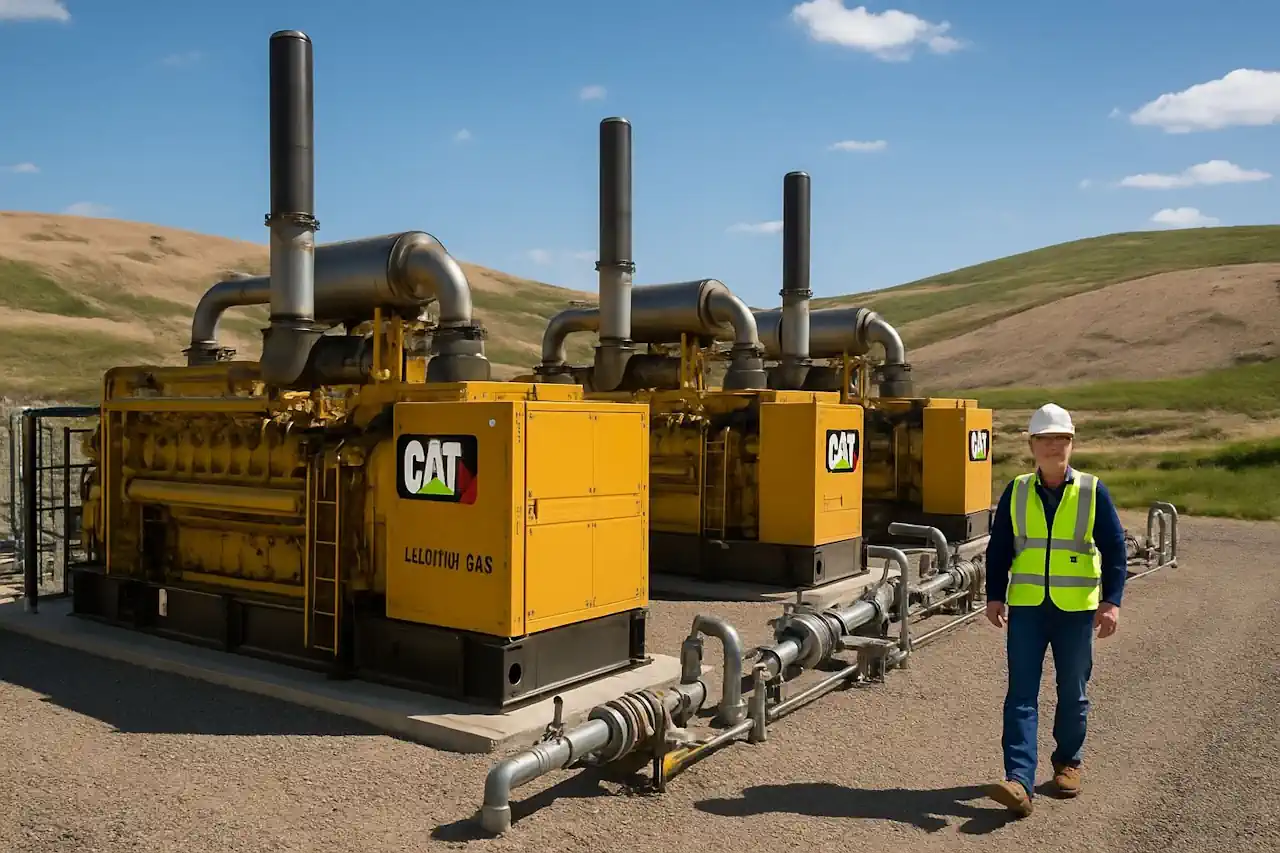
Caterpillar’s gas engine lineup — marketed under the Cat brand through its Energy & Transportation division — includes models specifically configured for landfill gas service. The Cat G3500 and G3600 series are the primary platforms used in landfill gas applications, with the G3516 being one of the most widely deployed models in North American municipal landfill projects.
Caterpillar’s landfill gas engines are built on the same fundamental architecture as their industrial natural gas engines, with factory-configured modifications for low-BTU gas service including recalibrated fuel systems, hardened components, and application-specific engine control modules. This approach gives Cat a large installed base and an extensive dealer service network, which is a genuine operational advantage in remote or logistics-constrained project locations. For a detailed comparison, you can explore Caterpillar vs. Cummins landfill gas engines.
In terms of raw electrical efficiency, Cat’s G3516 platform in landfill gas configuration typically operates in the range of 35% to 38% electrical efficiency depending on gas quality, load factor, and ambient conditions. This is a meaningful gap compared to Jenbacher’s documented 39.6% to 41.7% range, and energy professionals should account for it when building 20-year project financial models.
Caterpillar Models Designed for Landfill Gas
- Cat G3516 LE: The most widely deployed Cat model in North American landfill gas projects, producing up to 1,600 kW per engine in lean-burn configuration
- Cat G3520 LE: Higher-output variant delivering up to 2,069 kW, suited for larger municipal landfill sites with stable gas supply
- Cat G3512 LE: Mid-range model producing approximately 1,005 kW, commonly specified for smaller landfill sites or early-stage gas capture projects
- Cat G3616: High-output platform reaching up to 4,475 kW per engine, positioned as Caterpillar’s large-scale landfill gas solution
The G3516 LE is the backbone of Caterpillar’s landfill gas portfolio. Its lean-burn combustion configuration is critical for low-BTU gas service — running lean keeps combustion temperatures in check, reduces NOx formation, and helps the engine tolerate the variability in methane content that’s inherent to landfill gas. The G3516’s 16-cylinder architecture also gives it a mechanical robustness that Cat’s dealer network is deeply familiar with servicing across North America and beyond.
Where Caterpillar genuinely differentiates itself is aftermarket support. Cat dealers maintain regional parts inventories, and service contracts through Cat Financial can significantly reduce operational risk for landfill operators who don’t have in-house engine expertise. For remote sites or smaller operators without dedicated technical staff, this service infrastructure is a real and tangible advantage over any competitor.
The G3616 positions Caterpillar at the high end of the output range, with up to 4,475 kW per engine. However, documented large-scale multi-engine landfill gas deployments using G3616 units are less prevalent in the public record than comparable Jenbacher J420 installations, which have a more extensive portfolio of verified large-project case studies available for due diligence review.
Electrical Efficiency and Power Output Benchmarks
Caterpillar G3516 LE in landfill gas service typically achieves 35% to 38% electrical efficiency depending on gas quality, ambient temperature, and engine load factor. In optimal conditions with high-methane landfill gas and full engine loading, the upper end of that range is achievable. In variable gas quality conditions typical of older or mixed-waste landfills, efficiency tends toward the lower end of the bracket.
Caterpillar does not publish as extensive a library of verified project-specific efficiency data for landfill gas applications as INNIO Jenbacher does. Most available Cat landfill gas performance data comes from EPA LMOP (Landfill Methane Outreach Program) project records and third-party engineering assessments, rather than manufacturer-published case studies with verified output and efficiency figures.
In terms of raw power output, the Cat G3520 LE at 2,069 kW edges past the Jenbacher J420 at 1,694 kW on a per-unit basis. This means that for a target installed capacity, you may need fewer Cat engines on paper — but the efficiency gap means you’ll generate fewer kilowatt-hours from the same volume of landfill gas, which is the metric that drives project revenue.
For smaller sites under 2 MW total capacity, the Cat G3512 LE is a competitive option and benefits from widespread familiarity in the service sector. At this scale, the efficiency difference between platforms has less absolute financial impact, and Cat’s serviceability advantage can legitimately tip the decision in its favor depending on project location and operator resources.
Power Output Head-to-Head: Jenbacher vs. Caterpillar
On a per-engine output basis, Caterpillar’s G3520 LE at 2,069 kW slightly exceeds the Jenbacher J420 at 1,694 kW. But total project output is determined by how many engines you deploy and how efficiently they convert gas to electricity — and this is where Jenbacher’s documented multi-engine project results pull ahead. The Istanbul Enerji project delivers 36.4 MW from 26 J420 engines. Equivalent multi-engine Caterpillar installations of that scale in landfill gas service are not as well documented in the public domain.
Scalability: Which Engine Handles Large Multi-MW Projects Better
For projects above 10 MW, the Jenbacher J420 has a stronger documented track record. The Chengdu Chang’an installation at 29.7 MW across 20 engines and Istanbul at 36.4 MW across 26 engines demonstrate a level of multi-unit scalability with verified efficiency data that Caterpillar’s landfill gas portfolio has not matched publicly. INNIO’s containerized engine solutions also simplify logistics for large sites, allowing modular deployment that can be expanded as gas production increases over the landfill’s life cycle.
Small-Scale Site Suitability for Each Brand
Below 2 MW, the competitive landscape is more balanced. Caterpillar’s G3512 LE and Jenbacher’s J208 and J320 both serve smaller landfill sites effectively. At this scale, Cat’s dominant service network, faster parts availability, and operator familiarity in many markets make it a genuinely competitive choice — particularly for public sector or municipal operators with limited technical resources who prioritize minimizing downtime over maximizing electrical efficiency.
Electrical Efficiency Head-to-Head: Jenbacher vs. Caterpillar
This is where the comparison becomes most consequential for project financials. Electrical efficiency determines how many kilowatt-hours you produce per cubic meter of landfill gas — and since gas production from a landfill follows a fixed natural curve that you cannot accelerate, efficiency is the primary lever for maximizing revenue from a site with finite fuel resources.
Jenbacher Efficiency Range: 39.6% to 42% Across Documented Projects
Across the four major Jenbacher landfill gas case studies in the public record, electrical efficiency ranges from 39.6% at the Quito, Ecuador installation to 41.7% at Chengdu, China. The Istanbul project sits at 41.3%, and the Canadian Biomont installation achieves 85% total efficiency in CHP configuration. These are not theoretical peak figures — they are operational results from running projects across different continents, climates, and gas quality profiles.
The consistency of Jenbacher’s efficiency across geographically and operationally diverse projects is significant. Ecuador, China, Turkey, and Canada represent vastly different waste stream compositions, climates, and gas quality profiles. The fact that Jenbacher maintains a tight 39.6% to 41.7% efficiency band across all four contexts suggests robust adaptive combustion management rather than performance optimized for ideal lab conditions.
For a 10 MW landfill gas project running at 41% electrical efficiency versus 36% electrical efficiency, the difference in annual electricity generation at equivalent gas consumption is substantial. Assuming 8,000 operating hours per year, a 5-percentage-point efficiency advantage translates directly to additional megawatt-hours of billable generation — a gap that compounds across the full 20-year project life and significantly affects internal rate of return calculations.
How Caterpillar Efficiency Compares at Equivalent Load Ranges
Cat’s G3516 LE in landfill gas service typically achieves 35% to 38% electrical efficiency under real operating conditions. At the upper end of that range, Cat closes the gap with Jenbacher’s lower-performing documented installations. However, in variable gas quality environments — which is the normal operating condition for most landfill sites — Cat’s efficiency tends to settle toward the middle of its range rather than the ceiling, while Jenbacher’s adaptive systems hold efficiency higher under the same variable conditions.
CHP Capability and Total System Efficiency
Combined heat and power configuration changes the financial calculus of a landfill gas project entirely. When you recover usable heat from the engine jacket water and exhaust, total system efficiency can more than double compared to power-only generation. The catch is that CHP economics only work when there’s a viable thermal energy offtake within economic piping distance of the engine — an industrial facility, a district heating network, a greenhouse operation, or a leachate evaporation system on the landfill itself.
How Jenbacher CHP Pushes Total Efficiency to 85% in Some Projects
The Biomont installation in Canada is the most striking documented example of Jenbacher CHP performance in landfill gas service. Three J612 engines produce 4.8 MW of electricity and 5.2 MW of thermal output simultaneously, achieving a total system efficiency of 85%. That figure means 85 cents of every dollar of energy in the landfill gas is converted to usable electricity or heat — a remarkable result for a fuel as variable and contaminated as landfill gas.
Jenbacher’s CHP architecture recovers heat from three sources: the engine jacket water cooling circuit, the charge air cooler, and the exhaust gas heat exchanger. The jacket water circuit alone typically yields 25% to 30% of fuel energy input as recoverable low-grade heat at around 90°C, while exhaust gas recovery adds higher-grade heat suitable for steam generation or direct industrial process use. Combining all three recovery points is what pushes total efficiency into the 80%+ range.
Caterpillar CHP Options for Landfill Gas Sites
Caterpillar offers CHP configurations across its G3500 and G3600 engine series through its Cat Electric Power division and authorized system integrators. Cat’s jacket water heat recovery systems and exhaust heat exchangers are well-proven in industrial CHP applications, and total system efficiencies in the 75% to 80% range are achievable in landfill gas CHP service under favorable conditions.
Cat’s CHP offering benefits from its broad industrial presence — many potential heat offtake partners are already Cat equipment users, which can simplify commercial negotiations for heat supply agreements. However, documented total efficiency figures for Cat landfill gas CHP installations comparable to Jenbacher’s 85% Biomont result are not as readily available in the public project record, making direct numerical comparison difficult without site-specific engineering data.
Emissions Performance and Regulatory Compliance
Emissions compliance is non-negotiable in landfill gas projects. Burning landfill gas converts methane — a greenhouse gas roughly 28 times more potent than CO₂ over a 100-year period — into carbon dioxide and water vapor, which is a net environmental benefit. But the combustion process itself generates NOx, CO, and non-methane organic compound (NMOC) emissions that must meet EPA, EU IED, or local regulatory standards depending on project jurisdiction. Engine selection directly affects how easily and cost-effectively you meet those limits. For insights into managing these emissions, explore gas flaring systems vs. gas-to-energy systems for LFG utilization and compliance.
Both Jenbacher and Caterpillar offer lean-burn combustion architectures as standard for landfill gas service, which keeps NOx formation lower than stoichiometric combustion alternatives. Lean-burn operation dilutes the combustion mixture with excess air, lowering peak combustion temperatures and reducing thermal NOx production. The tradeoff is slightly higher CO and hydrocarbon emissions at the exhaust, which may require oxidation catalysts depending on local permit requirements.
Jenbacher CL.AIR Exhaust Aftertreatment System
INNIO’s CL.AIR exhaust aftertreatment system is a modular, integrated emissions control solution designed specifically for Jenbacher gas engines. It combines a three-way catalytic converter or oxidation catalyst with selective catalytic reduction (SCR) depending on permit requirements, and the system is engineered to work within Jenbacher’s engine control architecture rather than as a bolt-on afterthought. This integration means the engine management system actively optimizes combustion parameters to keep exhaust composition within the catalyst’s operating window, extending catalyst life and maintaining compliance without operator intervention.
For landfill gas applications where siloxanes and chlorinated compounds in the fuel gradually deposit on catalyst surfaces, CL.AIR’s modular design allows catalyst sections to be inspected and replaced independently without taking the entire engine offline. This is a meaningful operational advantage on sites where continuous generation is tied to power purchase agreements with performance penalties for unplanned downtime.
Caterpillar Emissions Control Options
Caterpillar addresses emissions compliance through a combination of factory-set lean-burn combustion calibration and compatible aftertreatment systems supplied through its dealer and system integrator network. Oxidation catalysts for CO and NMOC control are standard on most Cat landfill gas configurations, and SCR systems for NOx reduction are available where permit thresholds require them. Cat’s emissions control approach is less vertically integrated than Jenbacher’s CL.AIR system — third-party catalyst suppliers are commonly used — which gives operators procurement flexibility but places more responsibility on the site operator and service provider to manage catalyst compatibility and replacement scheduling.
Installation Flexibility and Site Logistics
Jenbacher offers its landfill gas engine systems in both stationary building-based configurations and containerized solutions, where the engine, generator, control system, and gas conditioning equipment are pre-integrated into a standard shipping container frame. Containerized units significantly reduce civil construction requirements on site, shorten commissioning timelines, and simplify future relocation if gas production at the primary site declines and the equipment needs to be redeployed. For landfill sites in remote locations or developing markets where construction resources are constrained, the containerized format is a substantial logistical advantage. Learn more about landfill gas production rates and their impact on equipment deployment.
Caterpillar’s installation approach is similarly flexible, with skid-mounted packages and enclosure options available through its dealer network. Cat’s global dealer infrastructure — with over 2,700 dealer locations worldwide — provides unmatched on-the-ground support for installation commissioning, particularly in regions where specialized gas engine expertise is scarce. In North America specifically, Cat’s installation ecosystem for landfill gas projects is deeply established, with decades of EPA LMOP project experience and a large installed base of operational references that simplify permitting and financing conversations with lenders and regulators.
Which Engine Is Right for Your Landfill Gas Project
There is no universal answer — the right engine depends on your site’s gas volume and quality profile, your project scale, your location’s service infrastructure, and whether you have a viable thermal offtake for CHP. What the data does show clearly is that these two platforms are not equivalent performers, and the gaps between them are material at commercial project scale.
- Project scale above 5 MW: Jenbacher’s J420 has a substantially stronger documented track record with verified efficiency data from multi-engine installations
- Electrical efficiency priority: Jenbacher’s 39.6%–41.7% documented range outperforms Cat’s typical 35%–38% in landfill gas service
- CHP with high total efficiency target: Jenbacher’s documented 85% total efficiency at Biomont sets the benchmark that Cat has not publicly matched in landfill gas CHP
- Remote location or limited technical resources: Cat’s dealer network and service infrastructure provide a genuine operational risk reduction advantage
- Small sites under 2 MW: Both platforms are competitive; Cat’s serviceability advantage can legitimately outweigh Jenbacher’s efficiency edge at this scale
- Variable gas quality conditions: Jenbacher’s adaptive combustion management is purpose-built for this challenge and maintains efficiency better under fluctuating methane content
For most projects above 5 MW where electrical generation revenue is the primary economic driver, the efficiency advantage of Jenbacher is difficult to justify setting aside. The verified project data from Istanbul, Chengdu, and Quito consistently shows Jenbacher operating in a performance band that Cat’s publicly documented landfill gas results have not reached. Over a 20-year project life with a power purchase agreement pricing electricity at market rates, that efficiency gap translates to a significant difference in cumulative revenue.
That said, dismissing Caterpillar entirely would be a mistake. For operators in regions where Jenbacher dealer coverage is thin, for smaller sites where the absolute revenue impact of the efficiency gap is modest, or for projects where rapid mobilization and parts availability are paramount, Cat’s ecosystem delivers real value that a spreadsheet efficiency comparison doesn’t fully capture.
When Jenbacher Is the Stronger Choice
Choose Jenbacher when your project is above 5 MW, when maximizing electrical kilowatt-hours from a finite gas resource is your primary objective, when you’re targeting CHP configurations with high total system efficiency, or when your site’s gas quality is highly variable and you need proven adaptive combustion management to maintain stable, efficient operation across the full range of methane concentrations your landfill will produce over its lifetime.
When Caterpillar May Be the Better Fit
Caterpillar earns serious consideration for projects below 2 MW, for sites in North America or other regions with dense Cat dealer coverage where service response time is a critical operational requirement, for operators with existing Cat equipment relationships and trained maintenance personnel, and for projects where financing or permitting timelines favor a platform with a large, well-documented regional installed base that lenders and regulators are already familiar with. For more information, you can explore the comparison between Caterpillar vs. Cummins landfill gas engines.
Frequently Asked Questions
Landfill gas engine selection generates consistent questions from project developers, site operators, and energy consultants evaluating their options. The answers below draw on verified project data and documented technical specifications rather than manufacturer marketing claims.
These questions cover the most consequential decision points in a landfill gas engine comparison — efficiency, output, fuel flexibility, project scale, and financial incentives — so you have the technical grounding to evaluate proposals with confidence.
What Is the Electrical Efficiency of GE Jenbacher Landfill Gas Engines?
GE Jenbacher landfill gas engines achieve electrical efficiencies between 39.6% and 41.7% in documented operational projects. The Istanbul Enerji installation using 26 J420 engines achieved 41.3% electrical efficiency at 36.4 MW output. The Chengdu Chang’an project with 20 J420 engines reached 41.7% total efficiency at 29.7 MW. The Quito, Ecuador installation with a mixed J320 and J420 fleet achieved 39.6% total efficiency across a 5 MW array.
These figures are from operational installations across different continents, gas quality profiles, and ambient conditions — making them more meaningful for project planning than laboratory peak efficiency ratings. The consistency of Jenbacher’s efficiency across such varied operating environments reflects the robustness of its adaptive combustion management system rather than performance optimized for ideal test conditions.
How Does Caterpillar’s Landfill Gas Engine Efficiency Compare to Jenbacher?
Caterpillar’s landfill gas engines, primarily the G3516 LE and G3520 LE in lean-burn configuration, typically achieve 35% to 38% electrical efficiency in operational landfill gas service. This represents a gap of approximately 2 to 6 percentage points compared to Jenbacher’s documented operational range of 39.6% to 41.7%.
The efficiency gap is most consequential at larger project scales where the absolute difference in kilowatt-hour output from the same gas volume compounds significantly over time. At a 10 MW project running 8,000 hours per year, a 5-percentage-point efficiency advantage equates to a substantial volume of additional billable generation annually — a gap that accumulates across a 20-year project life into a significant revenue differential. For more insights, you can explore the comparison between Caterpillar vs. Cummins landfill gas engines.
It’s worth noting that Caterpillar does not publish as extensive a portfolio of verified, project-specific efficiency data for landfill gas applications as INNIO Jenbacher does. Most available Cat efficiency figures for landfill gas service come from EPA LMOP project records, third-party engineering studies, and dealer technical documentation rather than manufacturer-published case studies with independently verified operational results. This makes direct numerical comparison at equivalent project scales more challenging than it should be for a technology with such significant capital cost implications.
Can Jenbacher Engines Handle Variations in Landfill Gas Quality?
Yes — Jenbacher engines are specifically engineered for variable-quality, low-calorific-value fuels, which makes landfill gas a core application rather than an edge case for the platform. The engine control system continuously monitors gas quality at the engine inlet and adjusts ignition timing, throttle position, and air-fuel ratio in real time to maintain stable combustion across a wide range of methane concentrations. This adaptive capability is what allows Jenbacher to maintain 39.6%–41.7% electrical efficiency across projects in Ecuador, China, Turkey, and Canada — four very different gas quality environments.
The practical implication for project developers is that you don’t need to over-engineer your gas conditioning system to deliver pipeline-quality methane to the engine. Jenbacher’s operating envelope for landfill gas accepts methane content across the typical 35% to 60% range found in municipal solid waste landfills, with the engine management system handling the variability rather than requiring expensive upstream gas upgrading equipment to compensate.
Jenbacher Landfill Gas Fuel Flexibility Summary
Methane content operating range: 35% to 60% CH₄
Gas conditioning requirement: Moisture removal, particulate filtration, siloxane management
Combustion adaptation method: Real-time ignition timing and air-fuel ratio adjustment
Efficiency maintained under variable gas: 39.6%–41.7% across documented multi-continent projects
Contaminant tolerance: Engineered for H₂S, halogenated compounds, and siloxane-contaminated landfill gas with appropriate upstream conditioning
Upstream gas conditioning — specifically moisture knockout, particulate filtration, and siloxane management — remains essential regardless of which engine platform you choose. Siloxanes in landfill gas combust to form crystalline silicon dioxide deposits on piston crowns, valves, and spark plug electrodes, causing accelerated wear and efficiency loss.
Proper siloxane removal upstream of the engine, combined with Jenbacher’s robust internal components, is what enables the long maintenance intervals and consistent efficiency figures seen in the documented project portfolio.
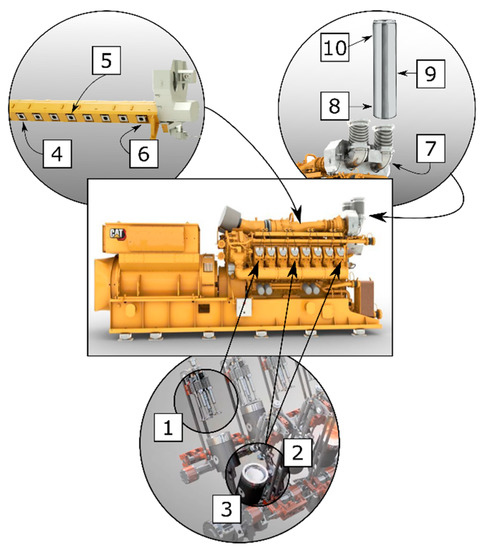
“Characterization of Deposits Formed in Gas Engines Fuelled by Coal Mine Methane” from www.mdpi.com and used with no modifications.
What Is the Maximum Power Output Achievable With Jenbacher Landfill Gas Engines?
The largest documented Jenbacher landfill gas installation in the public record is the Istanbul Enerji project in Turkey, which delivers 36.4 MW of electrical output from 26 J420 engines. In principle, there is no hard ceiling on total installed capacity — additional engines can be added in parallel as gas production supports it, and Jenbacher’s modular containerized deployment format makes phased expansion straightforward. For sites with exceptional gas volumes, the J612 at up to 4,499 kW per engine offers higher output per unit than the J420, though the J420 remains the dominant choice in large landfill gas arrays due to its proven operational track record at scale.
Are Landfill Gas Engines Eligible for Carbon Credits or Renewable Energy Tariffs?
Landfill gas power generation is eligible for multiple financial incentive structures in most major markets, and the engine platform you choose affects how much value you can capture from each mechanism. Higher electrical efficiency directly increases your renewable energy certificate (REC) or feed-in tariff revenue because more certificates are generated per unit of gas consumed — making the Jenbacher efficiency advantage financially relevant beyond just the electricity sales revenue line.
In the United States, landfill gas projects qualify as a renewable energy source under the EPA’s Landfill Methane Outreach Program (LMOP) and can generate Renewable Energy Credits under applicable state RPS (Renewable Portfolio Standard) programs. Landfill gas is also classified as a renewable fuel under the EPA’s Renewable Fuel Standard (RFS), making electricity and thermal energy from these projects eligible for D3 Renewable Identification Numbers (RINs) in qualifying configurations.
In the European Union, landfill gas power generation qualifies under the Renewable Energy Directive (RED II) framework, with member states implementing feed-in premiums, guarantees of origin, and capacity market support mechanisms that vary by country. Projects that achieve high total system efficiency through CHP — as Jenbacher’s Biomont installation demonstrates at 85% — may qualify for enhanced support levels under national CHP incentive schemes that tier payments based on measured system efficiency.
Carbon credit eligibility depends on the specific carbon market your project operates in. Under voluntary carbon markets, landfill gas destruction and utilization projects generate verified carbon units through methodologies including Verra’s VM0004 and Gold Standard’s Landfill Gas Destruction methodology. The methane destruction credit — based on the global warming potential differential between methane and CO₂ — is typically the largest component of carbon value in these projects, and it’s generated regardless of whether the gas is used for power production. The electricity generation layer adds REC or feed-in revenue on top of the methane destruction credit, making landfill gas projects one of the more financially layered renewable energy project types available to developers.
If you’re evaluating landfill gas engine platforms for an upcoming project, INNIO Jenbacher’s landfill gas solutions team provides detailed technical consultation and project-specific performance modeling to help you optimize engine selection for your site’s gas profile and financial objectives.
Landfill gas engines are critical components in converting methane emissions into usable energy. Companies like GE Jenbacher and Caterpillar are leading the way in developing efficient engines for this purpose. The power output and efficiency of these engines are crucial factors in determining their effectiveness in energy conversion. For a detailed comparison, you can explore more about Caterpillar landfill gas engines and their performance metrics.