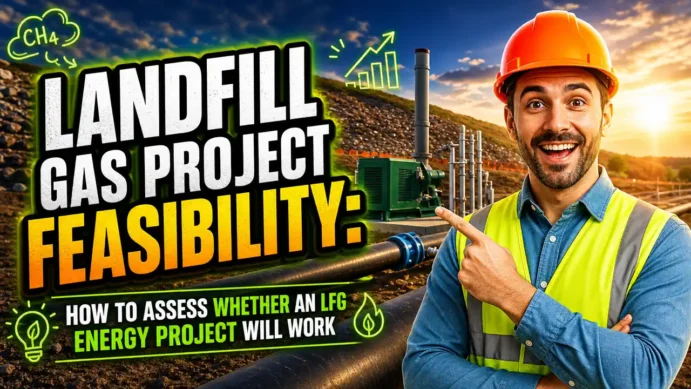
A landfill gas project feasibility study should answer a deceptively simple question: is there enough recoverable landfill gas, of suitable quality and for long enough, to justify investing in a particular use for it?
Answering that question properly takes more than entering a waste tonnage into a landfill gas model. You need reliable waste disposal records, a realistic assessment of landfill gas generation and collection, an understanding of the condition of the gas extraction system, and a viable market for the recovered energy.
And where the landfill history, waste composition or likely collection performance is uncertain, field investigation may be necessary to establish what the landfill can actually deliver.
For projects in the United States, the US Environmental Protection Agency’s Landfill Methane Outreach Program (LMOP) provides an excellent starting point. Its Landfill Gas Energy Project Development Handbook covers the technical, economic and regulatory factors affecting LFG energy project feasibility.
This article explains how I would approach an initial landfill gas project assessment and, just as importantly, where apparently precise feasibility calculations can become misleading.
This article is written primarily for US landfill gas projects. Regulatory requirements, energy incentives and project economics differ between US states and can change over time.
Start With the Gas Resource, Not the Technology
One of the easiest mistakes to make at the start of a landfill gas energy project is to begin with the technology. Someone decides that a landfill should have a 2 MW engine plant, an RNG upgrading system or a vehicle-fuelling project before establishing what quantity and quality of gas can actually be delivered.
I prefer to work in the opposite direction.
First establish the likely landfill gas resource. Then determine how much of that resource can realistically be recovered. After that, examine the possible uses for the gas and the economics of each option.
This distinction is important because landfill gas generated is not the same as landfill gas collected. A model may predict substantial methane generation within the waste mass while an existing extraction system delivers considerably less gas to the blower station.
EPA’s current LMOP Project Development Handbook follows a similar staged approach. Its first project-development step is to estimate LFG recovery potential and carry out an initial assessment before progressing into project technology, economics, contracts and detailed development.
Is One Million Tons of Waste the Minimum for a Landfill Gas Project?
You will often see 1 million tons of municipal solid waste quoted as a minimum size for an LFG energy project. That figure does have a basis in EPA guidance, but it should not be treated as a hard economic cutoff. That figure has been around for some time and makes no allowance for the reduced organic content where general organic waste is diverted to composting and anaerobic digestion, nor for separate food waste collection and processing.
EPA’s current LMOP Project Development Handbook uses several questions for initial screening. These include whether the landfill contains at least 1 million tons of MSW, has a depth of 50 feet or more, is open or recently closed, receives at least 25 inches of precipitation annually, and contains sufficient organic material to generate LFG.
These are screening characteristics, not a substitute for a feasibility study.
A smaller landfill with a good collection system and a valuable thermal energy user next door may offer a better project than a much larger landfill located many miles from a gas pipeline, electricity interconnection or suitable heat user.
The real question is therefore not simply:
How many tons are in the landfill?
It is:
How much usable gas can this landfill reliably deliver, for how long, and what is that gas worth at this location?
The Landfill Data You Need Before Modeling
A landfill gas model is only as useful as the information on which it is based. Before carrying out serious modeling, assemble as much of the landfill’s disposal history as possible.
1. Annual Waste Acceptance
Ideally, obtain annual waste acceptance tonnages from the first year of operation through to the present day. If the landfill is still operating, obtain realistic forecasts of future acceptance through its expected closure date.
A single waste-in-place number is useful for screening, but the annual placement history is much more informative because methane generation from recently deposited waste is very different from methane generation from waste deposited decades ago.
If historical records are incomplete, survey information and estimated waste densities may help reconstruct the disposal history. However, reconstructed figures should be clearly identified as estimates rather than incorporated into the model as though they were measured data.
2. Waste-in-Place
Total waste-in-place remains a fundamental feasibility parameter. Check whether the recorded tonnage includes only MSW or also substantial quantities of inert, construction and demolition, industrial or other wastes with very different methane-generation characteristics.
Also investigate whether significant quantities of waste have ever been excavated, mined or relocated.
For more background on how waste quantity and age influence LFG generation, see our guide to landfill gas production rates.
3. Landfill Opening and Closure Dates
You need to know when disposal began, whether the landfill remains active and, if so, its expected closure date and remaining permitted capacity.
For a landfill receiving waste, overall gas production will be affected by continuing additions of biodegradable material. Once disposal ceases, the landfill contains a finite biodegradable resource and overall gas generation eventually declines.
This is particularly important when evaluating a closed landfill. A closed site can certainly support an energy project, but the investment has to be assessed against the projected future gas curve rather than today’s flow alone.
4. Waste Composition
Not every ton of waste has the same methane-generation potential.
Food waste, paper, cardboard, yard waste and other biodegradable materials contribute to methane generation. Inert material contributes little or none. Changes in recycling, organics diversion and waste-management policy can therefore make historical waste composition substantially different from recent composition.
This becomes particularly important when forecasting future gas generation at active landfills.
5. Moisture and Climate
Moisture strongly influences the rate at which biodegradable waste decomposes. In general, decomposition proceeds faster under suitable moist conditions than in very dry waste, which is one reason methane-generation rate assumptions vary with climate.
However, do not confuse the biological effect of moisture on gas generation with the operational effect of excess liquid on gas collection.
A wet landfill may generate substantial methane while flooded extraction wells and liquid-filled laterals prevent the gas collection system from recovering it efficiently. That distinction can be extremely important during a feasibility investigation.
The temperature of the waste is also important. In cold climates a shallow landfill may never reach the temperature needed for the methanogens to become well-established.
6. Waste Placement and Compaction Practices
Another factor that deserves attention is how the waste was actually placed.
Where the landfill operator has good historical records and disposal practices are well understood, an experienced engineer may have reasonable confidence in assumptions about waste density, composition, moisture and degradation behaviour.
That confidence can fall sharply when assessing a landfill with poorly documented waste sources, uncertain disposal practices or unknown levels of compaction.
In my experience, this is one of the circumstances in which it becomes particularly important to distinguish between a model based on assumed characteristics and field evidence of what the waste mass is actually capable of delivering.
Using EPA LandGEM for Landfill Gas Feasibility
EPA’s Landfill Gas Emissions Model (LandGEM) is one of the most widely used US tools for estimating landfill gas, methane, carbon dioxide and other landfill emissions.
The current model is LandGEM Version 3.1, published by EPA in 2024. It is an Excel-based model and can use site-specific information or default parameters where suitable site-specific information is unavailable.
For feasibility work, LandGEM provides a useful way of turning historical and projected waste placement into an estimated methane-generation curve. It is particularly useful for screening and comparing scenarios.
What it does not do is magically reveal how much saleable gas will arrive at your energy plant.
The Main LandGEM Inputs
| Input | What It Represents | Why It Matters |
|---|---|---|
| Waste acceptance | Waste deposited by year | Establishes the quantity and age profile of the waste resource |
| Methane generation rate (k) | Rate at which methane-generating material decomposes | Strongly influences the timing and shape of the gas-generation curve |
| Methane generation potential (L0) | Potential methane yield from the waste | Influences the total methane-generation potential |
| Landfill operating history | Opening, waste-placement and closure periods | Determines the age distribution of the waste and future decline |
| Site-specific/default parameters | Assumptions used where measured information is unavailable | Can materially affect predicted results |
Be Careful With Default k and L0 Values
It is tempting to select default values for the methane generation rate constant, k, and methane generation potential, L0, run the model and regard the resulting curve as the answer.
It isn’t.
EPA has published different parameter sets for different modeling and regulatory purposes, and LandGEM allows site-specific information to be used where appropriate. Consequently, it is misleading to describe a single pair of k and L0 figures as universally applicable “EPA defaults.”
The selected values should be appropriate to the purpose of the calculation, landfill conditions, climate, waste characteristics and applicable regulatory framework.
For an investment decision, it is also sensible to examine sensitivity. If a relatively small change in a defensible k, L0 or waste-history assumption changes a profitable project into an unprofitable one, that uncertainty deserves attention before capital is committed.
Generation Is Not Collection: Estimating Recoverable Landfill Gas
This is probably the most important conceptual distinction in an LFG feasibility study.
A landfill gas model estimates generation. An energy project operates on collected gas.
Some generated gas may escape through the surface, migrate laterally, oxidize within cover soils or remain outside the effective influence of extraction wells. Collection performance also changes as landfill operations, cover conditions and the wellfield evolve.
There is therefore no single collection-efficiency percentage that should automatically be applied to every landfill.
EPA guidance recognizes that collection performance depends on factors including wellfield coverage, cover type and condition, collection infrastructure and operating practices. A well-covered, comprehensively extracted area may perform very differently from an active disposal area under daily cover.
For an existing gas field, long-term operational data can be far more informative than applying a generic collection-efficiency assumption.
Landfill Gas Pumping Trials: Testing What the Landfill Can Actually Deliver
Where reliable operating data from an established gas collection and control system is available, it provides an invaluable reality check on modeled gas generation. But many feasibility studies concern landfills where that information does not exist.
This is where a landfill gas pumping test or pumping trial can become particularly valuable.
Pump testing is not a new concept in US landfill gas engineering. EPA’s earlier Turning a Liability into an Asset: A Landfill Gas-to-Energy Project Development Handbook described a pump test as the most accurate method for estimating gas quantity short of installing a full collection system.
The same EPA guidance emphasized the importance of positioning test wells so that they are representative of the waste from which gas will ultimately be recovered. It also recommended testing the extracted gas for quality as well as quantity because the information is relevant to both energy-system design and project financing.
What Does a Landfill Gas Pumping Trial Do?
In simplified terms, one or more extraction wells are installed in representative parts of the waste mass and connected to controlled gas-extraction equipment. Monitoring probes may also be installed around the extraction well or wells.
Before and during extraction, measurements can be made of gas pressure, applied vacuum, flow and gas composition. Extraction can then be varied while observing how the well and surrounding waste mass respond.
A properly planned test can provide evidence about:
- achievable landfill gas extraction rates;
- methane, carbon dioxide and oxygen concentrations;
- changes in gas quality as extraction increases;
- well-head vacuum and flow characteristics;
- pressure response in the surrounding waste;
- approximate well influence under the test conditions;
- the onset of air intrusion at higher extraction rates;
- the effect of high liquid levels on well performance; and
- contaminants relevant to the proposed energy-recovery technology.
Gas quality testing can extend beyond methane concentration. Depending on the proposed end use, analysis for sulfur compounds, siloxanes and other contaminants may be important because they can materially affect gas-treatment requirements and equipment operating costs.
A Pumping Trial Does Not Measure Total Landfill Gas Generation
This distinction is worth making carefully.
LandGEM and similar models estimate gas generation from the waste. A pumping trial provides field evidence about gas recovery or extractability from the part of the landfill being tested under the conditions of the test.
The two should therefore be regarded as complementary.
A pumping trial does not prove that its measured flow can simply be multiplied across the entire landfill. Waste age, depth, composition, moisture, density, cover condition and liquid levels may vary substantially from one area to another.
Nor should the maximum flow that can physically be pulled from a test well automatically be described as sustainable gas yield.
Maximum Pumping Rate Is Not Necessarily Sustainable Gas Yield
As the applied vacuum and extraction rate increase, methane concentration may begin to fall while oxygen and nitrogen increase as atmospheric air is drawn into the waste through the landfill surface or other preferential pathways.
The maximum flow that the extraction equipment can produce may therefore be very different from the flow that can be maintained while preserving suitable gas quality and safe landfill conditions.
The useful result is the relationship between flow, vacuum, gas composition and landfill response.
High liquid levels can complicate the interpretation further. EPA’s current collection-system guidance recognizes that liquids accumulating in extraction wells reduce the volume of waste to which vacuum can effectively be applied and can increase the potential for air intrusion.
A disappointing pumping test may therefore reveal a poor gas resource, but it may instead reveal a poorly completed well, high liquid levels, inadequate cover or another collection limitation. Engineering judgement is needed to distinguish between these possibilities.
When Should a Pumping Trial Be Considered?
I would give field verification increasing weight as uncertainty about the landfill increases.
If a landfill has reliable waste records, well-understood operating practices and several years of good-quality gas collection data, there may be little benefit in carrying out a separate short-term pumping trial merely for the sake of doing one.
At the other extreme, consider a landfill with no established collection system, uncertain waste composition, incomplete historical records and unfamiliar waste-placement or compaction practices. In that situation, basing a major investment entirely on theoretical modeling would involve much greater uncertainty.
A representative pumping-test program can then provide an important bridge between modeled methane generation and the gas supply that a full-scale collection system may actually be capable of delivering.
For a significant investment, the test program should be designed around representative areas of the landfill rather than selecting one particularly convenient or apparently productive location. Spatial variability and, where relevant, seasonal conditions should be considered when interpreting the results.
Use Existing Wellfield Data Wherever Possible
Where a gas extraction system already exists, obtain records for:
- total LFG flow;
- methane concentration;
- oxygen concentration;
- carbon dioxide concentration;
- blower suction and available vacuum;
- individual well flow and pressure where available;
- flare operating history;
- wellfield downtime;
- condensate and liquid problems; and
- significant changes to wellfield configuration.
Look for trends rather than relying on a single day’s readings. An energy plant needs a dependable fuel supply, not a particularly good gas-flow measurement recorded on the day of the site visit.
Long-term operational data also helps reveal seasonal variation, deterioration or improvement following wellfield modifications and the relationship between extraction rate and methane concentration.
Collection System Condition Can Determine Project Feasibility
The feasibility study should not treat the landfill gas collection system merely as a pipe connecting the landfill to the proposed energy plant.
Well spacing, well depth, completion details, landfill cover, air intrusion, liquid levels, lateral gradients, header sizing and available vacuum can all affect recoverable gas.
Our guide to landfill gas extraction well design discusses this subject in more detail.
Condensate and Liquid Management
Landfill gas leaves the waste warm and saturated with water vapor. As it cools in the collection system, condensate forms.
If pipework does not drain properly, condensate can accumulate at low points and restrict or completely block gas flow. Extraction wells can also suffer from high liquid levels.
EPA’s Project Development Handbook notes that as liquid rises within a well’s perforated casing, vacuum is applied to an increasingly smaller volume of waste. Gas recovery from the well can therefore fall even though methane generation within the surrounding waste continues.
Consequently, an apparently disappointing gas field does not necessarily indicate poor methane generation. It may indicate poor gas recovery.
Before concluding that a landfill lacks sufficient gas for an energy project, establish whether the existing wellfield is actually capable of collecting the available resource.
Vacuum and Air Intrusion
More vacuum is not automatically better.
The extraction system needs sufficient negative pressure to collect LFG effectively, but excessive extraction can increase air intrusion. This can reduce methane concentration and introduce oxygen into parts of the system where it is undesirable.
Good wellfield operation is therefore a balancing exercise, and the feasibility study should consider whether projected energy-plant flow can be maintained without compromising safe and effective landfill gas control.
Choosing an End Use: Electricity, Direct Use or RNG?
EPA currently groups LFG energy projects into three broad categories: electricity generation, direct use and renewable natural gas (RNG).
The best option depends on more than gas quantity. Location can be equally important.
A landfill beside an industrial heat user presents a different opportunity from one beside a suitable natural gas pipeline, while a landfill with an economical electricity interconnection presents another.
Electricity Generation
Reciprocating engines have long been widely used for landfill-gas electricity generation, although turbines and other technologies are also available.
Electricity projects need to consider more than generator capacity. Gas treatment, electrical interconnection, parasitic electrical demand, engine availability, maintenance, emissions permitting and the value of the electricity all affect the result.
A rule of thumb relating scfm of LFG to MW of electrical output can be useful for initial screening, but it should never replace calculations based on actual methane concentration, gas heating value, generator efficiency and expected availability.
Grid connection can also change the economics dramatically. An attractive gas resource does not compensate for an uneconomic interconnection.
Direct Thermal Use
Direct use can be one of the simplest LFG utilization options where a suitable energy user is located close to the landfill.
Potential users include boilers, kilns, dryers and industrial process-heating applications. Because the project avoids converting the gas into electricity, it may achieve high overall energy utilization with relatively straightforward gas treatment.
The difficulty is usually geographical: a good heat customer needs to be close enough for the pipeline and associated infrastructure to remain economic.
This is why feasibility should examine the area surrounding the landfill rather than evaluating the landfill in isolation.
Renewable Natural Gas (RNG)
Landfill gas can be upgraded by removing carbon dioxide, moisture and contaminants and increasing its methane concentration to produce renewable natural gas.
RNG may be injected into a suitable natural gas pipeline or used locally, including as compressed natural gas (CNG) or liquefied natural gas (LNG).
RNG has become increasingly important in the US landfill-gas sector, but the upgrading equipment, compression and interconnection requirements mean that adequate gas flow and project scale are important.
EPA’s current LMOP screening information indicates that pipeline-injection RNG projects generally require a minimum LFG flow of approximately 800 to 1,000 scfm. This should be treated as a screening criterion rather than an immutable engineering law.
EPA also indicates that onsite or nearby vehicle-fueling projects may typically operate with approximately 50 to 600 scfm, depending on fueling-station size and local fuel demand.
For a comparison of the main utilization pathways, see landfill gas to electricity versus RNG.
Do Not Assume Every RNG Project Automatically Earns RIN Revenue
Federal and state environmental attributes can have a major effect on RNG economics, but their treatment needs care.
Under EPA’s Renewable Fuel Standard (RFS), qualifying fuels derived from landfill biogas can generate cellulosic biofuel D3 Renewable Identification Numbers (RINs). However, upgrading landfill gas to RNG does not by itself guarantee RIN revenue.
The fuel must satisfy an EPA-approved pathway and the relevant RFS requirements. Anyone evaluating an RNG project should therefore model environmental-credit revenue separately from the underlying commodity value of the gas and confirm current eligibility rather than assuming historical credit values will continue throughout the project life.
See EPA’s Renewable Fuel Standard information for landfill gas projects for current guidance.
Economic Feasibility: Follow the Gas to the Customer
Once you have a defensible recoverable-gas forecast, the project economics can be examined.
At screening level, I would concentrate on four questions:
- How much gas can be delivered reliably?
- For how many years can that flow be maintained?
- What capital and operating expenditure is required to turn it into a saleable energy product?
- What is that energy product realistically worth?
EPA provides LFGcost-Web and other LMOP resources for initial economic assessment.
But any screening model should eventually give way to site-specific quotations and commercial information if the project progresses.
Capital Costs
Depending on the project, capital expenditure may include:
- new extraction wells and laterals;
- wellfield rehabilitation;
- headers and condensate management;
- blowers and gas treatment;
- flare modifications;
- engines, generators or RNG upgrading equipment;
- electrical interconnection;
- gas pipeline and pipeline interconnection;
- civil works and buildings;
- engineering and permitting; and
- contingency.
Be particularly careful when comparing published $/kW or $/scfm cost benchmarks. One estimate may include the collection system, interconnection and civil works while another starts at the inlet flange of the energy plant. Apparently comparable numbers may therefore describe very different project scopes.
It is also worth mentioning that accounting principles for landfill gas vary. In nations where regulations have for many years required flaring as a minimum requirement and the provision of a landfill to dispose of municipal waste is tendered to comply with the waste regulations, the provision of the gas collection system and flare is paid for by the municipal authority. On that basis, landfill gas utilisation will show a profit as long as the income from energy sales exceeds the costs from a take-off point at an existing already funded flare.
Where the cost of landfill gas utilization is also required to pay for the extraction wells, the collection infrastructure and the emergency flare provision it will be a lot harder to show profitability.
Operating Costs
Landfill gas is not equivalent to clean commercial natural gas. Moisture and trace contaminants can affect treatment requirements and equipment maintenance.
Depending on the site and technology, siloxanes, hydrogen sulfide and other compounds can be particularly important. Gas analysis should therefore form part of serious feasibility work rather than assuming that methane concentration alone defines fuel quality.
Revenue
Potential revenue sources can include:
- electricity sales;
- thermal energy sales;
- RNG commodity sales;
- Renewable Energy Certificates where applicable;
- qualifying RIN revenue;
- state low-carbon fuel credits where applicable; and
- other eligible environmental attributes.
Do not assume that every project qualifies for every revenue stream or that environmental attributes can always be stacked. Eligibility, ownership and contractual allocation need to be established for the particular project.
Regulation Is a Feasibility Input, Not Something to Check Later
For US projects, regulatory requirements can affect both the cost of the project and the infrastructure already available at the landfill.
Relevant federal requirements may include the Clean Air Act standards for municipal solid waste landfills, including applicable New Source Performance Standards and the National Emission Standards for Hazardous Air Pollutants (NESHAP).
Newer applicable MSW landfills may fall under 40 CFR Part 60 Subpart XXX, while the regulatory history and construction or modification date of the landfill affect which requirements apply. MSW landfill NESHAP requirements are contained in 40 CFR Part 63 Subpart AAAA.
Subpart XXX includes design-capacity and non-methane organic compound (NMOC) emission criteria that can trigger gas collection and control requirements. The often-quoted 34 Mg/year NMOC threshold should therefore be considered within the complete applicability and calculation requirements rather than used as a stand-alone test.
State air permitting, local requirements, electrical interconnection rules and pipeline specifications may impose additional requirements.
A landfill already required to collect and control LFG presents a different economic case from one where the entire collection system would have to be installed solely to support the proposed energy project. Existing compliance infrastructure can reduce the incremental capital required for beneficial use, although it should never be assumed that an existing system has sufficient capacity or condition for the proposed project.
Use the EPA LMOP Database to Check Your Assumptions
One of the most useful resources for a US feasibility assessment is EPA’s LMOP Landfill and Project Database.
The associated project data can be searched and analyzed by characteristics including project category, project type, developer, start date, electrical capacity and LFG flow.
This gives you something that a theoretical gas model cannot provide: examples of what has actually been developed at other US landfills.
For example, if your feasibility assessment predicts a particular collectible LFG flow, examine operational projects with similar flows. What technologies are being used? What scale of electrical generation has actually been installed? Are comparable projects producing RNG, electricity or direct-use gas?
This is useful as a reasonableness check.
However, do not take the comparison too far. Two landfills with similar waste-in-place or gas flow can have completely different economics because pipeline distance, electricity prices, interconnection costs, gas quality, regulatory requirements and contractual arrangements differ.
The LMOP database is therefore an excellent technical benchmarking resource, but it is not a substitute for site-specific financial analysis.
Self-Development or a Third-Party Developer?
Once a project survives initial technical and economic screening, the landfill owner needs to decide how it should be developed.
Self-development gives the owner greater control and potentially retains more project revenue, but it also requires capital, specialist engineering, procurement capability, energy-market knowledge and long-term operational resources.
A third-party developer may finance, build and operate the project in return for gas rights, a royalty, lease payments, revenue sharing or another commercial arrangement.
Neither route is automatically better.
When evaluating potential development partners, I would look beyond the headline royalty or revenue-share percentage. Examine their experience with similar landfill sizes and project technologies, operational record, financial strength and proposed allocation of risk.
Contract issues can include:
- gas rights and ownership;
- minimum payments or royalties;
- ownership of RINs, RECs and other environmental attributes;
- minimum performance requirements;
- responsibility for wellfield improvements;
- gas quality requirements;
- project expansion rights;
- downtime and force majeure provisions;
- equipment ownership at the end of the agreement; and
- decommissioning and site restoration.
A good feasibility study strengthens the landfill owner’s position in these negotiations because it reduces the information imbalance between the site owner and prospective developer.
What Makes a Landfill Gas Feasibility Study Defensible?
The answer is not a particularly sophisticated spreadsheet. It is traceability and verification.
A reviewer should be able to determine where the waste tonnage came from, why particular LandGEM parameters were selected, how collectible gas was derived from modeled generation, what operational or pumping-test evidence supports the assumptions, where capital-cost estimates originated and what supports the projected energy price.
Where information is uncertain, say so and test the sensitivity.
In my experience, false precision is one of the things to avoid in early feasibility work. A model predicting 1,247 scfm ten years from now is not necessarily more useful than a well-supported range showing what happens under conservative, central and optimistic assumptions.
The purpose of feasibility work is not to produce an impressive-looking answer. It is to determine whether a project remains attractive when reasonable assumptions are challenged and, where the uncertainty justifies it, tested against conditions in the field.
A Practical Landfill Gas Feasibility Sequence
For an initial assessment, I suggest working through the project in approximately this order:
- Establish the waste inventory – annual tonnage, composition, age, waste-placement history, remaining capacity and closure assumptions.
- Model methane generation – using LandGEM or another appropriate model with defensible assumptions.
- Assess the quality of the evidence – identify uncertainty in waste records, composition, compaction, moisture and model parameters.
- Validate recoverable gas – compare modeled generation with long-term extraction data or, where justified, representative pumping trials and field measurements.
- Review the collection system – wells, liquid levels, condensate, vacuum, cover and available capacity.
- Analyze gas quality – not just methane, but contaminants relevant to the proposed technology.
- Identify realistic end users – electricity, direct thermal use or RNG.
- Check infrastructure – grid, pipelines, roads, utilities and available site area.
- Establish regulatory requirements – federal, state and local.
- Prepare screening economics – CAPEX, OPEX, revenue and environmental attributes.
- Run sensitivity cases – particularly recoverable gas flow, energy value, capital cost and project life.
- Benchmark the result – including comparison with relevant LMOP projects.
- Decide whether detailed development is justified – including further field investigation, engineering, quotations and commercial negotiations.
If the project does not survive this initial screening, that is not a failed feasibility study. It may have prevented a much more expensive failure later.
Frequently Asked Questions
What is the minimum waste-in-place for a landfill gas energy project?
There is no universal minimum. EPA LMOP uses approximately 1 million tons of MSW in place as one of several initial screening characteristics, alongside factors including waste depth, landfill status, precipitation and organic content. Waste quantity should ultimately be assessed alongside waste age, composition, collectible gas flow, project type, infrastructure and energy value.
How accurate is LandGEM?
LandGEM is extremely useful for estimating landfill gas and methane generation, but its output is a model estimate rather than a field measurement. Results depend on the waste history and modeling parameters used. For investment decisions, modeled generation should be compared with actual wellfield data or appropriate field investigations wherever the uncertainty justifies doing so.
Does LandGEM tell me how much gas an energy project can use?
Not directly. LandGEM estimates gas generation. The amount available to an energy project depends on the collection system, wellfield coverage and condition, liquid levels, air intrusion, system downtime and other site-specific factors. This is why the distinction between modeled generation and recoverable gas is so important.
Do I need a landfill gas pumping trial?
Not necessarily. If a landfill already has several years of reliable extraction-system data, that operating history may provide better evidence than a short pumping trial. Where there is no established collection system, or where waste composition, compaction, disposal history and gas recovery are uncertain, a representative pumping trial can provide valuable field evidence about extractable gas quantity, quality and landfill response.
Does a pumping trial measure the landfill’s total methane generation rate?
No. A pumping trial measures the response of the tested area of the landfill to controlled extraction. It provides evidence about recoverable gas under the test conditions, whereas LandGEM and similar models estimate methane generation from the waste. The two methods are best regarded as complementary.
Can a closed landfill still support an LFG energy project?
Yes. Closed landfills can continue generating methane for many years after waste placement ends. The important issue is the future decline curve. Feasibility should therefore be based on expected recoverable gas throughout the proposed project life, not simply today’s flow.
Which is better: landfill gas electricity or RNG?
Neither is universally better. Electricity can be attractive where grid connection and power value are favorable. RNG may be attractive where sufficient gas flow and a suitable pipeline or vehicle-fuel market exist. Direct thermal use can outperform both where a good heat customer is located nearby. Site location and market access can be as important as landfill size.
How much landfill gas is needed for an RNG project?
EPA LMOP currently indicates that pipeline-injection RNG projects generally require approximately 800 to 1,000 scfm of LFG as an initial screening criterion. EPA indicates lower flows may support onsite or nearby vehicle-fueling projects where sufficient local fuel demand exists. Actual feasibility depends on gas quality, upgrading costs, interconnection, fuel demand and available revenues.
How long should an LFG feasibility study take?
There is no meaningful universal duration. A desktop screening exercise using good existing landfill records can be completed relatively quickly. A more rigorous assessment involving pumping trials, gas analysis, engineering design, interconnection studies, regulatory work, quotations and commercial negotiations can take much longer. Data availability and the level of investment risk usually determine how much investigation is justified.
Conclusion: Model the Resource, Then Test the Assumptions
A landfill gas feasibility study should progressively replace assumptions with evidence.
Start with waste records and a gas-generation model. Then ask how much of that gas can actually be recovered. Where an operating gas collection system exists, use its historical performance data. Where it does not, and the uncertainties justify further investigation, a properly designed pumping trial can provide field evidence that a desktop model cannot.
Then examine the collection system, gas quality, project location, infrastructure, regulatory requirements and energy markets before selecting the technology.
LandGEM, LMOP’s Project Development Handbook, LFGcost-Web and the LMOP project database provide excellent US screening resources. Older EPA technical guidance on pump testing also remains useful because it addresses the practical problem of checking theoretical gas estimates against landfill performance in the field.
The most useful feasibility study is not necessarily the one predicting the largest energy project. It is the one that identifies the project scale and end use that remain viable under realistic assumptions — or identifies early enough that the proposed project should not proceed.
References and Further Reading
- US EPA LMOP – Landfill Gas Energy Project Development Handbook – current EPA guidance covering LFG modeling, technology, economics, regulation, collection-system design and project development.
- US EPA – Landfill Gas Emissions Model (LandGEM), Version 3.1 – EPA’s current landfill gas emissions model and user documentation.
- US EPA – Turning a Liability into an Asset: A Landfill Gas-to-Energy Project Development Handbook – historical EPA guidance containing useful engineering information on landfill gas pump testing and field verification. Note that regulatory and economic information in this older publication should not be relied upon as current guidance.
- US EPA LMOP – Tools and Resources for Landfill Gas Energy – includes LFGcost-Web and other project-development resources.
- US EPA LMOP – Landfill and Project Database – US landfill and LFG energy project information useful for project screening and benchmarking.
- US EPA LMOP – Non-Electricity Project Options – current screening information for RNG and direct-use alternatives.
- US EPA LMOP – Renewable Fuel Standard Information for Landfill Gas Energy Projects – current information relevant to RFS pathways and qualifying landfill-derived fuels.
Technical note: This article is intended as general guidance for preliminary project assessment and does not replace site-specific engineering, environmental, regulatory, legal or financial advice. Regulations and incentive programs can change; current federal, state and local requirements should be checked for each project.