
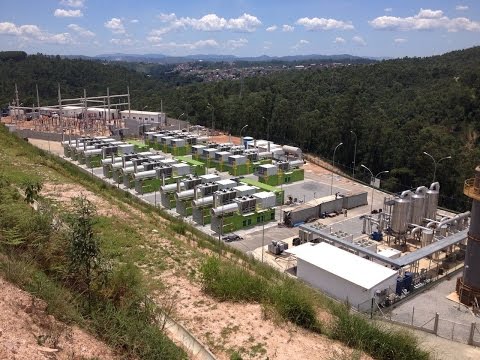
This Landfill Gas Biogas Plant in Brazil site receives the extracted landfill gas, also known as biogas, from around 8,000 tons of urban waste a day. The landfill thermal power plant has an installed capacity of MW, nearly 30 MW, which can supply power to a city of 300,000 inhabitants.
So for this reason, we say that this really is one of the largest thermal power plants in the global power generation sector, in the production of energy derived from landfill biogas. There are 21 engines, of MW each, which are basically divided in three sections.
The first of these is a gas treatment unit, for treating biogas, where they cool the biogas and remove the humidity and impurities. Then they put this treated biogas into generator engines and once the energy is generated, which is at KV, they raise the generated energy to 138 KV and put it into the electrical power transmission system.
This engine, one that we’ve bought, has been acoustically treated; we’re standing beside the generator engine and you can hardly hear any engine noise.
Today, this electric power is used here on-site, obviously this entire landfill runs off this power.
The remainder of the power, which is the majority, is fed into the transmission network at 138 KV, and it then joins the interconnected national grid, the SIN, as we call it.
On entering into this system, it becomes available for purchase by the various potential buyers of this type of renewable energy. So this project will generate the equivalent of around 300,000 tons of CO2 per year through the use of biogas in these generator engines.
In other words, they cease to emit about 300,000 tons into the atmosphere every year, which is quite substantial, and makes this project very interesting from an environmental point of view.
This project was chosen by the Sao Paulo State Government as one of the projects that would represent it at COP2 Paris, that took place in 2016. So it was a great honour for us, the State Government embraced this project and saw it as matching all of the criteria, having all of the technical requirements to merit its selection.
This project is totally aligned with Brazilian National Policy on Solid Waste, which unreservedly states that it should not be sent to a landfill site before going through a sorting process and here we make the best possible use of all of the biogas that is extracted from the landfill site, then recycle it through electricity production.

To Grupo Solvì, this thermal power plant represents its consolidation in the renewable energy sector. We built one in Salvador, another in the south and now this one of 30MW, and the trend is that it will grow.
They will buy three more engines very soon (2016), followed by another three, so this Landfill Gas Biogas Plant will continue to grow significantly.
As found on Youtube