Have you ever stared at your site’s gas production figures and thought, “Are these numbers actually right?” It’s one of the most common frustrations in waste management.
Landfills produce methane constantly, and measuring it accurately matters enormously. Get your Landfill Gas Production Rate wrong, and you’re either over-planning your capture system or missing real emissions. Either way, your operations take a hit. 1
Good calculation methods change that.
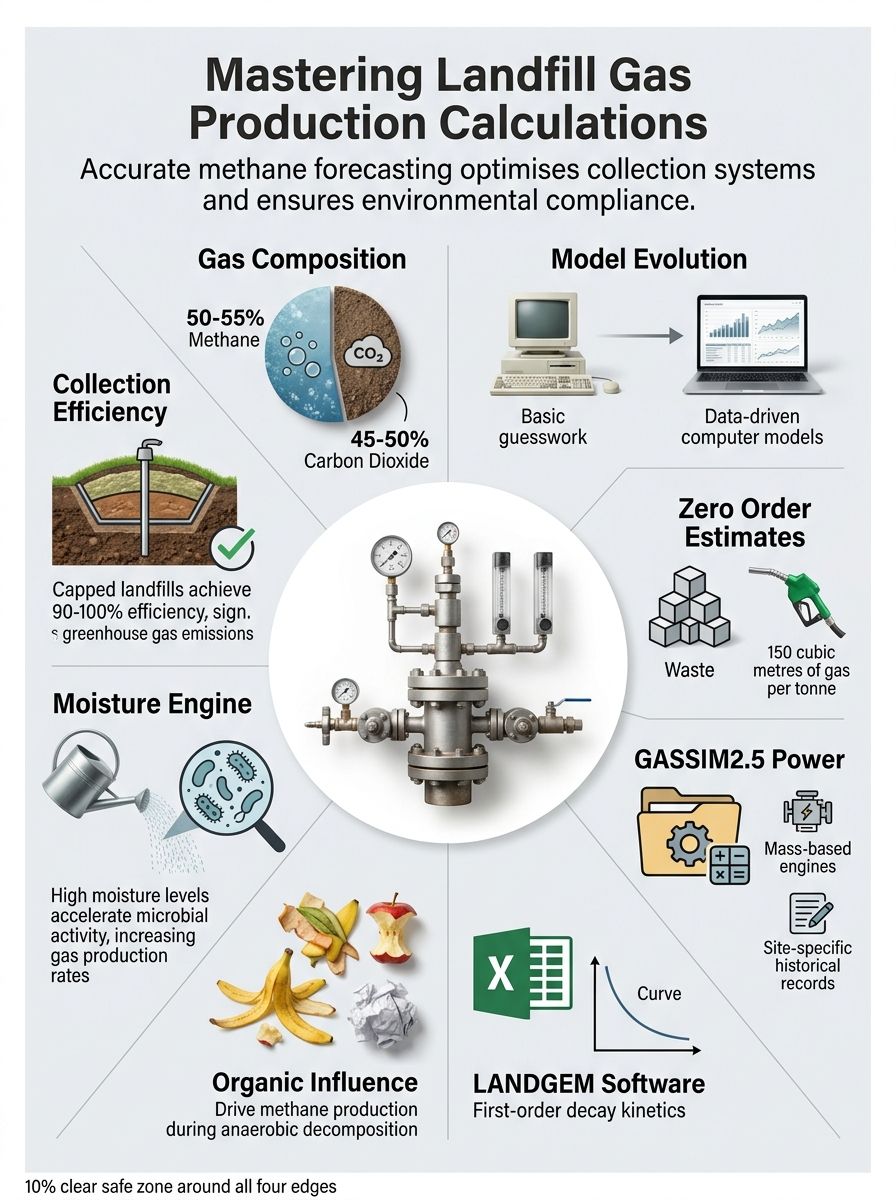
Here’s a useful starting point: landfill gas contains roughly 50 to 55 per cent methane and 45 to 50 per cent carbon dioxide, with small amounts of other gases in the mix. 2 That methane share tells you how much energy you can recover and how much greenhouse gas you need to manage.
Methane is the real concern for climate change. It traps heat far more effectively than carbon dioxide, so getting a handle on it is a top priority for every waste professional. But, once extracted and utilised, it becomes a very valuable income source.
This guide walks you through the calculation models that help you measure landfill gas production accurately. You’ll also discover the key factors driving methane emissions at your site. 3
Waste composition, moisture content, temperature, and collection efficiency all play a role. By the end, you’ll have practical knowledge to sharpen your gas management plan and reduce your environmental impact.
I’m going to walk you through the exact steps, and I think you’ll find it more straightforward than you expect.
Key Takeaways
- Landfill gas contains 50-55% methane and 45-50% carbon dioxide; methane traps heat far more effectively than carbon dioxide.
- Simple Zero Order Spreadsheet Model estimates 5-10 cubic metres of gas per tonne during first 10 years; roughly 150 cubic metres lifetime total.
- GASSIM2.5 and LANDGEM models incorporate waste composition, moisture content, temperature, and pH to forecast methane emissions accurately for operational planning.
- Collection efficiency ranges from 10-80% at operational landfills and 90-100% at capped sites; affects total greenhouse gas emissions significantly.
- Waste stabilisation occurs when residual methane generation drops below 0.5 L/(m² h), marking the endpoint of active decomposition and reduced emissions.
Landfill Gas Production Assessment
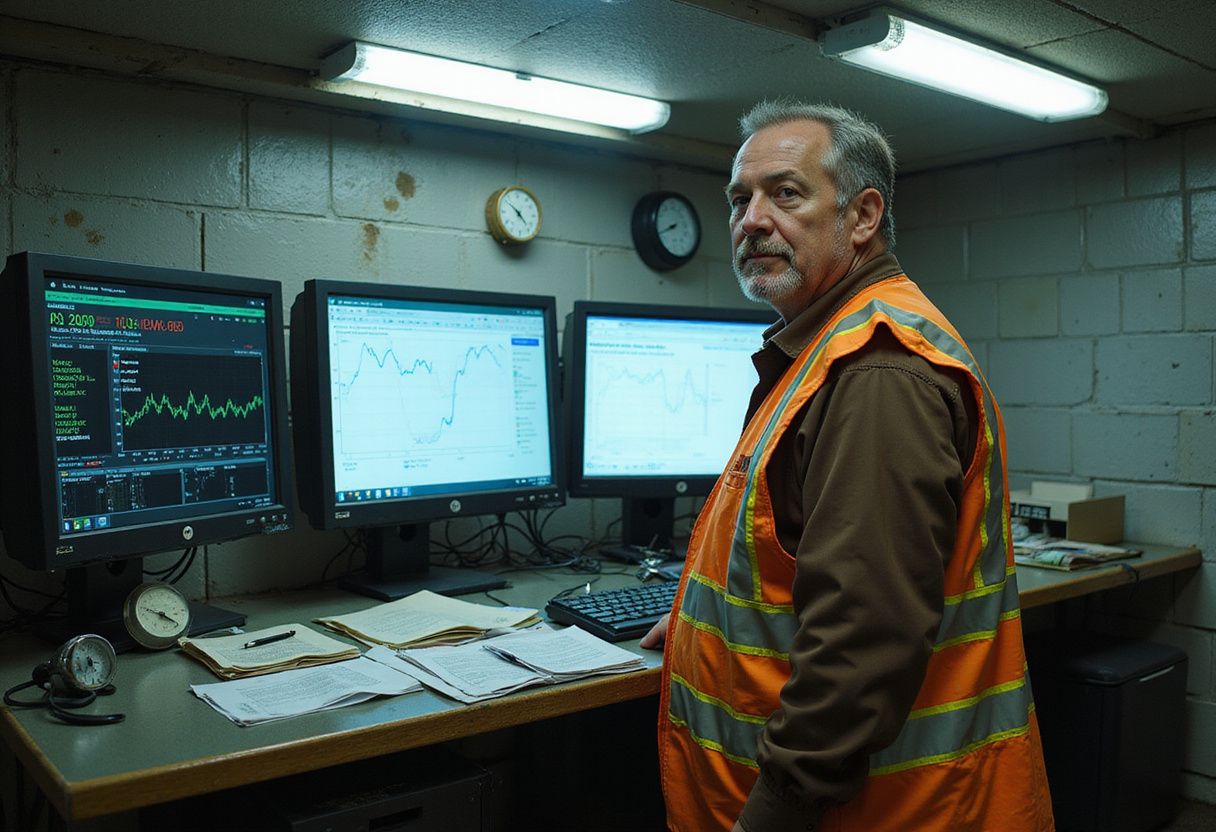
Landfill gas production assessment methods have changed dramatically over the decades. The industry moved from basic guesswork to sophisticated computer models that track methane emissions with real precision.
Understanding how these calculation approaches work, and why they matter, gives waste professionals the tools to manage landfill gas collection systems effectively and reduce climate impacts.
How have landfill gas calculation models developed over time?
Landfill gas models have changed a lot since waste professionals first started tracking methane emissions. Early approaches used simple maths and basic assumptions about how waste breaks down.
Scientists realised that waste decomposition follows first-order decay patterns, meaning the rate of gas production slows over time. This discovery shaped how engineers built their forecasting tools.
The U.S. Environmental Protection Agency created LandGEM to help predict gas generation over several decades. This model became a standard tool across the United States and England.
Waste professionals now use site-specific historical waste inputs to make their projections more accurate. Models incorporate actual waste composition data from each landfill site. These tools project significant methane volumes that facilities must manage and plan for.
The shift from rough estimates to data-driven models transformed how waste management companies approach landfill gas generation. Different landfill gas production rate calculation methods emerged as technology improved and our understanding deepened.
The Simple Zero Order Spreadsheet Model offered waste professionals an easy starting point for basic calculations. GASSIM2.5 came next, adding more features and greater capability for complex sites. These tools let engineers survey and compare different calculation methods side by side, and professionals could test various scenarios before building their landfill gas management plan.
The development of these models made electricity generation from biogas more predictable and profitable. Collection efficiency calculations grew more precise, helping teams capture more renewable natural gas.
Modern models use tracer dispersion method data and UAV mass balance method results to refine their outputs. According to a February 2026 UK Government study on landfill methane measurement, combining UAV mass balance surveys with the Tracer Dispersion Method can definitively verify a site’s Methane Collection Efficiency for regulatory applications. This makes them active compliance tools, not just theoretical concepts.
Climate impacts assessments rely on these improved forecasting tools. The evolution from basic spreadsheets to sophisticated software shows how the waste industry has adapted to tackle methane emissions seriously.
Good models make the invisible visible, turning decades of buried waste into measurable, manageable numbers.
Why is it important to survey and compare different calculation methods?
Different calculation methods exist for landfill methane production, and each one brings its own strengths. The Simple Zero Order Spreadsheet Model offers simplicity and speed for quick assessments.
GASSIM2.5 provides more detailed features for complex scenarios. LANDGEM delivers strong capabilities used across many sites. Tools like those endorsed by the Environment Agency help waste professionals track emissions accurately.
Your choice of method shapes the accuracy of your landfill gas emissions model results. Surveying these options means you can pick the right tool for your specific waste composition, moisture content, and site conditions. Real-world examples show that each method works well when applied correctly.
- Municipal solid waste sites have used different approaches with great success.
- Methane collection efficiency varies across sites, so your calculation method must account for this reality.
- Some methods suit sites focused on climate change mitigation through methane capture.
- Others work better for operations targeting ROCs or other regulatory compliance goals.
As highlighted in an April 2026 industry report on methane gas capture subsidies, landfill methane capture sites supply roughly 2.5 TWh of electricity annually in the UK. The ROCs scheme funding these operations is set to expire in March 2027, which makes choosing the right calculation method even more critical for securing alternative investments going forward.
The UK Environment Agency recognises that different models handle flaring, gas engine performance, and renewable natural gas recovery differently. Waste professionals gain real advantages by analysing multiple approaches before committing to one system.
This comparison process reveals which method handles your specific waste stabilisation patterns, temperature ranges, and pH levels most effectively. You avoid costly mistakes by testing different models against your site data first.
The energy content of your waste, the collection rates you achieve, and your long-term emissions projections all depend on selecting the most suitable calculation approach for your circumstances.
Methods for Calculating Landfill Gas Production
Scientists use different tools to measure how much methane gas landfills produce. LANDGEM, GASSIM2.5, and the Simple Zero Order Spreadsheet Model each offer different ways to track landfill renewable natural gas and help waste professionals understand fossil fuels better through the landfill methane outreach program.
What is the Simple Zero Order Spreadsheet Model?
The Simple Zero Order Spreadsheet Model gives you a quick way to estimate landfill gas production without needing fancy software or complex data inputs. This straightforward tool works as a rough initial estimation tool, and waste professionals like you can use it for preliminary assessments before moving to more detailed modelling.
Each tonne of Municipal Solid Waste produces roughly 5 to 10 cubic metres of landfill gas during the first 10 years after deposition. The model estimates a total of around 150 cubic metres of landfill gas over the waste’s lifetime. 2 The spreadsheet approach keeps things simple, so you don’t need advanced modelling skills to get useful results.
Simple tools often give you the best answers when you need them fast.
Most professionals use this model as a starting point when they want quick answers about landfill renewable natural gas potential at a site. You input basic information, and it calculates your gas production estimates using straightforward calculations. 3
The approach suits initial project planning, feasibility studies, and early-stage assessments where a ballpark figure matters more than pinpoint accuracy. Many landfill operators and environmental consultants rely on this spreadsheet method because it requires minimal data and delivers results quickly.
The model’s simplicity also makes it accessible across different experience levels. Everyone on your waste management team can understand the outputs and use them for decision-making.
What are the assumptions and limitations of the Simple Zero Order Model?
The Simple Zero Order Spreadsheet Model rests on some fairly shaky foundations for real-world landfill sites. Those assumptions can trip you up if you’re not careful. 2
| Assumption | What This Means for Your Work | Real-World Impact |
|---|---|---|
| Uniform Gas Production Per Tonne | Every tonne of waste produces identical gas, no matter what’s in it. Plastic, food waste, paper… all treated the same. | Completely misses that waste composition varies significantly across different sites and disposal areas. |
| No Waste Moisture Changes | Model ignores shifting moisture levels inside the landfill over time. Pretends everything stays static. | Moisture drives methane production, so overlooking it creates major calculation errors. |
| Ignores Temperature Variations | Treats all landfills as if temperature stays constant. Doesn’t account for seasonal shifts or depth changes. | Temperature directly affects microbial activity and gas yields, so this assumption breaks down fast. |
| Overlooks Operational Practices | Fails to reflect how daily operations, compaction, and cover materials shape gas generation patterns. | Your site’s specific management approach gets completely buried in the calculation. |
| Misses Site-Specific Factors | Doesn’t capture unique conditions like soil type, climate, hydrology, or waste age distribution at your facility. | Results in significant over or under-estimation, particularly for complex or mixed waste landfills. |
| No Time-Dependent Decay Modelling | Assumes gas production follows the same pattern forever. Doesn’t model how decay rates slow over years and decades. | Long-term projections become wildly inaccurate after a few years of operation. |
| Cannot Handle Variable Gas Yields | Treats all waste batches as producing equal methane yield. Reality shows variation depending on decomposition stage. | Early-stage waste generates differently than mature, stabilised waste in the same landfill. |
| Rough Estimates Only | Suitable for rough initial estimates and ballpark figures. Never designed for detailed projections or regulatory compliance. | Using this for serious planning or environmental reporting could expose your organisation to risk. |
| Ignores pH Fluctuations | Doesn’t account for how pH levels shift as decomposition progresses. Treats chemistry as fixed. | Methane generation depends on pH conditions, so missing this creates blind spots. |
| Heterogeneous Landfills Fail | Works poorly when waste composition varies significantly across different sections or layers of your site. | Results become unreliable for sites with mixed or layered waste types. |
What features and capabilities does GASSIM2.5 offer?
GasSim2.5 brings genuine power to your landfill gas production rate calculations. The toolkit delivers features that waste professionals genuinely need for real-world applications. 4
| Feature | Capability | Application for Waste Professionals |
|---|---|---|
| Mass-Based Calculation Engine | Computes landfill gas generation rates using the mass of waste deposited as the foundation. The system processes each waste stream composition separately for accuracy. | You can forecast methane emissions with confidence. Site managers gain reliable data for operational planning and resource forecasting across different waste types. |
| Historical Waste Integration | Incorporates site-specific historical waste inputs into prediction models. Your facility’s actual disposal records feed directly into calculations. | Predictions become more precise when your unique waste profile shapes the output. Past disposal patterns inform future methane generation estimates. |
| Waste Composition Analysis | Breaks down each waste stream by composition type. The tool recognises that biodegradable matter behaves differently from inert materials. | Environmental officers can identify which waste categories drive methane production. Strategic waste management decisions follow from this composition data. |
| Resource Assessment Module | Evaluates landfill gas as a potential energy resource. Outputs show quantity and rate of gas production for energy recovery projects. | Facility operators explore energy generation opportunities. Financial viability assessments for gas-to-energy schemes rest on these calculations. |
| Risk Analysis Functionality | Generates outputs specifically designed for risk evaluation. The system identifies potential hazards from gas accumulation and migration. | Safety managers assess environmental compliance risks. Mitigation strategies develop from the risk data GasSim2.5 produces. |
| Regulatory Compliance Support | According to Environment Agency toolkits and guidelines, GasSim was explicitly developed to meet the UK Environment Agency’s risk assessment requirements for landfill operations, specifically aligning with Technical Guidance Note LFTGN03. This makes it a formal compliance necessity for UK sites, not just a useful option. | Your facility meets reporting obligations with confidence. Compliance documentation draws directly from GasSim2.5 outputs for regulatory submissions. |
| Dual-Purpose Reporting | Produces outputs useful for both resource assessment and risk analysis simultaneously. One calculation serves multiple operational needs. | Teams reduce redundant modelling efforts. Single analysis supports energy projects, safety protocols, and compliance reporting together. |
| Site-Specific Customisation | Adapts calculations to your particular facility conditions. Historical inputs and waste composition reflect your actual operations, not generic assumptions. | Results match your landfill’s real characteristics. Planning decisions rest on data that truly represents your site’s gas production patterns. |
Golders consultants developed GasSim2.5 with UK government funding, and the latest version arrived in early 2012. This tool transformed how waste professionals approach methane emissions forecasting.
The system combines sophistication with practical utility for your daily operations. Operators use it for energy recovery planning, compliance reporting, and environmental risk management, all from one platform.
How does LANDGEM function and where is it applied?
LANDGEM operates as a Microsoft Excel-based tool that helps landfill operators estimate emission rates from municipal solid waste sites. 5 This macro-enabled software, which requires Office 2007 or newer, uses waste composition data to figure out how much carbon becomes available for slow, moderate, and rapid degradation rates.
The tool models waste breakdown using first-order decay kinetics, which depends on how wet the waste becomes. LANDGEM provides default values based on actual experiences from UK landfills for various moisture conditions, though operators can adjust these figures manually if needed.
Professionals use this calculator to estimate emission rates for total landfill gas, methane, carbon dioxide, and other pollutants that escape from waste sites.
Landfill operators apply LANDGEM across the industry to meet strict federal regulations, including New Source Performance Standards and National Emission Standards for Hazardous Air Pollutants. 3 The tool gives waste professionals a practical way to track what gases their sites produce, which matters for environmental compliance and operational planning.
Facilities rely on LANDGEM outputs to understand their methane emissions better and make informed decisions about gas collection systems. This Excel-based approach transforms complex emission science into usable data that supports regulatory reporting and environmental protection.
Factors Influencing Methane Emissions
Several key factors shape how much methane your landfill produces. From what waste goes in, to how wet, warm, and stable it becomes, each one plays a part. Understanding these drivers helps you manage emissions better and take real control of your site’s gas generation.
How does waste composition affect methane emissions?
Organic waste types drive methane production rates in landfills. Food scraps, paper, and garden waste break down fast and create lots of gas. Inorganic materials like metals and plastics sit there doing very little.
Your landfill’s methane output depends heavily on what you put in. Different waste streams show varying methane generation potentials based on their energy characteristics. A landfill packed with organic matter produces far more gas than one filled with construction debris.
The energy content of waste affects methane generation significantly. Rich organic materials release more methane during anaerobic decomposition than poor ones do. 6 This is why waste professionals track composition so carefully.
- Reducing organic waste through composting and recycling decreases methane emissions substantially.
- Diverting food and paper waste before it reaches the landfill lowers your site’s gas production.
- Sites that run strong source separation programmes see real drops in their methane outputs.
- Organic materials dominate methane creation; inorganic waste contributes almost nothing to gas generation. 7
Your calculation models, whether using GASSIM2.5 or LANDGEM, must account for these composition differences. Professionals using the Simple Zero Order Spreadsheet Model should input accurate waste type data to ensure calculations reflect actual conditions at your facility.
What role does moisture content play in methane production?
Moisture content acts as the engine that drives methane production in landfills. 8 Higher moisture levels enhance microbial activity, accelerating gas production across the waste mass.
Think of it this way: the microbes working in your landfill need water to survive and thrive, much like any living organism. Soil gas transport and oxidation rates vary based on fluctuations in moisture, influenced by weather and climate trends throughout the year.
- Waterlogged conditions can slow gas movement through cover soils.
- Dry conditions reduce microbial activity altogether.
- Intermediate cover soils typically account for the largest percentage of total emissions, due to their thinner profile.
- Engineered and intermediate cover layers respond differently to moisture changes.
The presence or absence of engineered biogas recovery affects methane concentration in cover soils. This then influences how moisture interacts with the gas as it moves upward.
Optimal oxidation of methane occurs at moisture potentials near water-holding capacity, around ten kilopascals. At this precise moisture level, the chemical reactions that break down methane work at peak efficiency.
Professionals working with GASSIM2.5 or LANDGEM models need to account for these moisture variations. They directly shape your emissions calculations and predictions. Understanding these dynamics helps you make smarter decisions about collection efficiency and waste stabilisation.
How do temperature and pH influence methane emissions?
Temperature and pH levels act as critical control switches for methane generation rates. They directly shape how much biogas your landfill produces. Here’s what you need to know about these two powerful factors.
| Factor | Impact on Methane Emissions | Key Considerations for Waste Professionals |
|---|---|---|
| Temperature | Temperature influences the rate of microbial activity and thus the rate of methane generation. Warmer conditions accelerate decomposition processes significantly. Methanogenic bacteria thrive within specific temperature ranges. Cold landfills produce methane far more slowly than their warmer counterparts. Each degree increase drives faster microbial metabolism. Seasonal variations create fluctuating gas production rates across the year. 7 | Monitor temperature fluctuations throughout your site regularly. Deeper waste zones maintain more stable temperatures than surface areas. Climate conditions in your region shape baseline production expectations. Cover systems can insulate waste and regulate internal temperatures. Operational practices influence heat retention within landfill cells. Plan gas extraction strategies around temperature patterns you observe. |
| pH Level | Optimal anaerobic conditions and pH levels are necessary for methanogenic bacteria to maximise methane production. pH operates as a biological control mechanism for gas yields. Acidic environments inhibit methane-producing organisms substantially. Neutral to slightly alkaline conditions favour maximum bacterial activity. The k value (decay rate constant) depends on pH and moisture content. As the k value increases, methane production also increases proportionally. 2 pH instability reduces overall gas generation capacity. | Test pH levels regularly using appropriate sampling protocols. Target pH ranges between 6.5 and 7.5 for optimal performance. Leachate management directly affects internal pH stability. Waste composition influences whether pH drifts acidic or alkaline. Buffering capacity varies depending on your incoming waste streams. Chemical amendments can restore pH balance when needed. |
| Combined Effects | Temperature and pH interact constantly to shape final methane yields. Neither factor operates in isolation within your landfill environment. High temperatures paired with poor pH control produce suboptimal results. Stable pH combined with warm conditions maximises gas generation rates. Microbial communities respond to both parameters simultaneously and dynamically. Decay rate constants shift based on these interconnected variables. | Design monitoring systems capturing both temperature and pH data points. Correlate gas production figures with environmental measurements collected. Predictive modelling improves when you track these parameters together. Gas extraction planning benefits from understanding their combined influence. Site-specific conditions demand customised management approaches for each landfill. Your calculation models must account for both factors explicitly. |
Waste professionals recognise that managing these two environmental parameters transforms methane prediction accuracy considerably. Your landfill gas production models like LANDGEM and GASSIM2.5 incorporate temperature and pH adjustments into their calculations.
Zero Order spreadsheet models require you to input these values manually for reasonable estimates. Real-world performance data shows that facilities controlling both factors achieve significantly higher gas recovery rates. Site characterisation studies should prioritise measuring these baseline conditions before operational commencement.
What is collection efficiency and how does it impact emissions?
Collection efficiency measures how much landfill gas your site actually captures compared to what the landfill produces. Think of it as your system’s report card. Capped landfills with impermeable liners achieve collection efficiencies of 90-100%, whilst operational landfills typically range from 10-80%. 9
Well-managed landfill gas collection systems can reach methane collection efficiencies ranging from 52% to 99%, depending on your setup and how seriously you take maintenance. This matters because landfills account for roughly 24% of total greenhouse gas emissions in CO₂-equivalents globally, so every percentage point counts. Based on 2026 UK environmental regulatory guidance for waste sector emissions, landfill operators need to reach at least 85% methane collection efficiency by 2030 to meet national carbon targets.
Your collection efficiency directly shapes your emissions profile. A site capturing 75% of methane produces far fewer emissions than one capturing only 25%.
Actively monitored sites report lower efficiencies than those based on estimation. This reveals something important about our industry. Many countries estimate methane emission reductions due to landfill gas collection with assumed efficiencies often exceeding 20% without proper justification, and that’s where things get dodgy. 10
Accurate measurement of landfill gas collection proves crucial because overestimating your efficiency masks real environmental impact. Your collection system’s performance depends on waste composition, moisture levels, temperature conditions, and pH balance within the landfill.
Getting these factors right means you capture more gas, reduce more emissions, and report honest numbers that actually reflect your site’s environmental contribution.
How does the energy content of waste affect methane generation?
Waste materials with higher energy content produce more methane gas during anaerobic decomposition. 2 Organic waste that contains more energy, such as food scraps and paper products, breaks down faster and releases greater quantities of methane compared to lower-energy materials.
This relationship matters greatly for waste professionals using calculation models like LANDGEM or GASSIM2.5. These tools help predict gas production rates based on waste composition data. 11 The energy content directly influences how much methane your landfill will generate over time, making it a critical factor in emission forecasting and environmental planning.
Anaerobic decomposition of high-energy organic materials produces significantly more methane than lower-energy waste streams. Waste professionals must understand this principle because it shapes how landfill gas production assessment models function and what results they deliver.
Your waste composition decisions affect the entire methane generation process, from initial decomposition rates through to final emission quantities. Sites with waste containing greater energy density will experience higher methane outputs. This impacts collection efficiency requirements and overall gas management strategies.
This knowledge helps you make better decisions about waste handling, storage methods, and gas capture system design across your operations.
Why is waste stabilisation important for methane emissions?
Stabilisation of landfill material matters far more than many professionals realise. A landfill reaches stabilised status once residual methane generation drops below 0.5 L/(m² h). This threshold marks a critical turning point in site management.
Achieving this level signals that decomposition has slowed dramatically, which means the site produces far less greenhouse gas. Stabilised waste contributes significantly less to long-term emissions compared to actively decomposing material still breaking down inside the landfill.
You can measure this progress using models like LANDGEM or GASSIM2.5. These tools help track whether your site is moving closer to stability. The energy content of waste, combined with factors like moisture content and temperature, directly influences how quickly material reaches this stable state.
- Post-closure management performance depends heavily on achieving waste stabilisation.
- Sites that reach stabilised conditions require far less ongoing monitoring and intervention.
- Methane emissions drop considerably once decomposition slows, protecting your local environment.
- Stabilised sites are safer and more compliant with environmental regulations.
Getting your calculations right through proper assessment methods ensures you understand exactly where your landfill sits on the stabilisation journey.
This transformation means residual gases escape at minimal rates. The stabilisation process demonstrates that your landfill has moved from an active decomposition phase into a dormant state, where biological activity has essentially ceased.
Professionals across waste management must prioritise stabilisation as a fundamental objective. It represents the endpoint of active decomposition and the beginning of genuine environmental protection at your facility.
Conclusion
Understanding landfill gas production rates puts you in control of methane emissions management. You now know how Simple Zero Order models, GASSIM2.5, and LANDGEM each offer different pathways to calculate gas generation with precision.
Waste composition, moisture levels, temperature shifts, and pH values all work together to shape how much methane your landfill produces. Tracking these factors gives you real power over your operations.
Collection efficiency matters enormously. Systems that capture between 52 to 99 per cent of methane transform a climate problem into an energy resource worth roughly 5 kWh per cubic metre.
Your waste professionals can apply these calculation methods right away to forecast gas production, plan extraction systems, and meet environmental targets without delay.
Resources like Ricardo and pmc.ncbi.nlm.nih.gov offer deeper technical guidance whenever you need to refine your approach further. Start measuring your landfill’s gas potential today, because every tonne of waste you manage properly keeps methane out of the atmosphere and energy in your hands.
FAQs
1. What key factors affect landfill gas production rate calculation?
Waste composition, moisture levels, and temperature all play a big role. Research on pmc.ncbi.nlm.nih.gov shows that organic waste like food scraps can produce up to 50% more methane than paper or yard waste. Get the numbers wrong, and your whole estimate falls apart.
2. How does Ricardo contribute to methane emissions research?
Ricardo, the UK-based consultancy, provides technical tools and studies that help you measure and model landfill gas output more accurately. Their work supports better decisions on emission control.
3. Can I use a browser to access landfill gas calculation resources?
Yes, you can open any browser and visit pmc.ncbi.nlm.nih.gov to find peer-reviewed data on methane emission factors.
4. What is rde436, and why does it matter for landfill gas studies?
rde436 is Ricardo’s reference document that sets out methods for calculating landfill gas production using first-order decay. If you work in waste management, this one is worth a close read.
References
- ^ https://www.researchgate.net/publication/309708372_ASSESSMENT_OF_LANDFILL_GAS_LFG_ENERGY_POTENTIAL_BASED_ON_ESTIMATES_OF_LFG_MODELS
- ^ https://pmc.ncbi.nlm.nih.gov/articles/PMC9529986/
- ^ https://www.researchgate.net/publication/359794548_Application_of_landGEM_mathematical_model_for_the_estimation_of_gas_emissions_from_contaminated_sites_a_case_study_of_a_dumping_site_in_Lahore_Pakistan
- ^ https://www.gov.uk/government/publications/landfill-methane-measurement-and-metrics/landfill-methane-measurement-and-metrics-summary
- ^ https://www.epa.gov/land-research/landfill-gas-emissions-model-landgem
- ^ https://pmc.ncbi.nlm.nih.gov/articles/PMC11531075/
- ^ https://www.sciencedirect.com/science/article/pii/S0956053X23005743
- ^ https://www.sciencedirect.com/science/article/pii/S0269749124005219
- ^ https://www.tandfonline.com/doi/full/10.1080/20430779.2012.730798
- ^ https://www.sciencedirect.com/science/article/abs/pii/S0956053X23007791
- ^ https://www.sciencedirect.com/science/article/abs/pii/S0360544224027257